Navigating Supply Chain Relocation in a Changing Trade Environment
Global supply chains are undergoing a significant transformation as businesses reassess their manufacturing, sourcing, and distribution strategies. Factors such as geopolitical tensions, shifting trade policies, rising production costs, and disruptions caused by global events have encouraged companies to relocate parts of their supply chains to new regions. Industries including IT infrastructure, automotive manufacturing, aviation, and medical equipment are increasingly diversifying their supplier networks to reduce dependency on a single market and improve operational resilience. This relocation trend is creating new opportunities for global expansion while also introducing additional regulatory and compliance challenges.
As companies go into markets and find different ways to get goods they have to deal with more rules about international trade, customs and paperwork for crossing borders. It helps companies avoid problems, like delays, fines and interruptions that can hurt their business. They must navigate trade regulations and customs requirements carefully.
From product classification to customs clearance businesses need rules to follow for global operations. They also need help with supply chain optimization, managing inventory and handling orders. This is because companies want to work reduce risks and adjust to the changing global trade scene with confidence. Therefore businesses are looking for trade compliance services to support their operations.
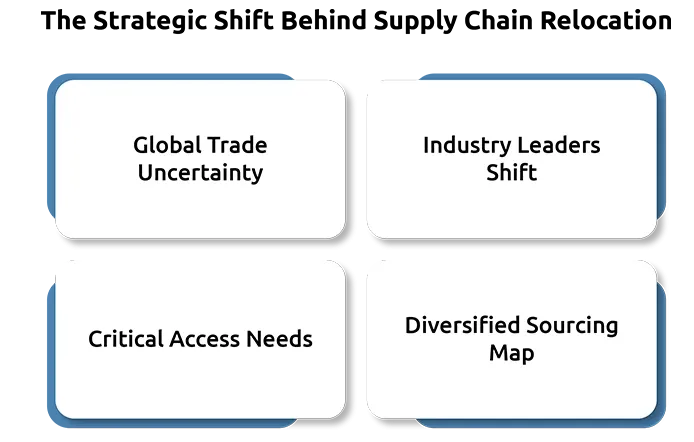
The Strategic Shift Behind Supply Chain Relocation
Businesses around the world are moving their supply chains to safer places. They want to make sure they can still operate smoothly when things get tough. There is a lot of uncertainty in the world of trade now. Some countries are not getting along. That is causing problems. There are also trade wars and changes in taxes on imported goods. All of these things are making it clear that the old way of getting supplies from one place is not a good idea. They are also using something called nearshoring. This means they are moving production to a country. The goal is to get things to market faster and to be able to see what is going on in the supply chain.
Industries such as IT hardware, automotive components, aviation equipment, and medical devices are at the forefront of this change because the companies need to have access to the critical components, and the companies also need to have uninterrupted global distribution networks. The companies can navigate the disruptions better. The companies can also maintain competitiveness, in the international markets by doing a few things. The companies can diversify the sourcing locations. The companies can also strengthen the supply chain resilience of the companies.
Navigating Regulatory Complexities in New Markets
When companies move their supply chains they have to deal with a lot of rules and regulations. These rules can really affect how well the company runs. Every place is different so companies have to learn about the rules for importing and exporting things in each market. They also have to get the licenses and fill out the right paperwork or they might get in trouble and have to pay fines. Companies have to be very careful to do everything or they will have problems and delays with their supply chains.
Getting the category for a product is really important. The correct code, which is called the HS code and the Harmonized Tariff Schedule classification determine what duties and taxes you have to pay. Businesses need to know what these rules are and use them correctly. They have to understand what Incoterms are and use them to make it clear who is responsible for what when people buy and sell things across borders.
When we talk about supplier networks that are getting bigger around the world companies have to look at how their suppliers are following the rules too. Supplier compliance practices are really important. Companies must deal with these issues to keep their supply chain running smoothly and to help them grow internationally over time. They need to make sure supplier compliance practices are, in place to support term international growth and maintain supply chain continuity.

How Importer of Record and Exporter of Record Services Simplify Global Expansion
When companies move their supply chains to places and start doing business in other countries they have to deal with a lot of rules and regulations. The Importer of Record Service makes sure all the paperwork is done correctly that companies are doing what they are supposed to do that they are paying the taxes and that they are following all the customs procedures. An Importer of Record Service is very useful, for companies that are bringing things into a country because it helps them with the rules and regulations of that country. Similarly Exporter of Record Services helps companies by handling export papers, licenses and trade rules for countries. This reduces the risk of delays in shipping or breaking compliance rules. These services are especially helpful for industries, like IT, aviation, medical equipment and automotive manufacturing.
By using expert import and export knowledge businesses can speed up deployment times keep operations running smoothly and lower compliance risks when entering markets. This method helps organizations focus on growth plans while making sure their international operations follow the rules work efficiently and match the changing needs of trade. The import and export expertise helps businesses expand in markets while keeping operations compliant.
Compliance: The Key to Sustainable Supply Chain Relocation
As companies move their supply chains around to make them stronger they want to avoid problems and get into markets. This means that following trade rules is very important for companies that do business over the world. When a company goes into an area it has to deal with new rules new ways of doing paperwork and new customs rules. The company has to stay on top of these things so it does not get into trouble. More and more companies need help with trade compliance because they want to do business in countries without any problems. Trade compliance is a deal, for companies that do business globally and want to keep things running smoothly.
By combining planning expertise in rules technology that shows what is happening and strong practices to make supply chains better companies in IT, aviation, medical and automotive can build supply networks that are hard to break. These networks help companies grow for a time and trade smoothly across borders in a fast-changing world market.
DID YOU KNOW
“Shifting sourcing locations allows businesses to avoid certain trade-war tariffs, but navigating these new Free Trade Agreements (FTAs) requires intense customs expertise ”
FAQs
1. Why are supply chains being relocated?
Companies are changing their supply chains to deal with problems like tensions and natural disasters. They want to be ready for things like tariff volatility. To do this companies are moving away from using one way of doing things.
2. Why are trade compliance services in such high demand?
Crossing borders and following trade laws can be complex. Supply chain teams need to work with trade compliance services to ensure everything runs smoothly. You need help with trade compliance to handle changing customs rules. Please ensure materials are sourced ethically.
3. What happens if a company ignores trade compliance?
Failing to adhere to trade regulations leads to severe operational and financial risks. Companies can face stalled product launches, seized shipments, hefty regulatory fines, and long-term damage to their brand reputation.
4. How is technology changing trade compliance?
Technology are bridging the gap between logistics and regulations. AI-powered scenario simulators are used by supply chain leaders to test “what-if” models before shifting suppliers, while automated systems manage denied-party screening, goods classification, and digital customs strategies.
5. How are trade compliance services adapting?
Customs management has evolved from an administrative burden into a core boardroom function that advises on procurement and supplier changes. Organizations rely on customs brokers, supply chain intermediaries, and trade data to navigate the “cost of resilience” operating model.