Companies are growing their data centers to handle AI workloads as AI continues to grow rapidly. These systems focus around GPUs because of their fast processing of large amounts of data. However, shifting GPUs from one country to another is more difficult than moving typical IT hardware. Companies must handle logistics for AI hardware, global GPU shipment, import compliance, customs clearance, costs and taxes, & secure delivery.
Why GPU Logistics Is Becoming More Important
As companies use AI, machine learning, cloud computing, and high-performance computing, the demand for GPUs is increasing. Many companies must transport GPUs from suppliers or vendors to data centers located in other countries. Speed, planning, security, and compliance are all important in this new logistical market for AI hardware.
GPUs, servers, storage devices, networking equipment, racks, power systems, and cooling devices can all be included in a shipment. Before reaching at the final data center, these goods may travel through multiple countries. Effective planning allows companies to remove avoidable delays and maintain the deployment’s timeline.
Why Moving GPUs Across Borders Is Different
GPUs are sensitive and costly technical equipment. They must be handled, packed, shipped, and stored with carefully. When installed within servers and racks, some GPU systems may also be large or very heavy. GPU transportation is different than shipping smaller IT goods because of this.
Also during transit, GPUs may be sensitive to heat, moisture, shocks, and hard care. To reduce the chance of damage, proper packaging and safe shipping are important. Due to the equipment’s high value, companies may also require safe shipments and shipment tracking.
Before shipping, companies also have to check the import regulations of the country of destination. The shipping may be affected by product classification, customs value, origin, permits, a final use, and other restrictions. Therefore, a logistics plan is required to be created before the shipment reaches the country of origin.
It is also important to verify who will be in charge of import duties and customs at the location. If a company need a local entity to support the import process, it might require an Importer of Record (IOR). By checking these requirements before time, you can avoid documents difficulties, customs delays, & extra costs.
Importer of Record for GPU Shipments
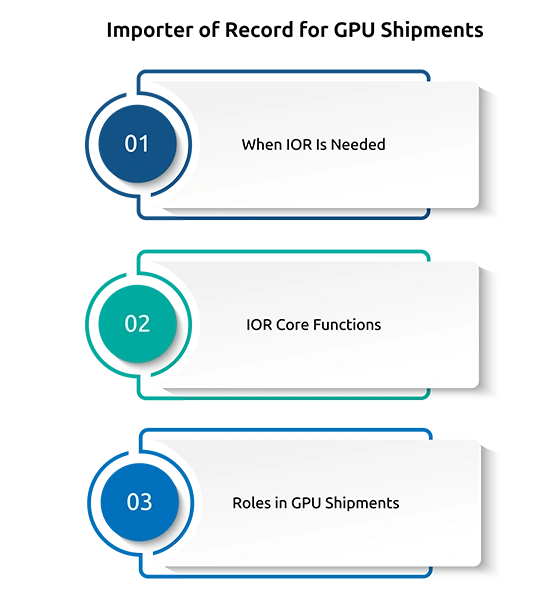
Choosing the Importer of Record (IOR) is an important challenge in cross-border AI hardware deployment. The IOR is in charge of simplifying customs entry and fulfilling import regulations in the destination country.
When a company lacks a local legal entity or a proper importing structure, it can require an IOR for data center equipment. Depending on the shipment and location, an IOR service can help in handling import documents, customs regulations, tariffs and taxes, and local compliance.
The importer, freight forwarder, seller, end user, and customs broker may all have different duties when it comes to costly shipments of AI hardware. Before delivery, these roles should be specified clearly.
Managing GPU Shipments Across Multiple Countries
Large AI deployments often involve shipments to several countries. Similar GPU servers may require to be shipped to data centers in North America, Asia, Europe, or the Middle East.
Customs processes, costs, product rules, & required documents may change by country. A method that is efficient in one country can not be useful in another. As a result, rather than using a single, similar technique for every destination, global AI hardware logistics must be planned at the national level.
Companies should verify customs documents, product classifications, tariffs, taxes, & import rules before shipping. Shipment tracking and careful delivery planning can also help avoid delays.
If a company does not have a local entity in the destination country, an Importer of Record (IOR) can help with the required import procedures.
How Technology Is Changing AI Hardware Logistics
Shipment tracking and AI handling of equipment are made easy by technology. Businesses can use tracking tools, digital documents, inventory systems, and logistics systems to find out where their equipment is and detect problems quickly.
Clear shipment information is important for large GPU supply chain management because one delay can have a major effect on the project. Connecting suppliers, freight teams, customs teams, and data center operators allows everyone to keep informed and handle shipments more easily.
Digital tools may also help teams in tracking cargo tracking, handling documents, and planning delivery. This provides companies more control over costly AI equipment and allows them to react faster when a problem happens.
Better data sharing also makes it easier to coordinate different shipments going to different countries and data centers.
Planning the Final Delivery to the Data Centre
Getting GPUs before customs is only part of the process. Additionally, the equipment is required to be at the correct data center quickly and safely.
The delivery may require a specific time, security inspection, a loading space, and specific handling. The team must also know where the GPUs need to be put.
The logistics team should work together with the data center staff before delivering important supplies. This makes sure that the site is ready to receive the equipment and reduces the risk of delays.
Conclusion
AI is growing fast, and companies need to move GPUs to different countries. This requires more than simply transportation. Companies must carefully organize GPU shipping, customs clearance, IOR services, import compliance, duties & taxes, cargo safety, and data center delivery.
Proper planning can help to avoid delays, solve issues, & transport AI equipment safely. AI hardware logistics will become increasingly important for companies globally as the technology grows.
Did you Know
The Global Graphics Processing Unit (GPU) Market is projected to reach USD 396.9 billion by 2033, expanding at a CAGR of 15.2% during 2026-2033.
FAQ
What makes GPU shipping different from normal IT equipment?
GPUs are expensive and sensitive equipment. They need safe packing, careful handling, secure transport, and proper tracking during the shipment.
What documents are needed to move GPUs across borders?
The shipment may need an invoice, packing list, transport documents, product details, HS code, value, and other documents required by the destination country.
Can the same GPU import process be used in every country?
No. Each country can have different customs rules, taxes, documents, and product requirements. The import process should be checked for each destination.
Can GPUs be shipped to several data centers at the same time?
Yes. Large AI projects can use planned shipment schedules to send GPUs to different data centers and countries while keeping each shipment organized.
What should companies check before importing AI hardware?
They should check the product, destination, customs rules, HS classification, duties and taxes, import documents, end use, and the required import structure.