Introduction
Artificial intelligence is driving a rapid increase in the movement of GPUs, AI servers, accelerator cards, high-speed networking equipment, and other data-centre hardware across borders. What looks like a normal technology shipment on the surface can involve several layers of customs and trade compliance once the equipment reaches an international border.
For customs teams, the difficulty often starts with the product itself. An AI server may contain several processors, GPUs, memory modules, networking components, and other specialized hardware. A generic description such as “AI server” may not offer sufficient information to know how to classify the equipment or whether further export-control screening is needed.
Why AI Hardware Needs More Detailed Customs Review
A standard IT shipment may be relatively easy to describe. A laptop, monitor, or conventional server can often be identified from its model and basic product description.
AI infrastructure is more complex. A shipment may include multiple GPU accelerators, specialized processors, high-speed memory, switches, storage systems and other components. The customs team may need to understand what each item does and how the complete system is configured before deciding on the appropriate customs treatment.
This is why a product description such as “computer equipment” or “GPU server” may not be sufficient. Technical specifications can become an important part of the customs documentation, particularly when the equipment has a high value or falls within a regulated technology category.
Getting the Customs Classification Right
Classification is one of the first areas customs teams need to address. GPUs, accelerator cards, servers, storage equipment, and networking hardware may have different tariff classifications depending on their characteristics and the rules of the importing country.
Using the wrong classification can affect the duty calculation and may lead to customs questions, reassessment, penalties, or delays. For that reason, companies should not rely only on a broad description when preparing an AI hardware shipment.
The product model, technical specifications, function, and configuration should support the classification used on the customs declaration. Keeping a clear classification rationale for each major SKU can also make it easier to respond if customs asks why a particular tariff code was selected.
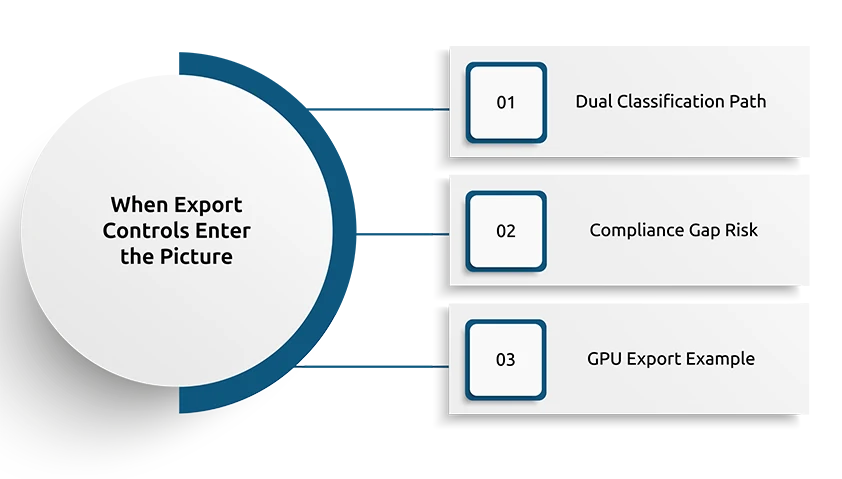
When Export Controls Enter the Picture
Customs classification is not the only review that may apply to advanced computing equipment. Certain products can also be subject to export-control requirements.
This is an important distinction from an HS or HTS classification to an ECCN. The HS or HTS code is used primarily for customs and tariff purposes and an ECCN is used under the applicable U.S. export-control regime to designate certain controlled items.
A company shipping an advanced GPU system may therefore need to address both questions before dispatch: How should the product be classified for customs purposes, and is the technology subject to export controls? Treating these as the same process can leave important compliance gaps.
Why Destination, End User and End Use Matter
The technical specifications of the equipment are only part of the review. The destination, end user, and intended use can also become important when advanced computing hardware is exported.
AI infrastructure can support ordinary commercial activities such as cloud services, research, engineering, data analytics, and enterprise computing. However, some advanced computing products can also fall within export-control rules depending on the transaction and destination.
This means trade teams may need to look beyond the product itself. They may also need to verify who is receiving the equipment, where it is going, and how it will be used when those checks are required under the applicable regulations.
Keeping Product and Regulatory Data Current
AI hardware changes quickly, and trade regulations can change just as quickly. A classification or compliance decision made for an earlier shipment should not automatically be reused for a newer model or a different destination.
Customs teams should have access to current information such as the manufacturer’s model number, technical specifications, country of origin, commercial value, product description, customs classification, and relevant export-control information.
This product data should ideally be maintained centrally so that the information used by procurement, logistics, customs brokers, and trade-compliance teams remains consistent. Better data also gives customs teams a clearer basis for assessing the shipment.

How Companies Can Prepare AI Hardware Shipments
The best time to resolve customs questions is before the equipment reaches the border.
Companies exporting GPUs and AI servers internationally should be ready to provide accurate product descriptions, model numbers, technical specifications, values, origin information, customs classifications and any applicable export-control classifications. Where necessary they must also check the destination, end user and intended use.
For high-value or technically complex shipments, involving the manufacturer and trade-compliance team early can help identify missing information before the freight is dispatched.
Companies should also avoid assuming that a classification or regulatory decision made for one country will automatically apply in another. Each destination can have its own customs and import requirements.
Conclusion
GPUs and AI servers are creating a different type of customs workload because these shipments combine high-value technology with detailed classification and, in some cases, export-control requirements.
The solution is not simply to add more paperwork. Customs teams need accurate product information that explains exactly what is being shipped, how it should be classified, what it is worth, where it originated, and—where relevant—who will receive it and how it will be used.
For companies moving AI infrastructure across borders, preparing this information before shipment can make the customs process much more predictable and reduce avoidable questions at the border. As AI hardware continues to move between more markets, strong coordination between technical, trade-compliance, customs, and logistics teams will become increasingly important.
Did You Know?
In January 2025, the World Customs Organization reported that China Customs had 62 AI/ML smart models, including 22 in pilot phase and 2 fully operational, showing how AI is already being used in customs risk management and operations.
FAQs
1. Why are GPUs difficult for customs teams to classify?
GPUs and accelerator systems can have detailed technical specifications & may be used in different types of computing equipment. The simple product details may not be sufficient for customs teams to determine the correct classification.
2. Is an HS code the same as an ECCN?
No. An HS or HTS code is used primarily for customs and tariff classification. An ECCN is used under the applicable export-control framework. A shipment may therefore require both types of review.
3. What information should companies provide for AI server shipments?
Useful information can be the exact model number, technical specifications, manufacturer, product description, value, country of origin, customs classification and relevant export-control information.
4. Is an end user check needed for an AI server shipment?
Yeah.Depending on the product, destination and applicable export control rules , companies may need to review the end user and intended use as well as the equipment itself.
5. How can companies reduce customs delays for GPU shipments?
Before shipping, makes sure product & shipment data are correct, keep classification records updated, check applicable export-control requirements and make sure the exporter, importer, broker and logistics teams are all working from the same information.