What is a Customs Broker?
Customs brokers expect an essential part in overall trade by helping associations investigate complex import and item rules. They go about as authorized experts who deal with the administrative necessities, guaranteeing merchandise moves flawlessly across borders while remaining consistent with lawful and levy commitments. Their skill improves the exchange cycle for organizations, permitting them to zero in on their center activities without getting hindered by customs-related intricacies.
Importer Definition
An importer is any individual or business that brings stock into a country from abroad. The importer is at risk for observing all rules, paying any commitments or costs, and ensuring the product fulfills the goal country’s rules. At the point when organizations need house assets to deal with these errands, customs agents step in to work with the whole cycle.
How Customs Brokers Support Both Importers and Exporters
Customs brokers support transporters by ensuring consistency with the relevant guidelines and by managing the documentation expected for customs breathing space. For exporters, merchants guarantee all product guidelines are kept, help with reporting the shipment, and confirm it meets the bringing-in nation’s prerequisites. Whether working with an importer of record (IOR) or an exporter of record (EOR), customs brokers go about as believed delegates, assisting organizations with keeping away from fines, delays, and other strategic difficulties.
Key Responsibilities of Customs Brokers
- Customs Clearance
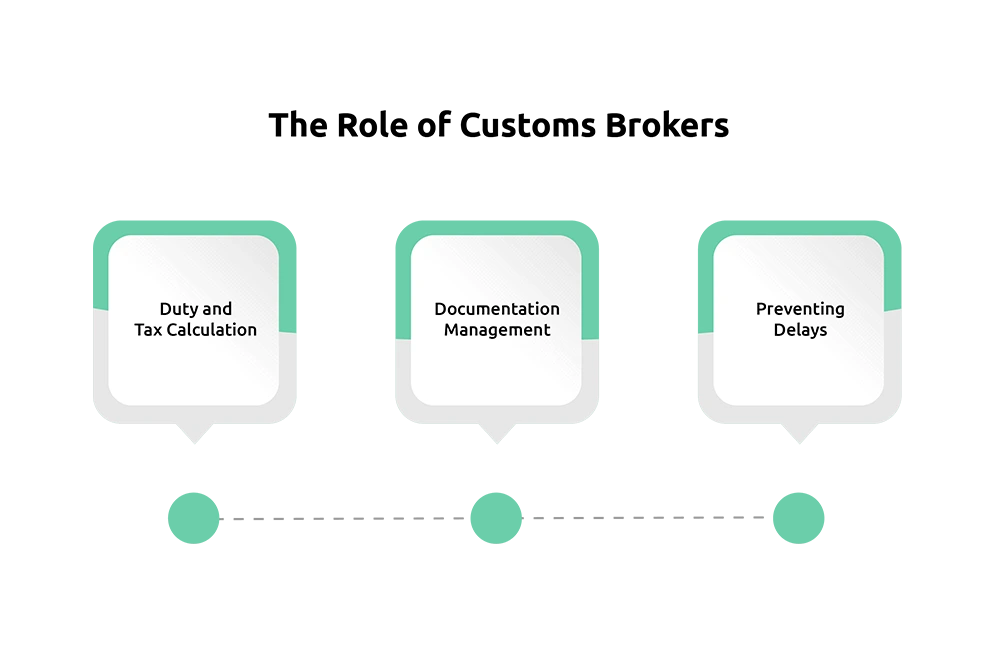
Customs brokers oversee the customs clearance process, which includes presenting vital administrative work, confirming item subtleties, and guaranteeing the shipment conforms to nearby and worldwide guidelines. By handling this, brokers prevent potential delays, ensuring goods are cleared efficiently and on time. - Documentation Handling
Precise documentation is vital in worldwide exchange, and customs dealers are answerable for planning and submitting reports like bills of replenishing, business solicitations, and customs statements. They ensure all details align with legal requirements, including the use of accurate harmonized system codes (HS codes), which classify goods for tax and tariff purposes. - Tariff and Duty Management
Customs brokers help with working out and paying the right levies and obligations. This incorporates utilizing tax benefits like the generalized system of preferences (GSP), which can lessen obligations on specific imports. Brokers ensure that importers pay only what is necessary, minimizing costs through an in-depth understanding of various tariff structures.
How Customs Brokers Assist Companies Acting as IOR
Customs brokers serve as a partner for companies acting as their own Importer of Record, providing more than just operational support. By identifying potential supply chain delays in advance & managing complex regulatory details, they enable businesses to scale globally with confidence. Brokers offer deep understanding of trade barriers & beneficial trade agreements, making sure that logistical strategies are optimized for both speed and cost-efficiency. This consultative approach transforms the IOR model from a reactive compliance burden into a competitive advantage, allowing organizations to enter new markets swiftly while mitigating operational risks and ensuring continuous regulatory alignment.
The Role of Importer of Record (IOR) in International Trade
In global exchange, the Importer of Record (IOR) is at risk for ensuring that the product keeps each local guideline and rule after entering a country. Importer of Record services works on the mind-boggling course of worldwide exchange, getting a sense of ownership by taking care of customs documentation, making good on obligations and expenses, and guaranteeing that all imported things fulfill administrative guidelines. For organizations without an in-house group or a neighborhood presence in the objective country, these administrations are particularly important in keeping up with consistency and staying away from exorbitant punishments.
How Customs Brokers Assist Companies Acting as IOR
Customs brokers assume a significant part in supporting organizations that act as their Importer of Record by taking care of the perplexing subtleties of import consistence. They guarantee that all-important reports are finished precisely and submitted on time, keeping away from possible deferrals or punishments. Customs brokers manage the classification of goods with the correct harmonized system codes (HS codes), ensuring accurate duty calculation and compliance with import restrictions. By taking on these regulatory burdens, customs brokers help companies focus on core operations, knowing their imports meet all local legal requirements.
Beyond documentation and regulatory compliance, customs brokers stay updated with changing laws and trade regulations. This watchfulness permits them to direct organizations on the particular necessities for their items, from well-being guidelines to unique allows or licenses. For organizations bringing in particular gear or delicate products, the mastery of a traditions representative is priceless for consistent and consistent passage into new business sectors.
Enhancing White Glove Delivery Through Compliance and Efficiency
White glove delivery is a top-notch administration intended for dealing with high-worth, touchy, or sensitive things that require exceptional consideration during transportation and arrangement. Not at all like standard conveyance administrations, white glove delivery incorporates fastidious bundling, cautious taking care of, unloading, and once in a while gathering or establishment at the last objective. This level of care is often essential for specialized equipment, medical devices, data center hardware, and other valuable items where safe, precise delivery is critical.
Conclusion: Summing Up the Value of Customs Brokers
One Union Solutions an important part in guaranteeing the smooth, consistent development of products across borders. By overseeing complex traditions documentation, utilizing programs like the generalized system of preferences (GSP) for cost savings, and adhering to DDP Incoterms for transparent, obligation-comprehensive shipments, they diminish the dangers and vulnerabilities frequently connected with worldwide exchange. For companies acting as importer or exporter of record, customs brokers are instrumental in handling regulatory compliance, duty calculations, and the precise classification of goods under harmonized system codes (HS codes).
In specialized services such as white glove delivery, their involvement is essential in creating a seamless transition from customs clearance to final, high-quality delivery. Through a mix of administrative mastery, process effectiveness, and particular help-taking care, customs representatives are vital accomplices for organizations exploring the intricacies of worldwide exchange.
DID YOU KNOW
More than 50% of countries allow licensed customs brokers to operate as companies or corporate entities, rather than only individuals. In some regions, retired or former customs officers are also permitted to work as customs brokers under specific conditions.
FAQs
What does a customs broker do?
A customs broker helps businesses navigate customs regulations, manage import/export documentation, calculate duties and taxes, and ensure compliance with trade laws.
How can a customs broker assist with white glove delivery?
Customs brokers ensure that goods are cleared through customs efficiently, allowing white glove delivery services to handle high-value or sensitive items safely and on time.
What is the role of the Importer of Record (IOR)?
The IOR is responsible for ensuring that imported goods comply with local laws, pay the appropriate duties, and are cleared through customs. Customs brokers can act as IOR if a business lacks a local presence.
How do customs brokers manage tariff and duty calculation?
Customs brokers calculate tariffs and duties based on the harmonized system codes (HS codes) and can leverage programs like the Generalized System of Preferences (GSP) to reduce costs.
How do customs brokers help reduce delays in international shipping?
Customs brokers reduce delays by ensuring all import and export documents are correctly prepared and submitted on time. They handle customs clearance efficiently by following regulatory requirements and verifying shipment details. Their expertise helps avoid errors, penalties, and hold-ups at customs checkpoints.