Introduction
More data and technology are being used by customs authorities to improve their risk assessment. AI is able of reviewing large amounts of cargo data and identifying trends that may lead to a higher customs risk. It can help customs officials in identifying which shipments could require extra checks while allowing regular shipments to get through the process. This increases the importance of correct customs documents, product descriptions, HS codes, values, and shipment information for importers. Customs compliance can be improved & unwanted inquiries during customs clearance may be reduced with the use of concise and reliable data.
What Is Customs Risk Assessment?
Customs authorities use a process called customs risk assessment to look for possible risks in shipment information. The goods, HS code, origin, value, importer, route, and customs documents may be checked. This helps them in identifying if a package requires more documents, checking, or checks. Also, importers can maintain improved customs compliance with accurate information.
How AI Is Changing Customs Risk Assessment
Customs risk assessment is becoming more data-driven due to AI. Compared to manual checks, it can check large amounts of trade and shipment data and much more quickly. AI systems may identify unexpected trends, identify data that might require more focus, and compare current shipments with past data. By checking factors including product details, HS codes, declared values, companies, routes, and previous deals, AI can also help with risk rating. This could help in identifying possible issues with customs classification or valuation as well as links between different shipments or trade parties.
Customs officers are not replaced by AI, in fact. It mainly supports in identifying possible risks so that customs officials can determine if more research or action is required.
How AI Can Identify High-Risk Shipments
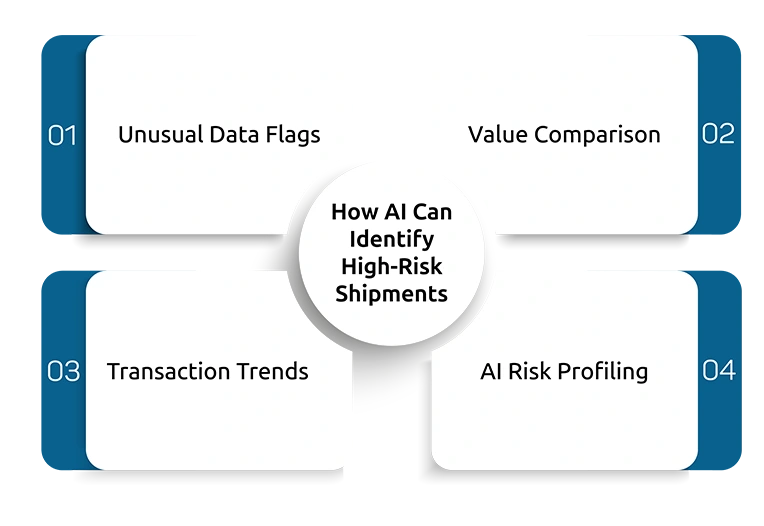
AI can help with customs risk analysis by detecting data that looks out of the usual or is different from past shipment records. For example, a product description that is different from past statements or is highly general, might require more review. Customs classification may also be challenged if the product’s provided HS code is different from its actual value.
AI-powered systems are also able to compare declared customs values with trade data or past transactions. Repeated mistakes in declarations, invoices, & other customs documents could mean that further review is required. Customs risk management may also include a review of unusual shipment routes or transaction trends. The exact risk factors depend on the customs authority and its system.
AI and Customs Fraud Detection
AI can help in the detection of customs fraud by reviewing large amounts of shipping data and finding patterns that might need to be handled. Identifying possible lower value, incorrect HS categorization, or differences in the reported country of origin can be helpful. Product descriptions that do not match other shipment information, repeat declaration patterns, or odd trade links may also be flagged. AI can identify details that may not appear consistent by comparing data from many shipments, companies, and transactions. This can assist customs teams in identifying possible problems related to customs compliance and duty avoidance.
AI does not, however, determine that fraud has taken place. Only possible risk indications are shown. After checking the data, customs officials decide whether more checks, documents, or other measures are required.
AI in Customs Compliance and Importer of Record Responsibilities
AI does not remove the Importer of Record (IOR) rules, but it can help customs officials for reviewing shipping risks. The IOR continues to in charge of making sure the required data is correct and that the shipment conforms with local customs rules. Correct customs declarations, product details, HS codes, values, and related documents are still required for compliance with customs laws.
Businesses can handle import regulations and prepare the required documents as needed with the help of an IOR service provider. The duties of the IOR, broker, declarant, consignee, and seller are different, even when a customs broker can handle customs declarations and clearing tasks. Businesses can avoid confusion and better handle their imports by keeping these duties clear. One Union Solutions can support businesses with IOR and import compliance requirements in different markets.
Challenges of Using AI in Customs Risk Assessment
AI can improve customs risk assessment, but it also has some challenges. Incorrect risk signals might result from incomplete or incorrect shipment data. An AI system could not work properly between countries due to differences in customs regulations, systems, & data. Risk models must use updated data, which could present another difficulty when regulations change.
Human review is important since some AI-based results may also be difficult to explain. Before taking steps, customs authorities may have to verify the data. Because sensitive trade and business data are handled by customs systems, data security and privacy are especially important. Above all, AI does not release the importer of their duty to comply with customs regulations. Importers are still required to give accurate information and follow with the related customs regulations.

Conclusion
AI is changing how trade data is reviewed and cargo risks are reviewed by customs authorities. It can help in detecting odd data, possible issues with compliance, and shipments that would require more thorough review. AI does not, however, take the role of importers’ duties or customs officers. Clear product information, valid HS codes, correct documents, and proper values are still important. Companies can better prepare for the growing use of AI in customs risk assessment by providing correct cargo data and strong customs compliance.
Did you know
U.S. private AI investment reached $285.9 billion in 2025, more than 23 times the $12.4 billion invested in China—though looking at just private investment figures likely understates China’s total AI spending, given its government guidance funds.
FAQ
How does AI identify a shipment that may need extra customs checks?
AI is able to compare cargo details with past records and trade data. Unusual amounts, product details, HS codes, routes, or transaction patterns might be identified for extra check.
Can AI detect an incorrect HS code?
AI is able to compare the product description & extra shipment details with the declared HS code. The shipment may be given further attention if the details do not appear reliable.
Can AI detect undervalued goods in customs declarations?
AI can use the provided HS code to verify the product details and other shipment details. If the details are shown to be less reliable, the shipment may be given greater priority.
Why are accurate product descriptions important for AI-based customs checks?
Customs systems are more prepared to review shipments when product descriptions are clear. Descriptions that are incorrect or wrong could cause more requests or checks.
Can the same AI customs risk system be used in every country?
No. Risk factors, systems, data, and customs regulations may change between countries. Therefore, AI-based risk analysis is based upon each customs authority’s demands.