The growing use of export restrictions on key raw materials for the energy & digital transitions, as well as for advanced manufacturing, poses significant risks to supply chain resilience & economic security. Monitors the use of these restrictions to contribute to a better understanding of why countries resort to such measures and their impact on global markets.
Major Reasons Governments Impose Export Restrictions
Trade barriers come in a variety of forms. This paper examines one such barrier, export restrictions, & how it impacts trade & global supply in selected strategic goods & raw materials. The goods and raw materials examined in the paper are of some interest for many reasons: they are generally geographically concentrated in a few countries, many are used in the production of high-technology goods in strategic sectors, & there are few substitutes for these raw materials, given the present state of technology. For all these reasons, importing countries are dependent on a usable supply of these raw materials.

Raw Materials and the Growing Risk of Geopolitical Trade Controls
Given the uniqueness & concentration of production of some raw materials, market power dynamics can come into play & be exploited for economic & non-economic reasons, via restrictions on output or trade. Raw materials are mainly used to produce other goods; they are positioned in domestic & global supply chains. This means that issues or policies that affect their supply can have important systemic results, which can be used as a reason for state action, mainly in the form of subsidies & restrictions on exports or foreign ownership, to support downstream domestic sectors. This occurs despite the mixed evidence as to the efficacy of such policies. Given its systemic importance, raw materials are also more prone to being targets of economic pressure & political issues.
Types of Trade Restrictions
Governments may enact policies that limit the free exchange of goods and services between countries. Such policies are known as trade restrictions or trade protections & include tariffs, import quotas, voluntary export restraints, subsidies, embargoes, domestic content requirements, & capital restrictions.
Trade restrictions are used to protect already established domestic industries from foreign competition, protect new domestic industries from foreign competition until they get established, protect & increase domestic employment, generate income from imposed tariffs, retaliate against the restrictions imposed by another country, & protect some industries & sectors for national security purposes.
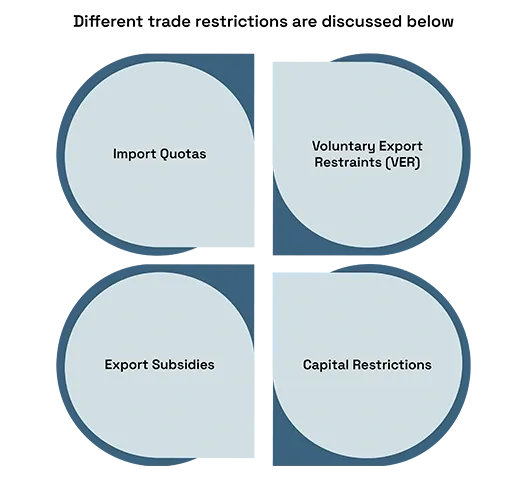
Different trade restrictions are discussed below.
Tariffs
A tariff is a type of tax that imposes additional costs on imports. Tariffs mainly aim to protect the domestic industries that produce similar goods and to reduce trade deficits. The economic impact of tariffs is reduced demand for imported goods, as they will be traded at a price above the free trade price. Tariffs imposed by large countries will force exporters to reduce the price of goods & services to retain their market share in the importing country, thereby altering the terms of trade and redistributing income from the exporting to the importing country.
Import Quotas
Import quotas use to the regulations set by a country that restrict the amount of a specific good that can be imported into the country, mainly for a specified period. On the other hand, import licenses specify the quantity of goods that can be imported into a country. As compared to tariffs where the government of the country imposing the tariff gains tariff revenue, the effect of quotas on the government is uncertain. Foreign producers can raise their prices after a country imposes a quota to gain higher profits than they would without the quota. These profits are known as quota rents.
Voluntary Export Restraints (VER)
As opposed to an import quota that is created by the government of an importing country, a VER is created by the government of the exporting country to limit the number of goods it can export to its trading partner. A VER allows the quota rent resulting from the decrease in trade to be captured by the exporting country, resulting in a welfare loss to the importing country.
Export Subsidies
An export subsidy is when the government pays for each unit it exports to stimulate exports. Export subsidies disrupt the functioning of the free market & change trade away from comparative advantage, thereby reducing overall benefit. Importing countries may impose countervailing duties, which are taxes levied on subsidized goods entering the country to neutralize the advantage created by the subsidy.
Capital Restrictions
Capital restrictions refer to the measures a government or central bank takes to control the flow of capital. This could be capital flowing in and out of the economy. Controls include taxes, tariffs, volume restrictions, etc., whereas regulations include foreign exchange, tax regulation, credit regulation, and investment restrictions. They have similar effects as trade restrictions – protect domestic industries, but capital restrictions can slow growth, & more restrictions can mean higher domestic prices for goods.
Conclusion
Export restrictions on strategic goods & raw materials are becoming a mainly important issue in global trade as countries seek to secure aviation industries, secure resources, & updated economic & national security. While these measures may provide short-term advantages for producing nations, they also create important challenges for global supply chains, increase market uncertainty, & develop costs for manufacturers that depend on important inputs.
Did you know?
In 2025, China showed how control over critical raw materials can reshape global power. By tightening and calibrating exports, Beijing disrupted supply chains, raised production costs, and exposed the dangers of deep dependencies across Europe, the United States, and beyond.
FAQ
1. What are export restrictions in global trade?
Export restrictions are government policies that limit or control the export of certain goods and raw materials through measures such as tariffs, quotas, licensing requirements, or export bans.
2. Why do countries impose export restrictions on strategic raw materials?
Countries impose export restrictions to protect resources, support domestic industries, maintain national security, control prices, and ensure the availability of critical materials within their own economies.
3. How do export restrictions affect global supply chains?
Export restrictions can disrupt global supply chains by reducing the availability of critical materials, increasing production costs, delaying manufacturing processes, and creating market uncertainty for importing countries.
4. Which industries are most affected by export restrictions?
Industries such as technology, electronics, automotive, and advanced manufacturing are highly affected because they depend heavily on critical raw materials.
5. What are the long-term effects of export restrictions on global trade?
In the long term, export restrictions can lead to higher prices, supply shortages, geopolitical tensions, reduced investment confidence, and greater efforts by countries to diversify supply chains and secure alternative sources of raw materials.