The import and export of aircraft maintenance equipment should be efficiently run in the aviation sector, as this will keep things moving smoothly. Customs clearance, taxation, and observance of export regulations should be considered carefully as far as the process of transporting aviation-related products across borders is concerned, so that the process is devoid of unjustified delays and hassles. The regulations are filled with twists and turns, making it hard to learn the ropes, but navigating through them becomes easy when the requirements are learnt and saves on otherwise expensive errors. The guide contains the necessary customs clearance operations, tax implications & compliance requirements for businesses engaged in the cross-border trade of aircraft maintenance equipment.
Customs Clearance for Aircraft Maintenance Equipment
Customs clearance involves getting permission to import or export goods from the authorities in charge. This could get complex in the case of aircraft maintenance equipment since products are specialised and could be classified as dual-use. The documents that play a significant role when exporting or importing equipment in the aviation field are the following:
Commercial Invoice: The document contains all crucial data about the price, description, quantity, and place of origin of the equipment.
Packing List: The way and size of things are packed in a list, making it much easier to deal with.
Bill of Lading/Air Waybill: It confirms the shipment, making it necessary to track the shipment.
Certificate of origin: A document that indicates the country where equipment was manufactured and may be utilised to determine the duty level according to the trade negotiations.
Export companies must learn about the International Traffic in Arms Regulations (ITAR) and the dual-use regulations. The compliance with such rules ensures that materials such as avionics parts are not stolen.

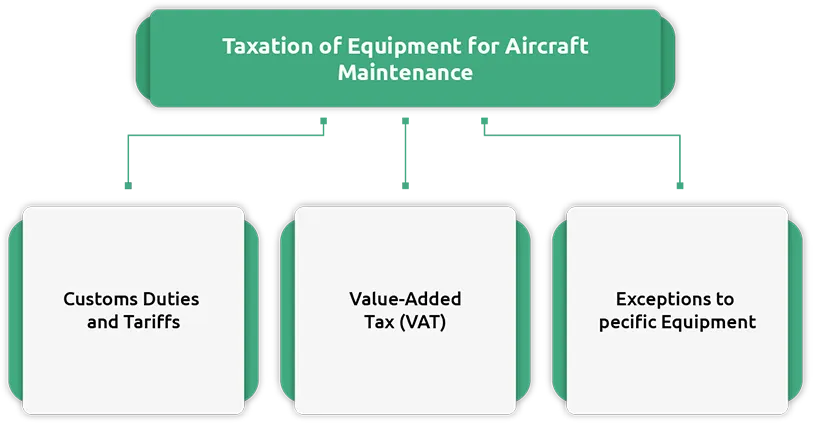
Taxation of Equipment for Aircraft Maintenance
Taxation, together with customs duties, is an important issue in the movement of goods internationally. Organisations should consider the factors that are important when importing aircraft maintenance equipment.
Customs Duties and Tariffs: Payment of duties depends on the nature and type of the product, in payment is made depending on the classification of the Harmonised System (HS) codes. The tasks could include a percentage or more than that, depending on the classification and destination country.
Value-Added Tax (VAT): VAT is collected on most imported goods, but there are certain exemptions, & aviation-related products have been exempted. Under the EU context, some aircraft-related services can be exempt from VAT.
Exceptions to Specific Equipment: Certain countries make an exception by letting aviation-related products, especially those involved in aircraft maintenance, not be taxed through VAT or at a lower tax rate.
Improper classification of goods by appropriately using the HS code is essential in ascertaining the right customs duties and taxes to charge.
Aircraft Maintenance Equipment HS code
The HS code for aircraft maintenance equipment is used to identify goods in global trade and decide taxes and duties. It is updated by the World Customs Organization to match new aviation technology. Using correct code helps avoid delays, penalties, and extra costs. Now digital customs systems and software help reduce mistakes and make clearance faster. In simple words, it helps aircraft parts move easily and legally between countries.
What are the aviation export regulations and why are they important?
Export regulations for aviation equipment control the movement of sensitive items like dual-use and military technologies. Laws like EAR and ITAR require companies to take permission before sending certain goods to other countries. They also check who will use the product and how it will be used to stop misuse. These rules help make international trade safe and legal.
Conclusion
The world of customs clearance, taxation, export controls, and aircraft maintenance equipment might not be easy to navigate. Nevertheless, being equipped with the knowledge and tools, companies can regulate their operations to get them running without much disruption. One Union Solutions also deals with international trade within businesses by offering professional assistance to address international trade complexities in achieving compliance, facilitating logistics, and promoting an effective import/export business. We aim to care for your business with these regulations and see your equipment reach where it should be on time.
Did You Know?
Industry estimates project that India’s MRO market will grow at a compound annual growth rate (CAGR) of 8.9 per cent to reach $4 billion by 2031.
FAQs
What is the Harmonised System (HS) code?
The HS code is an international system used to classify goods in global trade. It helps customs authorities decide the correct duties and taxes for imported products.
How can I check if an export license is required for aircraft maintenance equipment?
You may need an export license if the equipment is dual-use or military-related. Check ITAR/EAR rules or consult an export authority or expert before shipping.
How are customs duties calculated on aircraft maintenance equipment?
Customs duties depend on the HS code assigned to the equipment. The duty rate varies based on the product type and the importing country’s regulations.
Is VAT applicable to aircraft maintenance equipment?
In some countries, VAT is reduced or exempted for aviation-related equipment, especially for maintenance and repair purposes. Local tax laws should be reviewed to confirm eligibility.
How can I stay compliant with changing export regulations?
Stay updated by regularly reviewing export control rules, consulting compliance professionals, and ensuring all required documents and licenses are ready before shipment.