
The aviation sector is increasingly regulated, especially when it comes to exporting avionics systems and dual-use aircraft components that require strict compliance with global trade laws. With growing emphasis on global trade compliance, harmonized system code (HS Code) accuracy, and in-transit meaning under updated Incoterms 2025, businesses must navigate complex rules while maintaining operational efficiency. Aviation manufacturers and suppliers dealing with controlled electronics, navigation systems, and safety equipment now rely on integrated support such as freight forwarding services, customs clearance, DDP shipping, and expert Importer of Record (IOR) solutions to avoid delays, penalties, and compliance risks. By combining compliant documentation, accurate classification, and strong supply-chain visibility, companies can streamline international shipments while staying aligned with aviation export regulations.
There may be a dual nature to export controls regarding aviation equipment and dual-use technologies, which have both civilian and military applications, which can be especially troublesome. Regardless of whether you are operating on advanced avionics systems, aircraft parts, and other technologies, you must get to know the legal scene and cope with compliance to ensure that your business and international image are safeguarded.
The Role of Export Controls in Aviation Equipment
The export limits on aviation equipment aim to oversee the exportation of sensitive technologies and goods in the context of their sale, transfer, and conveyance across borders. Such controls ensure that some of these technologies cannot be abused in military actions, anti-terrorism deals/actions, or any other actions that may jeopardize the security of a nation or conflict with international agreements.
Export controls may be enforced by various regulatory bodies and the Bureau of Industry and Security (BIS) of U.S. Department of Commerce & the U.S. Department of State may play very important roles. Such agencies decide on the products and technologies that need export licenses and the stipulations on the documentation required. Such regulations are intricate and depend on the country of use and the country of end usage of said technology.

Dual-Use Technologies and the Complexity of Export Controls
The most sensitive are dual-use technologies, ones with military use and others for civilian use. These encompass an avionics system that may apply to commercial and military airliners, or aircraft safety and navigation technology. In the case of dual-use goods, entrepreneurs should also confirm whether such products are included in the licensing agency’s control list, which may differ depending on the export destination. For example, some advanced avionics systems used in navigation or communication can be considered dual-use technology. Depending on who is purchasing the systems, either a foreign government or a foreign military, there can be more scrutiny and licensing that it will have to go through.
Exporters must carefully assess the end-user and the final use of dual-use technologies before shipment. Additional approvals may be required if the equipment is intended for military or defence-related purposes. Proper product classification under export control regulations helps avoid compliance issues. Maintaining detailed records and licenses is essential for audit and regulatory checks. Working with export compliance experts can reduce risks and prevent costly delays.
Key Regulations Affecting Export Controls
Various legal systems and regulations are the bases of export controls in the United States, and for that matter, in other nations:
Export Administration Regulations (EAR): They are regulated by the Bureau of Industry & Security (BIS), also known as the EAR, and regulate the export of items that can potentially be used in a civilian or military dimension. The avionics, radar, and electronic components have been controlled as EAR.
International Traffic in Arms Regulations (ITAR): The ITAR are regulations developed & enforced by the U.S. Department of State and govern the exportation of goods or services related to defence articles. It strictly regulates military technology and components of dual-use systems, aircraft engines, missile guidance systems, and military avionics.
Wassenaar Arrangement: It is a worldwide compact that tries to regulate the export of weapons and other dual-use goods. It helps the member countries coordinate their export control in such a manner that they are not able to export sensitive technologies to a regime that can be hostile.
All these structures play a crucial role in overseeing the movement of sensitive technology, and any business must familiarise itself with the finer details of the specific regulations to avoid breaching them along the way.
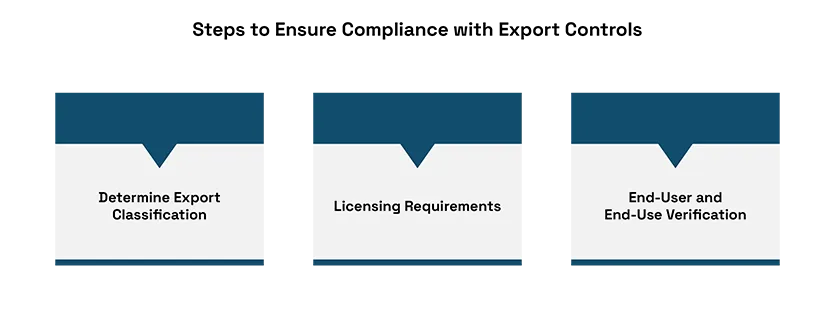
Guidelines to Compliance with Export Controls
Export Classification: The export classification of the object that you wish to export has to be identified so that you can navigate through the export controls. It is usually done through the Commerce Control List (CCL) of EAR-controlled goods or the U.S. Munitions List (USML) of goods under ITAR. The category your product falls into will also help you determine whether you need an export license.
Licensing Requirements: After the classification, the business should learn about the need for any export license to ship the goods. The licensing requirements will depend on the nature of the product, the destination country, and the end-user or end-use. When a license is required, enterprises must apply to appropriate agencies, e.g., BIS or the U.S. Department of State.
End-User Verification, End-Use Verification: It is important to know and verify the end-user of the product and end-use. The exporters should ensure that the item will not be used for military or illegal purposes. Export controls usually require companies to check the authenticity of the end user and ensure that their products will not be abused as per international regulations.
Documentation and Records: Exporters should keep good transaction records such as the license to export, customer agreement and end-user certifications. The records assist the companies in ensuring that they abide by the rules and regulations and facilitate key documentation in case of an audit.
Conclusion
Moving around exportation restrictions of avionics and dual-purpose aircraft technology is very important to the businessperson in charge of the aviation equipment sector. The best way is to research the major regulations put in place and comply with them so that your businesses comply with the standards of compliance, hence operations are efficient and secure. Here at One Union Solutions, we are experts in aviation equipment, where we can deliver you the expertise needed to guide these difficult regulations confidently. We are to assist your company in complying with the regulations and making your business trade internationally efficiently.
Did you know?
The government of the United States of America controls exports annually to the level of the aviation industry and the defence industry, totalling more than 140 billion dollars, which highlights the importance of compliance with the rules of the government regarding the exportation of goods.
FAQs
What are export controls?
Export controls are rules that restrict the shipment of sensitive goods and technologies to other countries. They help prevent misuse for military, security, or illegal purposes.
What is the difference between EAR and ITAR?
EAR covers dual-use items that can be used for both civilian and military purposes. ITAR applies strictly to defence-related products, technologies, and services.
How can I check if my product is subject to export control?
You can identify this by classifying your product under the Commerce Control List (CCL) for EAR items or the U.S. Munitions List (USML) for ITAR items.
What happens if export control rules are not followed?
Non-compliance can lead to serious penalties, including fines, loss of export privileges, shipment delays, or business shutdowns.
How can One Union Solutions help with export compliance?
One Union Solutions provides expert guidance on export regulations, product classification, and documentation to ensure aviation equipment meets global trade compliance requirements.