Sustainability in International Trade: Financial and Operational Considerations
International trade is at the core of our international economy, allowing the activity of goods, services and capital across borders. Yet, as our world becomes ever more connected, its environmental and financial impacts are becoming increasingly scrutinized. International trade sustainability goes far beyond environmental considerations; it also encompasses businesses involved in import-export trade. This blog explores both financial and operational aspects of sustainability in international trade, with particular attention paid to how businesses in sectors such as aviation, healthcare, automotive, and IT can adopt sustainable practices that contribute both long-term profitability and global responsibility.
Sustainable Trading in an Era of Globalisation
Global trade has always supported global economic growth, but it also creates environmental & financial challenges for businesses. Shipping activities & air freight contribute greatly to the environmental impact globally. Many companies also face unseen costs due to ineffective supply chains & changing market conditions. Increasing understanding about responsible growth is now pushing businesses to rethink traditional trade practices. As a result, adopting sustainable and efficient trade systems has become important for long-term stability and responsible global growth.

Key Aspects of Sustainability in International Trade
Financial Sustainability through Efficient Supply Chains
Supply chain optimization is one of the key principles of sustainability in international trade, impacting both environmental and financial sustainability directly for import and export businesses.
Tariffs, Trade Barriers, and Sustainable Import-Export Policies
International trade policies have long been an issue for international businesses. One example of government efforts towards sustainability in global trade is carbon tariffs or “green tariffs”. These tariffs penalize companies engaging in environmentally risky practices while rewarding those adhering to green standards.
As sustainability grows to a bigger part of international trade deals, companies that import and export must change with the times and adapt to new rules. In the European Union, the Green Deal plan seeks to achieve climate neutrality in Europe by 2050, and the USMCA trade deal includes provisions for environmental protection. The two of these show how trade policies are changing to encourage greener behavior.
Balancing Global Trade Growth with Environmental Responsibility
Trade can affect the environment because it increases resource use and transport, which may cause pollution. But trade may be made more sustainable and efficient with improved planning and smart transport methods, and reduce delays, improve delivery times, and make the entire process more effective with the use of technology and smarter logistics. To reduce their impact, businesses should adopt eco-friendly practices and choose better transit routes. Global trade can grow in this way while saving the environment for the next generation.
Long-Term Investment and Financing for Trade
“Businesses in many areas, like aviation, healthcare, automotive, and IT equipment, are finding it easier to get long-term loans. Contributing money to projects that are good for the environment, like investing in an industry that uses green energy sources or making logistics networks use less energy, is what green bonds are all about. On the other hand, ESG-focused asset funds look for companies that meet certain sustainability standards, such as reducing their impact on the environment, improving working conditions, and fighting for ethical governance.
Businesses in sectors like aviation, healthcare, automotive, and IT are finding it easier to access long-term funding. Tools such as green bonds and ESG-focused funds support investments in clean energy, efficient logistics, better working conditions, and ethical business practices.
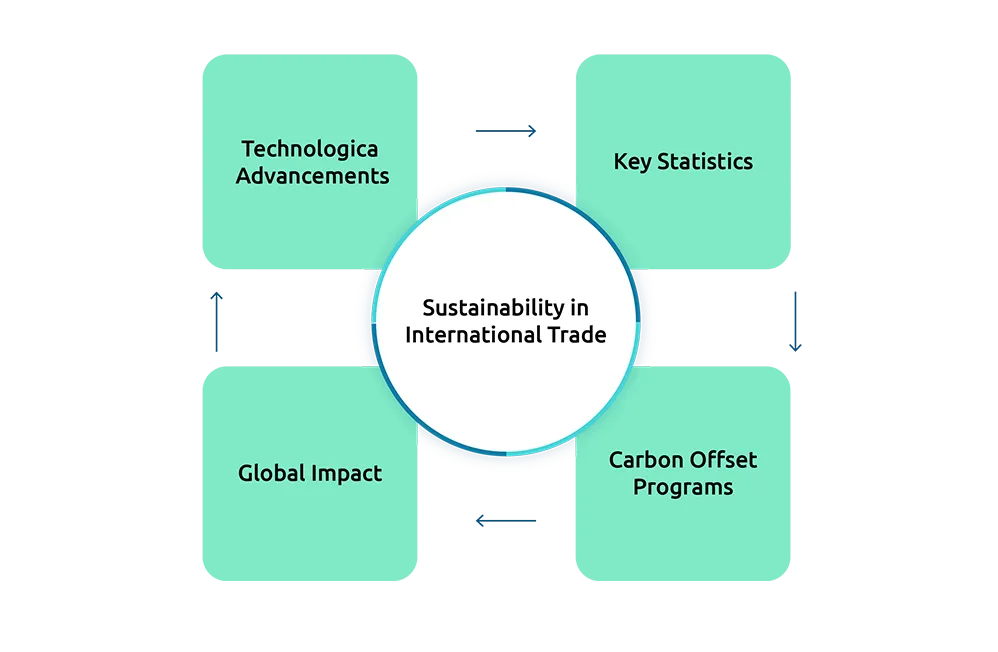
Technology & the shift to digital in business
In today’s digital-first global economy, technology is at the heart of sustainable international trade. Advanced tools like AI-powered demand forecasting, blockchain-based traceability, and IoT-driven logistics tracking are transforming how businesses manage cross-border operations. These innovations enable companies to monitor shipments in transit, and enhance supply chain transparency. At One Union Solutions, we integrate these technologies into our freight forwarding services, warehousing solutions, and customs clearance processes to promote green logistics and operational efficiency. With AI and machine learning, we optimize shipping routes and inventory management, reducing waste and emissions — aligning business profitability with environmental responsibility.
Building a Greener and Compliant Global Supply Chain
Sustainability in international trade isn’t just about reducing emissions — it’s about building a resilient, transparent, and compliant supply chain. Through alignment with Incoterms® 2020, AEO standards, and global trade compliance frameworks, businesses can ensure ethical and environmentally responsible trade practices. At One Union Solutions, our expertise as an Importer of Record (IOR) and Exporter of Record (EOR) helps companies maintain compliance while minimizing environmental impact. Our DDP services, white glove delivery, and multimodal transport solutions are designed to reduce carbon footprints and enhance logistics efficiency. By adopting supply chain best practices and leveraging AI-powered forecasting, we help international businesses move toward a future where profitability and sustainability go hand in hand.
What One Union Solutions Can Do for Long-Term International Trade
We are Importer of Record (IOR) and Exporter of Record (EOR) at One Union Solutions. We work with industries like aviation, healthcare, automotive, and IT tools. As more businesses realize how important sustainability is in international trade, it has never been more important for us to help them deal with the complicated issues that come up when doing business across borders.
Did You Know,
India’s environmental technologies market is valued at around $23 billion (2024–25) and is expected to grow at a 7.5% CAGR by 2028. Imports of environmental equipment from the U.S. also increased from $418 million (2020) to $692 million (2024), showing strong growth in green technology demand.
FAQs:
1. What is sustainability in trade?
Sustainable trade is an approach to international business that focuses on ethical practices, environmental protection, and fair economic benefits for all parties involved.
2. What are the 3 Rs for sustainability?
The 3 Rs of sustainability—Reduce, Reuse, and Recycle—are principles that help minimize waste, conserve resources, and support a circular economy.
3. What is the main purpose of sustainability?
The main purpose of sustainability is to balance current needs without harming the ability of future generations to meet their own needs.
4. What are the benefits of sustainable trade?
Sustainable trade helps reduce environmental impact while improving efficiency in global supply chains. It also supports long-term economic growth and encourages responsible business practices.
5. What is the difference between traditional trade and sustainable trade?
Traditional trade mainly focuses on profit and speed, while sustainable trade also considers environmental protection and ethical practices. It aims to balance economic growth with long-term responsibility.