Insight
Free Trade Agreements (FTAs) include lower costs, more consumer choices, and better access to international markets. For industries like healthcare, IT, automotive, and aviation, the benefits of free trade create new growth opportunities. However, there are also risks, as the free trade pros and cons show; businesses may face stronger competition and must follow strict trade rules.
While Free Trade Agreements (FTAs) open vast opportunities for international trade, they also introduce several operational challenges for global businesses. Companies in regulated industries like IT, healthcare, automotive, and aviation must navigate complex customs clearance procedures, adhere to Harmonized System (HS) Codes, and maintain shipping arrangements aligned with Incoterms® 2020. Additionally, managing DDP shipping, trade compliance, and Importer of Record (IOR) responsibilities requires precision to avoid penalties or shipment delays. At One Union Solutions, we help companies mitigate these risks by offering end-to-end global trade compliance and freight forwarding services, ensuring every shipment remains compliant and efficient under evolving free trade conditions.
How do Free Trade Agreements impact the global economy?
Free Trade Agreements can stimulate economic growth by increasing trade volumes, improving efficiency, and encouraging specialization among countries. They often strengthen regional cooperation and help nations integrate into global supply chains. However, benefits may vary depending on industry strength, labor markets, and how well countries manage economic transitions.
Free Trade Area vs. Customs Union vs. Single Market
It’s required to understand the differences between the Free Trade Area and common Customs Union, & Single Market agreements when discussing trade agreements. Free Trade Areas are the most general form of cooperation, with member countries agreeing to minimize or reduce tariffs and trade barriers among themselves. At the same time, each nation retains its trade policies with non-member nations.
Customs Unions go further by not only eliminating tariffs between members but also setting an external tariff that applies to goods entering from non-EU nations, similar to what the EU employs. Single-market arrangements provide the broadest coverage, expanding upon the benefits of customs unions to encompass not just goods but also services, capital and labor. A single market permits goods and services to flow freely among member states without restrictions between member nations; citizens working anywhere can even move freely between member countries- something evident within European Union member nations.
How Free Trade Agreements Improve Cross-Border Business
Free trade agreements support cross-border business by reducing tax & making it easier to transport goods across countries. They allow companies to reach customers, save shipping costs, & increase global trade. These agreements also help global commerce by reducing trade barriers and smoothing customs processes. Companies can import and export products more easily while following to trade regulations. Businesses with better access to trade chances may grow into new markets, increase sales, and improve relationships with consumers and partners all around the world
Key Benefits And Challenges of Free Trade Agreements
Free trade agreements (FTAs) have many advantages, but they often have drawbacks, especially for companies operating in regulated industries like IT equipment, healthcare, and aviation. Job displacement is a significant worry since industries that can’t compete with lower-priced imports may experience disruptions.
FTAs can create challenges related to complex regulatory compliance requirements. Businesses must ensure proper documentation, accurate HS Code classification, and adherence to varying customs regulations across multiple countries. Managing these compliance obligations can increase operational costs and need strong trade expertise to avoid delays or penalties.
Although labor rights and environmental protection clauses are often included in modern free trade agreements, their efficacy is dependent on each nation’s ability to implement them. Furthermore, the intricacy of adhering to several nations’ regulations, such as export controls, certification requirements, and customs processes, can raise operating expenses and create delays. This is especially difficult for smaller companies that need more resources to handle such complexities.
Free Trade Agreements (FTAs) offer several key benefits that drive economic growth and global cooperation. One of the primary advantages is increased market access, as FTAs eliminate tariffs and import quotas, making products more competitive and affordable in foreign markets. This is particularly valuable for industries like IT, aviation, and healthcare, which often face high export duties. FTA’s also stimulate economic growth by reducing import costs, fostering competition, and creating new jobs, which can raise wages and improve living standards.
Role of HS Codes in Free Trade Agreements
HS codes are very important in Free Trade Agreements because they help identify products correctly. They make sure the correct taxes and benefits are applied. Using the correct HS code helps businesses avoid delays, claim FTA advantages, and make sure smooth global trade. It also helps customs quickly understand the product and process shipments faster.
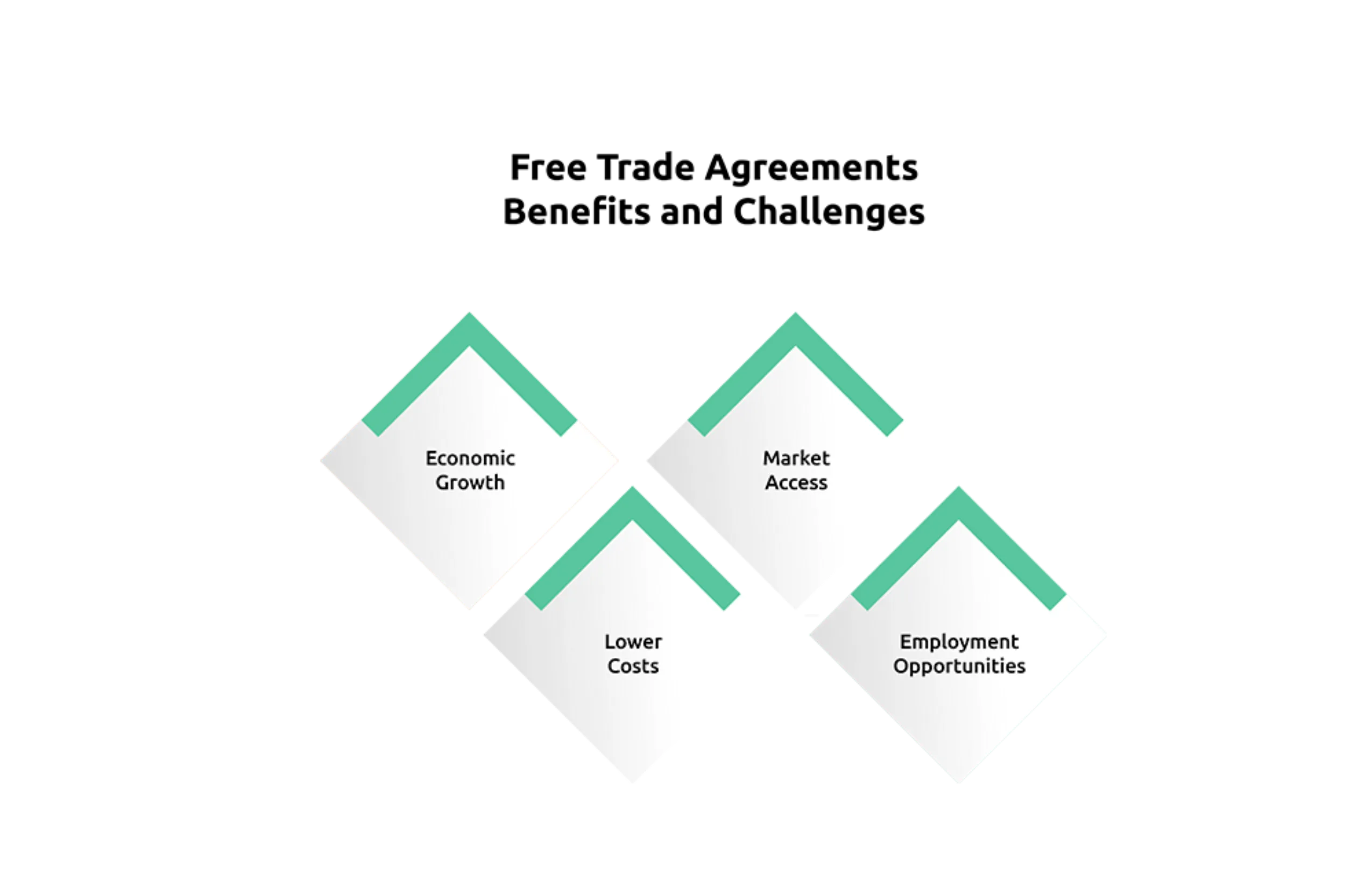
Understanding the Impact of Free Trade Agreements
Free Trade Agreements (FTAs) significantly influence modern supply chain management by reshaping customs clearance procedures, freight forwarding services, and cross-border trade operations. To fully benefit from FTAs, businesses must understand HS Code classification, align shipping arrangements with Incoterms® 2020, and manage Importer of Record (IOR) and Exporter of Record (EOR) requirements accurately. Proper documentation, warehousing coordination, and adherence to international trade regulations are essential to ensure smooth, compliant, and cost-effective global trade execution, particularly for industries such as IT, healthcare, aviation, and automotive.
Rules of Origin and FTA Compliance Strategy
Rules of Origin are a key part of Free Trade Agreements. They decide whether a product qualifies for lower or zero tariffs. For industries like IT, healthcare, automotive, and aviation, mistakes in origin documents can lead to duty loss, shipment delays, or penalties. Businesses must check supplier details, use correct HS Codes, and follow country-specific documentation rules. A clear FTA compliance strategy helps reduce risks, control costs, and ensure smooth global trade operations.
Conclusion
Free trade agreements have shown to be useful tools for encouraging cross-border collaboration, lessening trade restrictions, and stimulating economic expansion. Free trade agreements (FTAs) help companies in a variety of areas, such as healthcare, IT, aviation, and automobiles, since they reduce consumer costs, enhance expertise, and expand market access.
Did you know,
According to World Trade Organization report, countries with Free Trade Agreements experience up to 20% increase in trade volume.
FAQ’s
1. Why is trade compliance important in FTAs?
Trade compliance is important because it ensures businesses follow all rules, avoid penalties, and get full benefits from FTAs.
2. What negative impact will the free market have?
Another negative effect of a free market is the potential emergence of monopolies. Without government intervention, some companies may gain excessive market power and limit competition.
3. Why is product origin important in FTAs?
Product origin is important because only goods made in FTA partner countries get tax benefits. Wrong origin details can lead to penalties or loss of benefits.
4. Can One Union Solutions help with FTA compliance?
Yes. One Union Solutions helps businesses manage customs rules, documentation, and compliance to ensure smooth international trade under FTAs.
5. How does free trade influence global business growth?
Free trade helps businesses access international markets more easily and expand their customer base. It also supports global supply chains and encourages investment opportunities across different countries.