Insight
Compliance requirements are shifting quickly as international trade becomes more complex. In possession of multiple jurisdictions, documentation regulations, and inspection standards, customs delays may interrupt even a perfectly smooth international business process. However, with the beginning of artificial intelligence, business border clearance is changing in terms of being quicker, more intelligent, and more accurate.
Custom clearance with the help of AI is no longer in the area of the future. It is an increasing fact of operations for companies dealing with international freight management. AI is transforming the document process by automating and using predictive intelligence to make document processing faster and more secure, ensure compliance with any country’s laws, reduce penalties, and improve trade efficiency. In a global economy where time and precision are key aspects, this technology is rapidly becoming necessary.

Understanding AI in Customs Clearance
AI-powered customs clearance means the application of artificial intelligence to optimize and automate customs clearance of shipments in countries and international authorities worldwide. Such systems read, process, and validate intelligence from data across document such as invoices, declarations, licenses, and certificates.
The technology uses prior shipment data to model the risk with machine learning, propose the right Harmonized System (HS) code, and highlight the inconsistencies in real time. This saves paper handling, eases the process of communication with customs officials, and speeds the clearance process to minutes in most areas compared to days.
A Global Adoption & Transformation
Governments all over the globe are updating their border operations. The World Customs Organization (WCO) has been encouraging nations to embrace smart technologies such as AI to enhance compliance and ease trade.
Providing digital modernization in the European Union, the Union Customs Code (UCC) has included electronic declarations and risk assessment applications using AI. These systems assist EU customs in performing data processing more quickly, indicating non-compliant shipments, and cutting administration overheads.
AI-based targeting systems are also used in the United States Customs & Border Protection (CBP), which detects high-risk cargo. These tools utilize large amounts of data, such as the pattern in shipping, the origin country, and commodity information, to automate the detection process so that shipments with a low risk can proceed easily.
Singapore The National Trade Platform unites customs, trade, and logistics documentation and trade compliance in a single, AI-powered system. The result? Companies indicate that customs processing time has been cut in half, and fines due to incorrect declarations or missing items have also been reduced.
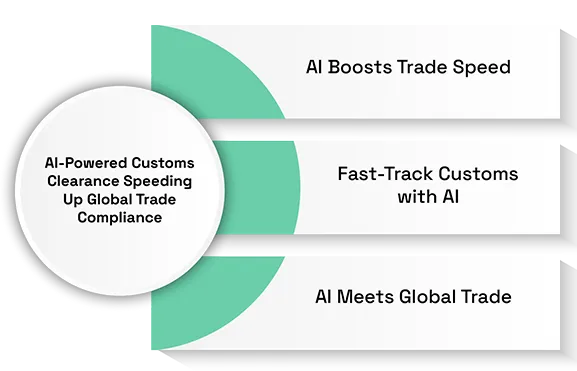
Benefits Beyond Speed
While faster clearance is a major win, AI offers broader strategic advantages for global businesses:
It significantly lowers the chance of compliance violations. Real-time updates on trade laws mean businesses stay aligned with country-specific rules, even during unexpected changes or emergencies.
It improves cash flow by reducing demurrage charges, inventory storage costs, & late delivery penalties. Faster processing allows goods to move through ports or airports without costly holdups.
Budgeting and demand planning are also more accurate with the help of AI. The predictive models suggest the risk or delay in some corridors or seasons, so that the business changes the inventory or transit schedule.
Complexities and Practical Solutions
Not all businesses are prepared to embrace AI completely. Smaller businesses may lack technical resources or internal capacity to manage intelligent platforms. Data privacy is another concern, especially when dealing with sensitive trade documents or supplier contracts.
However, cloud-based AI customs platforms are fixing these problems. They come with easy-to-use features, simple dashboards, and strong data security. Since there is no need to buy hardware or set up complex IT systems, even mid-sized importers and exporters can start small and scale up as their business grows.
The consultancies of global trade-based companies also contribute to filling it with advisory services, resources for onboarding, and training programs to facilitate the adoption of AI and enable it to be less problematic in compliance with domestic regulations.
AI-Powered Predictive Customs Risk Scoring
One of the latest developments in AI-driven customs systems is forecasting risk scoring. Instead of checking shipments only at the time of arrival, AI analyzes previous trade data, supplier behavior, product categories, & routing patterns to forecast compliance risks in advance. This helps authorities & businesses identify high-risk shipments early & focus on clearance for low-risk cargo. As a result, trade flows become more efficient, delays are reduced, & verification resources are used more efficiently.
Conclusion
AI in customs clearance is transforming how businesses manage global trade compliance. Whether it scrapes, delays, or stops documentation errors, AI facilitates more expedient, sanitary, and predictable transportation of commodities between international borders. With regulatory environments getting tighter over time and markets becoming increasingly integrated, companies require the ability to create solutions that can be changed as fast as the trade is!
Smart customs integration allows our clients to realize these efficiencies. At One Union Solutions, we ensure their global shipments remain compliant, on time, and ready for the future.
Did You Know?
According to the WCO, countries using AI in customs clearance have reduced average clearance time by up to 55% boosting global trade efficiency.
FAQs
Q1: How is AI changing customs clearance in global trade?
AI streamlines document checking, validation, & compliance processes in customs clearance.
It helps detect errors faster & reduces manual work for authorities & businesses.
This leads to fast clearance & smoother global trade operations.
Q2: What is AI-based risk assessment in customs?
AI-based risk evaluation analyzes past shipment data, trade patterns, & supplier behavior.
It identifies high-risk cargo before arrival at ports or borders. This allows authorities to focus on risky shipments & speed up safe cargo clearance.
Q3: How does AI reduce customs delays?
AI automatically identifies absent or incorrect information in trade documents.
It also suggests correct HS codes & ensures compliance before submission. This helps prevent shipment holds and reduces clearance time greatly.
Q4: Can AI replace customs officers in the future?
AI cannot fully replace customs authorities, as human decision-making is still important.
It mainly supports officers by managing repetitive & data-heavy tasks. Final checks & legal decisions will always require human expertise.
Q5: What industries benefit most from AI-powered customs systems?
Sectors like automotive, medical equipment, electronics, & e-commerce benefit the most.
These sectors deal with large-scale shipments & strong compliance rules.AI helps them improve speed, accuracy, & reduce working costs.