Insight
In the complex industry of aviation equipment logistics, where accuracy & time are important, the use of Incoterms (International Commercial Terms) can be seen as a foundation for an efficient operation. Such standardized terms, which were offered by the International Chamber of Commerce (ICC), define the roles and obligations of the seller and the buyer engaging in global trade and the cost and risk of a trade. Application and knowledge of the proper Incoterms will go a long way in overseeing shipments of aviation equipment to occur on schedule and reduce possible conflicts.
Incoterms clearly outline who is responsible for transportation, insurance, customs clearance, and delivery at each stage of the shipment. They help aviation companies avoid misunderstandings related to costs, risks, and ownership transfer. Choosing the right Incoterm ensures better coordination between freight forwarders, carriers, and customs authorities.It also supports compliance with international trade regulations and aviation safety requirements. Overall, Incoterms create transparency, improve planning, and help keep aviation equipment logistics efficient and reliable.
Understanding Incoterms
Incoterms are internationally agreed-upon terms that govern how buyers and sellers handle the transfer of goods. They indicate who will do the transportation, insurance, and customs clearance, among other logistics-related things. In the case of aviation equipment, where urgency and value are much needed, the proper choice of Incoterm would facilitate pleasurable work and adherence to international laws.
Significance of Incoterms in the Logistics of Aviation Equipment
Incoterms play an important role in aviation logistics. It helps to ensure accurate distribution of responsibilities at every step of the shipping process. Such clarity avoids the events of misreadings. It ensures no dispute between the concerned parties when transporting the aviation equipment. By specifying cost coverage in shipping, insurance, and other costs, Incoterms also facilitate budgeting. It controls the necessary process in aviation logistics because of the high transportation and insurance expenses.
Incoterms describe how the risk of loss or damage changes between the seller and the buyer. This issue is relevant when high-value insurance and liability are involved in aviation equipment. Secondly, they will also facilitate the regulatory compliance requirements and make the involved parties aware of their responsibility and obligation in the importing process in customs duty, taxation, and other statutory requirements.
Some Incoterms are especially appropriate for the transportation of aviation equipment:
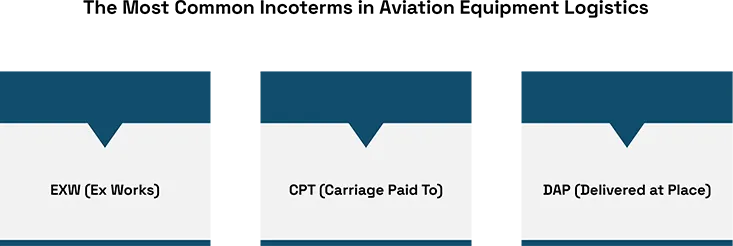
EXW (Ex Works): The seller offers goods at their place, and all transportation costs & risks are assigned to the buyer. The term is commonly applied where the purchaser can arrange logistics independently.
FCA (Free Carrier): The goods are delivered by the seller to a carrier of the buyer’s choice in a specified place. The term is appropriate where the buyer wants to manage the principal carriage.
CPT (Carriage Paid To): The risk shifts to the buyer upon the delivery of goods to the first carrier, but the seller has the cost of getting the goods to the place of destination. The term comes in handy when the seller easily serves the transport networks.
DAP (Delivered at Place): The seller obtains all expenses and risks to transfer the goods to a particular destination, excluding import duties and taxes. Such a word comes in handy when the customer desires door-to-door service.
DDP (Delivered Duty Paid): All the obligations of the seller are fulfilled, including transportation and insurance of the goods, as well as the payment of import duties, as a result of which the cargo is ready to unload on the buyer’s territory. The term makes the process easier for the buyer and puts the maximum on the seller.
Impact of Incoterms on Aviation Equipment Shipments
The use of Incoterms in aviation equipment logistics is influential on several important supply chain issues. First, it will make the business more effective as there is a proper definition of responsibilities, facilitating the simplification of processes and eliminating delays. Such clarity keeps both sides understanding what is expected of them, leading to easier operations and quicker transit of goods. Second, Incoterms enhance the predictability of costs as cost allocations are provided at every shipment level.
By having such a structure, buyers and sellers could predict the costs, making planning with money easier and eliminating the additional costs that may not be anticipated. In addition, Incoterms also reduce the chances of conflict through the guidelines given, thus leading to enhanced relationships with business counterparts. Finally, when trying to adhere to Incoterms, the international trade laws will be followed, since both partners understand what they must cover regarding customs duties, taxes, and more regulations. This minimizes any legal issues, and the shipment process of aviation equipment is completed without any undue delays.
Market Insights
By 2025, the air cargo sector will grow to $142 billion due to the rising appetite to transport goods of high value, one of them being aviation equipment. Moreover, the aerospace logistics services market is expected to reach a value of $15.68 billion in 2025, then $20.18 billion by 2029, with an annual increase of 6.5%. It is also seen that the aircraft MRO market will be experiencing a 4.7% CAGR up to 2030 and reach 15.1 billion, indicating that aviation equipment management also requires effective logistics.
How We Assist in Aviation Equipment Logistics
We offer customized logistics supply services for aviation equipment at One Union Solutions because we know every shipment has unique challenges. With our vast experience in international shipping, we assure you that everything about your goods shipping will be conveniently fulfilled right up to the finish. Together with our clients, we negotiate the most appropriate Incoterms in line with every shipment and the responsibilities, risks, burden, and cost outlay of shipping goods between countries.
Our end-to-end services include all the necessities for a successful aviation equipment logistics. This involves safe transportation, tailor-made insurance cover, and customs clearance procedures handled by experts to facilitate dealings with international borders. Knowing the particular needs of the aviation sector, we put the safety and integrity of your equipment at the forefront to ensure your deliveries are on time and reduce downtimes as much as possible. We promise complete solutions. Whether you need help transporting large-scale equipment or are looking at specialized parts of maintaining aircraft, we provide end-to-end solutions that simplify your logistics and go above industry standards.
Did You Know?
The aviation logistics industry is expected to grow by 7% annually over the next five years, driven by increasing demand for air travel and aircraft maintenance services.
FAQs
What do Incoterms mean in aviation equipment shipping?
Incoterms are international trade rules that clearly define who is responsible for transporting aviation equipment, handling customs, paying costs, and managing risks during shipment.
Why are Incoterms important for aviation equipment logistics?
Aviation equipment is high-value and sensitive. Incoterms help avoid confusion by clearly stating who handles loading, insurance, delivery, and risk at each stage of transport.
Which Incoterms are safest for high-value aviation equipment?
Incoterms like FCA (Free Carrier), DAP (Delivered at Place), and CIP (Carriage and Insurance Paid To) are preferred because they offer better control, clearer risk transfer, and stronger protection for expensive equipment.
How do Incoterms affect customs clearance in aviation logistics?
Incoterms define whether the buyer or seller is responsible for export and import customs clearance, helping ensure smoother compliance with aviation and customs regulations.
Can choosing the wrong Incoterm cause delays or extra costs?
Yes. Incorrect Incoterm selection can lead to unexpected charges, unclear insurance responsibility, shipment delays, or disputes over damage or loss.
How does One Union Solutions support Incoterm management for aviation equipment?
One Union Solutions helps businesses choose the right Incoterm, manage customs compliance, control logistics costs, and ensure safe, timely delivery of aviation equipment worldwide.