
Overview
Growing trade tensions between China and the United States are increasingly changing the global aerospace sector. Following the new Western tariff that affects major industries, the Chinese administration is evaluating counter-tariffs on aerospace imports, such as aircraft components, avionics systems, and maintenance equipment. The aerospace industry has mostly worked under open trade systems supported by international agreements and systematic tariff categorization, such as the HS code and the HTS Harmonized Tariff Schedule. The current geopolitical tension is pressuring governments to reconsider the supply chain. Also, logistics providers, exporters, and customs experts must now be looking for trade, Incoterms, and customs documentation methods. These developments are not only political but also major progress for local production and supply chain optimization.
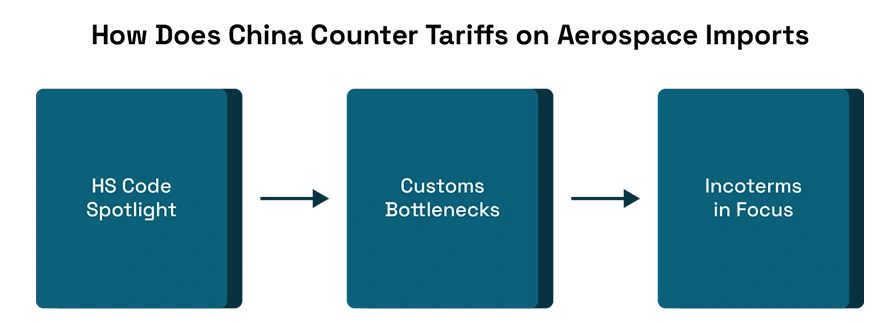
How Does China Counter Tariffs on Aerospace Imports?
China’s counter-tariff strategy focuses on both regulatory and operational tools rather than tariffs alone.
Tariff Adjustments and Trade Controls
Authorities may increase duties on selected Western aerospace goods while strengthening customs clearance inspections. Products categorized under specific HS codes connected to aircraft engines, navigation systems, and spare parts could face revised duty systems. Also, China could use trade systems similar to the Generalized System of Preferences (GSP) by providing favorable treatment to alternative suppliers from developing markets, thereby changing sourcing trades.
Operational and Logistics Policies
China may also add approval requirements affecting international freight services and importer problems. Businesses working under DAP or DAPs Incoterms could experience increased responsibility regarding risk transfer, documentation accuracy, and delivery agreement. Exporter of record services and importer of record service providers will become critical in managing dependability. Many organizations are already asking working questions, such as whether a freight forwarder can be an exporter of record or whether specialized partners are required to handle sensitive aerospace shipments.
How Will China Counter Tariffs Affect Western Aerospace Industry?
Current Status of Western Aerospace Tariffs
US aerospace manufacturers have seen growing costs due to export control regulations and supply insufficiency since 2023. Additional tariff pressure may further stop production schedules and maintenance operations worldwide. Organizations such as Boeing and Airbus depend heavily on globally distributed suppliers. According to the industry, nearly 35–40% of aircraft components used in the aviation trade involve cross-border trade at some stage of production. Even small tariff increases cause problems through the logistics chain and inventory planning systems.
Supply Chain and Approval Challenges
Counter-tariffs could force aerospace organizations to rethink inventory and order management strategies. Delays in customs clearance or revised documentation standards may increase maintenance times for aircraft and repair operations. Businesses may increasingly accept the best trade compliance software for import export rules to confirm correct categorizations, valuation, and licensing approval. Questions such as can a customs broker handle both import and export documentation are becoming more relevant as companies look to simplify operations while reducing approval risks.
China Bans Boeing Components, US Aviation Parts Imports in Tariff War
Recent reports show that China has considered restrictions on some aviation components sourced from U.S. suppliers. While not a complete ban, supply restrictions could grow local change efforts led by the Commercial Aircraft Corporation of China (COMAC) administration. Industry analysts estimate that China represents nearly 20% of global aircraft demand by 2040. Any limitation on Western imports may therefore change aircraft delivery schedules and aftermarket service markets globally. Such measures also increase problems within the World Trade Organization, as long-term tariff escalation risks lead to formal problems and revised agreements of aviation trade norms.

Conclusion
China’s consideration of counter-tariffs on Western aerospace imports marks a huge change in global aviation trade. Beyond direct pricing impacts, the policy direction signals bigger structural changes in logistics, agreements, and trade strategies. Exporters and freight partners must use increased trade approval processes, improve supply chain optimization, and carefully select Incoterms arrangements suited to developing risks. As geopolitical tensions continue to change aerospace trade, organizations that invest in flexible logistics and clear customs processes will be better able to guide uncertainty in global trade. Also, the aerospace sector is going into a phase where tariff plans and operational flexibility will show long-term competitiveness in global trade.
DID YOU KNOW?
China’s State Council Tariff Commission has announced that tariffs on US imports will increase from 84 percent to 125 percent from April 12.
FAQs:
1. Why is China considering counter-tariffs on aerospace imports?
China is evaluating counter-tariffs as a response to Western trade restrictions and tariffs affecting aviation technology and aircraft components. The goal is to protect domestic manufacturing while reducing dependence on global aerospace suppliers.
2. How could counter-tariffs affect global aircraft manufacturers?
Major manufacturers such as Boeing and Airbus depend on globally integrated supply chains. Tariffs may increase component costs, delay deliveries, and create working challenges across production and maintenance networks.
3. Will China completely ban Western aviation parts?
A full ban is unlikely in the short term. However, stricter inspections, licensing requirements, or sourcing restrictions may gradually change procurement toward local or alternative suppliers.
4. How does this impact aerospace logistics and customs compliance?
Companies may face tighter documentation checks, revised HS code classifications, and higher compliance risks. Importer of record and exporter of record services will become more important to confirm smooth customs clearance.
5. What role does China’s domestic aviation industry play in this strategy?
China aims to improve local aircraft development led by Commercial Aircraft Corporation of China (COMAC). Trade tensions may grow local production while raising regulatory discussions within the World Trade Organization regarding aviation trade rules.