Overview
China’s expansion of rare-earth export controls in 2026 marks a significant change in global trade, particularly for electric vehicle (EV) supply chains. Rare earth elements, necessary for manufacturing motors and batteries, have long been controlled by China’s production and export capabilities. With this new policy, the world’s leading EV manufacturers face increased uncertainty and possible disruption as they adjust to improved access to these necessary materials. Using the Generalized System of Preferences (GSP) policy for trade will give you benefits in trade. China’s move comes amid growing geopolitical tensions and a global change toward securing major goods. As demand for rare earths continues to grow exponentially alongside the EV market, international customers are preparing for the spread effects that may change supply chains far beyond China’s borders.
How Rare Earth Dependency Is Changing EV Manufacturing Strategies?
Electric vehicle manufacturers are revising their production planning as rare earth availability becomes a key factor in long-term planning. Companies are focusing on localized sourcing, improving material efficiency, & reshaping components to reduce dependence on limited resources. Battery & motor production are also exploring alternative materials & advanced engineering methods to maintain production stability. These changes are encouraging EV companies to build more flexible supply networks instead of depending on a single supplier region. By adapting manufacturing approaches, businesses can better manage future trade uncertainties & maintain consistent EV production worldwide.
China Expands Rare-Earth Export Rule in 2026
China expanded its export controls on goods, such as limitations on quantity, pricing, and export permits. These measures are related to confirming that local industries benefit first from China’s rich resource storage. For EV manufacturers globally looking for Freight forwarding companies near me, this means fewer available goods at high prices, making production planning and customs clearance more difficult. China’s rare earth export controls are growing as elements are required for advanced technologies.
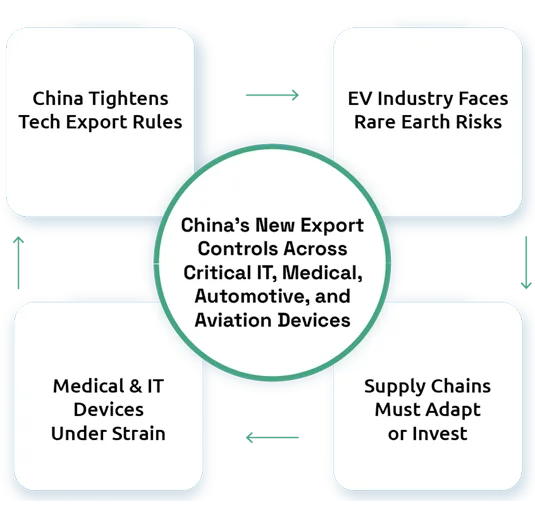
China’s New Export Controls Across Critical IT, Medical, Automotive, and Aviation Devices
Broader Strategic Impact
China’s policy is not limited to rare earths alone; International freight services now extend across a range of critical segments, including parts for IT systems, medical devices, automotive components, and aviation technologies. Combining the scope of controlled exports, China supports its increases over the global technology ecosystem using DAP and DAPs under Incoterms.
Implications for Automotive and EV Industries
EV supply chains are specifically vulnerable; to avoid this, use an Importer of record Service. The automotive industry depends on the HS code for rare earth goods for electric motors and advanced electronics. Exporter of Record services on export sizes and the requirements for special permits increase operational difficulty, mainly for manufacturers outside Asia.
Effect on Other High-Tech Sectors
Export controls on IT and medical devices also introduce risk to industries that depend on precision components. Aviation manufacturers may see increased costs for major parts. In each case, supply chain optimization will need to adapt, vary, or invest in alternative technologies.
China’s New Export Controls Impact on EV Supply Chains
Disruptions and Cost Pressures
China’s new export controls will impact global EV supply chains in many ways:
- Supply shortage: Minimum exports mean reduced global availability of a necessary good.
- Price Changing with demand and supply, prices may grow, affecting production costs and International shipping terms.
- Change in Vendor selection: Original equipment manufacturers outside China may look for alternative suppliers or invest in global processing.
Global Response Strategies on Rare Earths to Global EV Supply Chains
Major Partnerships
In response to China’s export controls, governments and organizations around the world are going after strategies to increase flexibility:
- Resource variation: Exploring and developing rare earth deposits in regions such as Africa, North America, and Australia.
- Partnerships: Working across borders to create processing systems and safe long-term supply agreements.
- Technological Innovation: Investing in research to reduce dependence on conventional rare earths and increase reuse processes.
Conclusion
China’s new export controls on rare earths represent a vital part of global EV supply chains. Reducing access to major goods in Inventory and order management, China has grown a major reevaluation among manufacturers and policymakers. The impact will be across automotive, technology, and medical sectors, growing efforts to various supply chain optimization, innovate alternative goods, and build more flexible global systems. As the world adjusts, the future of EV production will increasingly depend on collaboration, adaptability, and major goods planning for global shipments.
DID YOU KNOW?
India depends on imports for most rare earth permanent magnets, with 85–90% of demand sourced from China (2022–25). To reduce dependency, the Government of India has launched a ₹7,280 crore scheme to promote domestic rare earth magnet manufacturing.
FAQs:
What are China’s rare earth export controls in 2026?
China has expanded export limits on rare earth elements, including quotas, pricing rules, and special permits, prioritizing local industries.
How will these export controls affect EV supply chains?
The restrictions may cause supply shortages, increased costs, and force manufacturers to find alternative suppliers or technologies.
Which industries are most impacted besides EVs?
IT systems, medical devices, aviation, and other high-tech sectors dependent on rare earths will also face operational and cost challenges.
What global strategies are being adopted in response?
Governments and manufacturers are investing in alternative resources, cross-border partnerships, and technologies that reduce dependence on Chinese rare earths.
Can EV manufacturers reduce these risks?
Yes, through varied sourcing, investing in rare earth recycling, and using supply chain optimization tools like Importer of Record and Exporter of Record services.