
Overview
In global trade, many businesses suppose that once they understand the Customs clearance process, every shipment will follow the same path. In reality, no two imports are treated the same. Each shipment is evaluated based on product type, origin, documentation, valuation, and approval requirements. Even when goods arrive at the same port on the same day, regulatory checking and duty evaluation can differ hugely.
This is because global trade is governed by a difficult mix of international shipping terms, national regulations, trade agreements, and risk-management systems. Factors such as HS code categorizations, Incoterms, and the role of the Importer of Record Service all increase how authorities process a shipment.
Customs process: the same for both imports or not?
Understanding how Customs evaluates shipments
Although the systems of Customs clearance are continuous, the application is never similar. Customs officials review each import independently, verifying good descriptions, values, country of origin, and supporting documents.
Why similar processes still lead to different issues
Two shipments may appear similar but differ in precise ways:
- Product composition may lead to a different HS code or HTS Harmonized Tariff Schedule rate.
- Country of origin may impact applicability under the Generalized System of Preferences (GSP).
- Chosen Incoterms, such as DAP or DAPs change cost responsibility and risk management.
Because of these variables, one shipment may be cleared on-time, while another is stopped for inspection, valuation review, or regulatory approval.
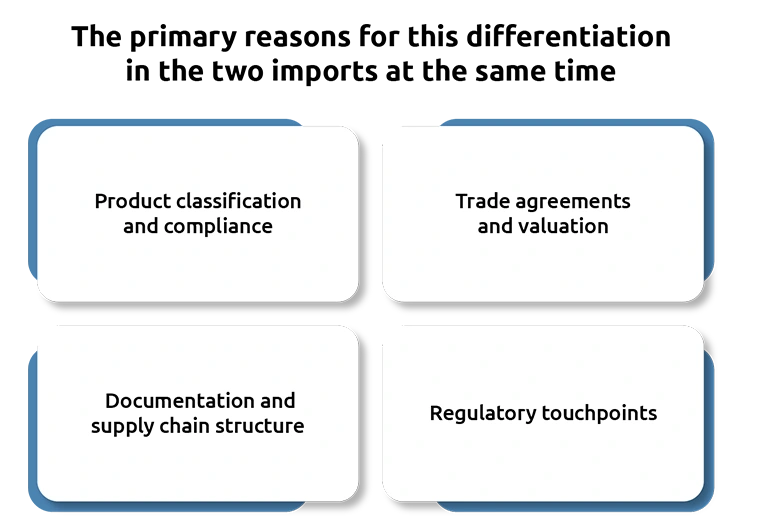
The primary reasons for this differentiation in the two imports at the same time
1. Product classification and compliance
Every good is categorized under a specific HS code, which determines duties, taxes, and requirements. A small difference in goods or work can completely change how Customs treats an import.
Regulatory touchpoints
Some goods require additional permits, technical standards verification, or safety documentation. These regulatory checks create distinctions even between shipments arriving simultaneously.
2. Trade agreements and valuation
Preferential duty programs like GSP depend on origin documentation and manufacturing criteria. If one shipment qualifies and another does not, Customs outcomes will vary.
3. Documentation and supply chain structure
The exporter of record services used, the declared value, and the consistency of paperwork affect risk profiling. Modern Customs systems analyze historical data, shipment patterns, and declared values across the entire supply chain.
Consequences of two imports at the same time
Operational and financial impact
When two imports are treated differently, businesses may face unexpected delays, demurrage, or additional duties. This directly impacts inventory and order management, production schedules, and customer requirements.
Hidden risks
Inconsistent treatment can stop logistics planning, international freight services coordination, and even premium delivery service responsibilities. A single delayed shipment can go across the supply chain, increasing costs and reducing dependability.
Compliance exposure
Incorrect categorizations, undervaluation, or documentation gaps can result in clearance, penalties, or shipment holds. Over time, repeated inconsistencies weaken approval standing and increase scrutiny.
How One Union Solutions helps you with two imports at the same time
One Union Solutions supports businesses by working as a major partner across international trade operations. Through structured Importer of Record Service and Exporter of Record services, organizations gain a compliant foundation for every shipment. Working on HS code determination, Incoterms selection, and documentation control, we reduce issues between similar shipments. Their Customs clearance expertise ensures that even when two imports arrive together, each is pre-aligned with regulatory expectations. With advanced logistics work, international freight services management, and supply chain optimization tools, businesses can track documentation, duties, and regulatory requirements in real time. This improves tracking, supports premium delivery service responsibilities, and minimizes disruption. Whether organizations depend on freight forwarding companies near me or operate across multiple regions, we combine approval and execution, helping standardize outcomes without ignoring shipment-specific differences.
Conclusion
No two imports are treated the same because global trade is built on components: product composition, origin, valuation, documentation, and regulatory systems. Even shipments that look similar on paper can experience very different issues once they enter Customs systems. Understanding this reality is necessary for modern importers. By combining strong approval methods, clear international shipping terms, and expert operational partners like One Union Solutions, businesses can reduce uncertainty, control risk, and turn complexity into a competitive advantage.
DID YOU KNOW?
China’s trade surplus has reached a historic high of $1.19 trillion (approximately 100 lakh crore rupees), representing a 20% increase compared to 2024 exports.
FAQs:
1. Are Customs procedures the same for every import shipment?
No. While the general Customs clearance framework is consistent, each shipment is assessed independently based on product type, HS code, origin, value, documentation, and regulatory requirements.
2. Why are two imports arriving together treated differently?
Differences in classification, country of origin, valuation, Incoterms, and documentation can change risk scores, duty rates, and inspection requirements, leading to different outcomes.
3. How does HS code classification impact Customs treatment?
HS codes determine duty rates, eligibility under trade programs like GSP, and applicable regulatory controls. Even small product variations can lead to different Customs decisions.
4. What risks arise when similar shipments receive different treatment?
Businesses may face unexpected delays, extra duties, compliance penalties, disrupted inventory and order management, and reduced supply chain reliability.
5. How does One Union Solutions help manage multiple imports at the same time?
We support Importer of Record Service, exporter of record services, HS code accuracy, documentation control, and Customs clearance planning to reduce inconsistencies and compliance risks.