International data center development will be faster than ever before. More businesses are using cloud computing, AI, edge computing, & digital services, resulting in higher needs for new data centers in different countries. Organizations are expanding into new markets to enhance service speed, minimize delays, & fulfill increasing customer demand. Building a data center in another country, however, needs more than just installing servers and IT hardware. Before equipment may be imported into the country, businesses must follow import compliance, local customs rules, and trade compliance rules. Wrong documents, incorrect HS codes, or changing import laws may cause customs delays, extra costs, & project problems. As import laws become mainly strict in many countries, organizations must understand the compliance process before shipping IT equipment internationally. Careful planning minimizes delays, avoids unwanted costs, & makes sure that international data center projects work on time.
Understanding AI Data Center Expansion
What is an AI data center?
An AI data center is a facility that houses the specific IT infrastructure needed to train, deploy, & deliver AI applications & services. It has advanced compute, network, & storage architectures & energy & cooling capabilities to manage AI workloads.
While traditional data centers contain many of the same components as an AI data center, their computing power & other IT infrastructure capabilities vary greatly. Organizations that want to capitalize on the benefits of AI technology would benefit from access to the necessary AI infrastructure.
There are many routes to this access, & most businesses will not need to build their own AI data centers from the ground up, a monumental undertaking. Options such as hybrid cloud & colocation have lowered the barrier to entry so that organizations of all sizes can reap the value of AI.
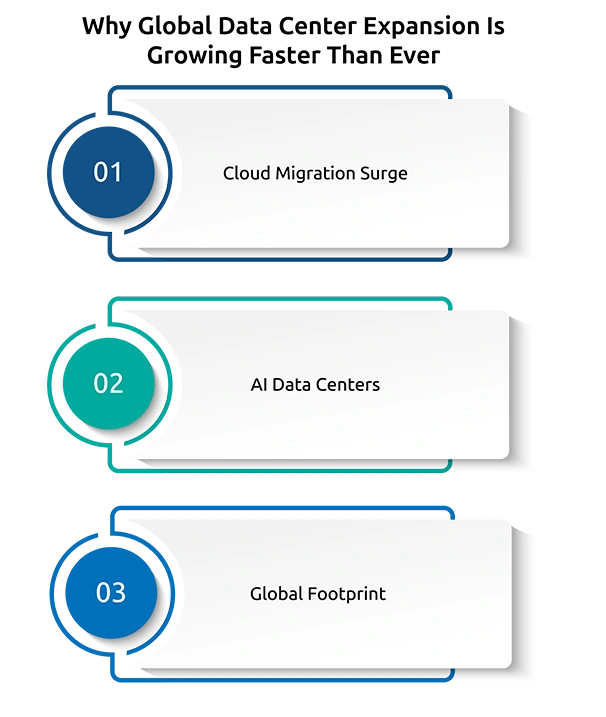
Why Global Data Center Expansion Is Growing Faster Than Ever
Businesses around the nation are growing and investing in global data center expansion to support the growing demand for digital services. In 2026, businesses that depend on fast, secure, and reliable data processing will require strong digital infrastructure. One of the main reasons of this growth is the increased use of cloud computing. More businesses are moving their data and software to the cloud, increasing demand for modern data centers. The rise of AI data centers is also supporting growth. AI equipment requires high-end servers and storage systems because they need to handle large amounts of data fast and effectively. Edge computing is expanding as companies develop smaller data centers closer to users. This increases speed and allows real-time applications. Many businesses are also entering new markets by building data centers in different countries to better support local customers and help business growth.
AI data centers vs. traditional data centers
AI data centers share many similarities with traditional data centers. They each contain hardware such as servers, storage systems & networking equipment. Operators of both need to consider things such as security, reliability, availability & energy efficiency.
The differences between these two kinds of data centers stem from the extraordinary demands of high-intensity AI workloads. In contrast to AI data centers, typical data centers contain infrastructure that would quickly be overwhelmed by AI workloads. AI-ready infrastructure is specially designed for cloud, AI & machine learning tasks.
For example, conventional data centers are more likely to be designed for & contain central processing units. Whereas AI-ready data centers require high-performance graphics processing units & their IT infrastructure considerations, such as advanced storage, networking, energy & cooling capabilities. Often, the sheer number of GPUs necessary for AI use cases also need far more square footage.
Key features of an AI-ready data center
High-performance computing
An AI-ready data center needs high-performance computing capabilities such as those found within AI accelerators. AI accelerators are AI chips used to speed up ML & deep learning models, natural language processing & other artificial intelligence operations. They are mainly considered to be the hardware making AI & its many applications possible
Advanced storage architecture
The velocity & high computational needs of AI workloads need huge data storage with high-speed memory. Solid-state drives, semiconductor-based storage devices that typically use NAND flash memory, are considered critical storage devices for AI data centers. Specifically, NVMe SSDs, which have the speed, programmability & capacity to manage parallel processing.
Resilient & secure networking
AI must be fast. Users expect instant responses from online AI applications & autonomous vehicles need to make split-second decisions on the road. AI data center networking must be able to support the high-bandwidth requirements of AI workloads with low latency. For hyperscale data centers, bandwidth requirements can range from several gigabits per second to terabits per second.
Adequate power & cooling solutions
The high computational power, updated networking & vast storage systems in AI data centers require huge amounts of electrical power & advanced cooling systems to avoid outages, downtime & overload.

The growth of AI data centers
The adoption of AI tools such as OpenAI’s ChatGPT by millions of nonexpert users has moved at an electrifying pace. This clear productivity & monetization potential of AI capabilities has led to an intense flow of new AI productivity tools, agents & content generators.
Open source models & the continued democratization of AI mean it’s not just major players making waves in the AI ecosystem. Almost any entity can be a tech company if they can identify an AI use case & adopt the IT infrastructure to get it done. The data center industry has grown to fit demand. Data center infrastructure around the globe is increasingly AI-ready, capable of processing high volumes of complicated computations & requests. The Asian Pacific & North American regions have the highest proliferation of data centers, mainly in areas such as Beijing, Shanghai, northern Virginia & the San Francisco Bay area.
Conclusion
The rapid development of AI data centers is developing the global digital infrastructure, enabling organizations to meet the growing demands of artificial intelligence, machine learning, & high-performance computing. However, building & scaling AI-ready facilities across global markets needs more than advanced hardware it depends on efficient global logistics, regulatory compliance, & resilient supply chain management.
Did you know?
The total data center market generated $416.09 billion in revenue in 2024 and is forecast to climb past $620 billion by 2029, according to Statista Market Insights.
FAQ
How is data center expansion changing global equipment supply chains?
Data center expansion is increasing demand for servers, GPUs, storage systems, networking equipment, and cooling solutions. Businesses must coordinate international shipping, customs clearance, warehousing, and final delivery to meet project schedules.
What equipment is required to build an AI data center?
AI data centers require high-performance servers, GPUs or other AI accelerators, high-speed storage, networking switches, power distribution equipment, and advanced cooling systems. The exact requirements depend on the facility’s computing workload and design.
What are the main challenges when shipping data center equipment internationally?
Common challenges include customs classification, import duties and taxes, product certifications, export controls, shipping coordination, and equipment handling. Missing documents or incorrect product information can cause delays and additional costs.
How can businesses reduce customs delays when importing data center equipment?
Businesses should verify HS codes, customs valuation, commercial invoices, product specifications, import permits, and destination-country requirements before shipping. Working with experienced customs brokers and appropriate import partners can also help reduce documentation errors.
What role does an Importer of Record (IOR) play in data center expansion?
An Importer of Record (IOR) manages the legal import responsibilities assigned to it under the destination country’s regulations, including customs declarations and applicable duties and taxes. IOR services can help businesses import servers, GPUs, and networking equipment into countries where they lack a suitable local importing structure.