Introduction
Data centers, machine learning, and AI all heavily depend on GPUs. However, because some advanced GPUs and computer devices can handle sensitive and powerful applications, they are restricted to export rules. These rules may restrict who can receive specific goods and where they can be shipped. Before shipping in 2026, international importers of IT equipment have to check the import laws of the target country, export license requirements, & current GPU export control regulations. These checks reduce the possibility of shipment delays or compliance issues while helping companies follow trade rules.
What Are GPU Export Controls?
GPU export controls are rules set by governments to control the sale and shipment of certain advanced GPUs & AI chips to other countries. These rules may also apply when products are resold or transferred to another country. Data centers, machine learning, and AI all use advanced GPUs. Due to their high processing capacity and possible use in sensitive technologies, some models could require extra testing. Companies should check the product type, destination nation, buyer, end user, & whether an export license for GPUs is required before shipment.
Normal customs rules are not the same as GPU export controls. The main focus of export controls is whether a product can be legally exported to a specific country or user. Import declarations, product classification, taxes, duties, and other entry processes are all covered by customs regulations. To avoid shipment delays & compliance problems, importers need to check both sets of regulations.
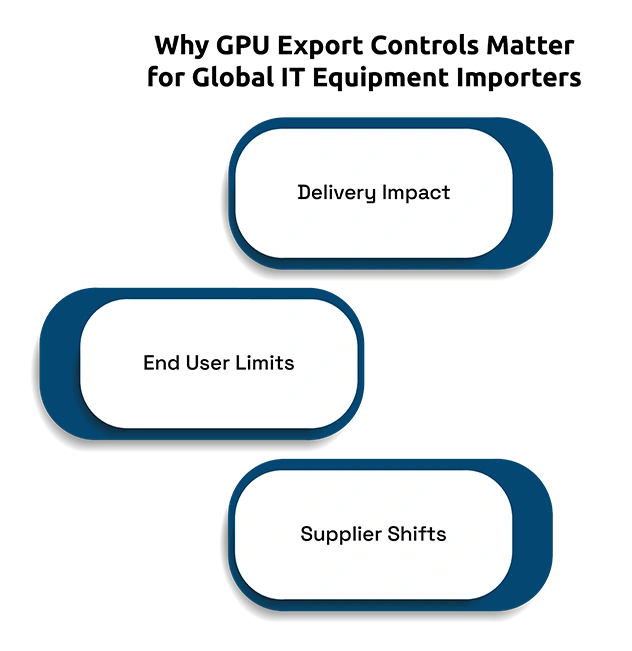
Why GPU Export Controls Matter for Global IT Equipment Importers
GPU export rules are important for companies who import servers, data center equipment, and AI systems. Rejected export approvals or shipment holds may result from the rejection or lack of a required export license. Delivery times and costs may be affected by this. Restricted Locations an End Users may restrict who can receive and where specific GPUs can be provided. Before placing an order, businesses need to review these details.
Businesses might have to look for different suppliers or change delivery times due to changes in sourcing and shipping plans. Companies who sell or move GPUs to another country without reviewing the appropriate rules may also face compliance risks. Not every transfer in the future may be covered by the initial export approval. Companies may make smarter buying decisions, prepare all the required documents, & reduce the chance of shipment issues by examining export rules early.
How GPU Export Controls Affect AI Servers and Data Center Equipment
GPU export limitations can be applied to individual circuits as well as entire computer systems. AI racks and GPU-powered servers may require extra checks depending on the GPUs and processing power they have. Export restrictions may also apply to high-performance computing (HPC) devices used for large-scale data tasks and AI training.
When network and storage equipment is delivered with AI systems, it is important to examine if export standards are applicable. Before being shipped to a different country, integrated systems & replace hardware, such as server parts and GPU cards, may also require checks. Before shipping, importers should check these regulations to verify if they require an export license or other permits.
Key GPU Export Control Checks Before Shipping
Companies should check the export regulations that relate to their products before shipping GPUs, AI servers, or other IT equipment to another country. They should verify the product’s details, the customer, the destination country, & the equipment’s intended use. Additionally, they have to decide whether other permits or an export license for GPUs are required. These checks reduce the risk of delays or compliance issues and help companies understand the regulations before delivery. Also, importers should make sure that the equipment fulfills the import rules of the destination country & that the shipping documents are correct.
How Importers Can Prepare a GPU Shipment for Compliance
Importers should make sure that all details and documents are prepared before delivering GPUs, AI servers, or other IT equipment. They should check the final end user, location country, intended usage, buyer data, and product model. They should also check if any other approvals, such as an export license for GPUs, are required.
Prepare the packing list, shipping documents, a commercial invoice, & any required import or export permits. Verify that the product details are consistent across all documents and that the products follow with import regulations in the country of destination. Verify whether any additional export regulations apply if the equipment is going to be sold again or shipped to another country. By completing these checks before to shipping, mistakes can be reduced & unexpected shipment issues may be avoided.

Conclusion
Businesses that ship GPUs, AI servers, and data center equipment across countries must follow to GPU export regulations. Companies should verify the product details, buyer, location country, and planned usage before exporting. Also, they should check whether any other permits, such as an export license, are required. By following to GPU export compliance rules, companies may better plan foreign deliveries and avoid shipping issues. Also, careful checks make it easier for importers to follow up with customs regulations and transfer their IT equipment across borders.
Did you know
The Data Center GPU Market is valued at USD 18.69 billion in 2025 and is projected to grow at a CAGR of 31.7% to reach USD 222.8 billion by 2034.
FAQ
Why should importers check the GPU model before shipping?
Companies can use the GPU model to identify their export classification and decide whether any special rules or licenses are applicable.
Do GPU export controls apply to complete AI servers?
Yes, the GPUs or processing power of some AI servers and computer systems may allow them to be handled. The system’s details provide the exact regulations.
Does an Importer of Record handle GPU export licenses?
In the destination country, an Importer of Record (IOR) is in charge of specific import duties. Export licenses are typically the exporter’s or another important party’s legal duty, depending on the applicable rules.
Why should businesses check the final end user of a GPU shipment?
Depending on who will receive or use the equipment, certain restrictions may apply. Businesses can find possible limitations before delivery by verifying the final end user.
Are GPU export controls the same as customs duties and taxes?
No, GPU export controls decide which products are allowed to export under the proper regulations. Taxes and customs charges may be charged when products enter a country.