Introduction
As global dependence on digital systems continues to grow, data centers have become the support of the modern economy. These systems power cloud services, allow smooth interaction, and store huge amounts of data for industries such as IT, aviation, medical, and automotive. Technological change is growing globally, and the demand for high-performance hardware is stronger than ever. Also, moving advanced IT equipment across borders is not as simple as booking a shipment. It requires special knowledge of international export regulations, customs clearance support, and global supply chain services that confirm every component arrives safely and properly.
What are Data Centers?
A data center is a central system that works as a house computing infrastructure, such as servers, networking gear, and storage systems. These simplified processes secure critical data that keeps businesses and governments. Every server rack, router, and storage device shipped to a data center must follow strong HS code and HTS harmonized tariff schedule classifications. This confirms proper customs handling, accurate taxation, and smooth clearance across borders. As data centers expand worldwide, so does the difficulty of the import export business that supports them.
Why do we require sending IT to data centers?
Businesses send IT hardware to data centers to confirm scalability, efficiency, and agreement with global digital systems. High-performance servers and networking systems, data centers cannot provide the uptime and speed that industries demand. The growth of technology is also supported by global trade facilitation measures such as the generalized system of preferences, which reduces tariffs on qualifying shipments. To confirm efficiency, organizations frequently depend on freight forwarding services and comprehensive import-export support. These solutions manage logistics, permits, and documentation under global trade rules. Common Incoterms, such as DAP or DDP shipping, define responsibilities between buyer and seller. Delivered Duty Paid logistics, the supplier takes care of duties and taxes, giving buyers statisfy that their technology will arrive ready for deployment.
What are the complexities of sending technology to data centers?
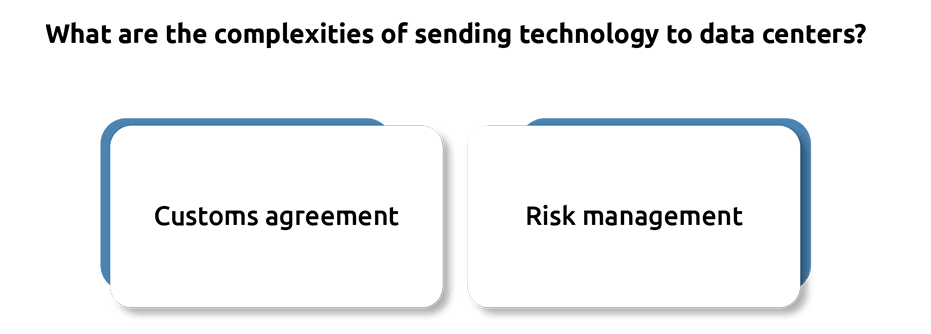
Transporting IT equipment to data centers involves significant challenges:
- Customs agreement: Each country imposes its own tariff structure, requiring correct HS code classification and sometimes import export registration.
- Risk management: IT equipment is high-value and sensitive. Many organizations choose a Delivery Duty Paid service for maximum security.
- Trade paperwork: From invoices to export register documentation, missing or inaccurate forms can cause costly delays.
- Specialized logistics: Data center hardware cannot be treated like regular cargo. It requires trusted global supply chain services and tailored handling.
- Taxation problems: Failure to apply correct rates under the HTS harmonized tariff schedule or claim eligible benefits under trade agreements can increase costs.
- Because of these complexities, organizations frequently struggle to manage shipments independently and look for expert solutions.
How can IOR help import data center IT equipment?
An Importer of Record (IOR) simplifies the process of moving IT equipment across borders. Working as the legal entity responsible for the agreement, IOR confirms all shipments meet local regulations.
- Importer of record services allow businesses to ship IT hardware without establishing a local subsidiary.
- IOR providers handle documentation, tariff payments, and customs clearance support in line with export customs brokerage requirements.
- They confirm agreement with Incoterms such as DDP, where the seller assumes responsibility for all costs and risks until delivery.
- Partnering with an IOR complements exporter of record services, creating a smooth system for end-to-end global technology movement.
- With these services, companies can focus on deploying IT solutions in data centers while experts manage the legal and logistical challenges of trade.
Conclusion
The journey of shipping IT equipment to data centers involves much more than logistics. It requires agreement with international export regulations, accurate HS code classification, and professional management of duties and taxes. By using importer of record services, DDP shipping, and specialized freight forwarding services, companies can reduce risks and confirm that their equipment arrives on time and ready for use. As demand for data centers grows globally, businesses that use comprehensive import-export support and global supply chain services will be best positioned to keep pace with the digital economy.
DID YOU KNOW?
Data center computing demand is growing. We expect global demand for data center power to grow by approximately 16% annually from 2023 to 2028, 33% higher than the growth from 2020 to 2023, reaching 130 GW by 2028.
FAQs:
Q1. Why is shipping IT equipment to data centers complex?
Because it requires compliance with HS codes, international tariffs, customs documentation, and specialized logistics handling for sensitive hardware.
Q2. What role does an Importer of Record (IOR) play in data center shipments?
An IOR takes legal responsibility for compliance, manages customs clearance, tariff payments, and ensures shipments meet local regulations.
Q3. How do Incoterms like DAP and DDP affect IT equipment delivery?
Incoterms define responsibilities between buyers and sellers. With DDP, the supplier handles all duties and taxes, ensuring a seamless delivery.
Q4. Can businesses ship IT hardware without a local subsidiary?
Yes, using IOR services allows companies to legally import equipment into foreign markets without establishing a local entity.
Q5. How can trade agreements like the Generalized System of Preferences help?
They reduce or eliminate tariffs on qualifying IT hardware shipments, lowering overall costs for businesses importing to data centers.