Overview
The recent rise in U.S. tariff policy, specifically under an increasingly import-restrictive trade agenda, is changing global trade work, and Latin America is firmly in the crosshairs. While many discussions around tariffs mainly focus on the main or traditional export categories, there is a growing issue among clients in the IT sector. Rising U.S. tariffs risk cutting Latin America’s IT exports by double digits, stopping supply chain optimizations, and reducing the region’s competitiveness in global technology markets. This challenge is especially pressing for Latin American organizations working in the worldwide technology value chain, from software companies in Mexico and Brazil to hardware assemblers and IT component suppliers across South America. As global digital transformation accelerates, Latin American economies have been positioning themselves as viable export hubs for software solutions. Also, the recent tariff increases threaten this momentum by raising the cost of accessing the U.S. market, the region’s largest trading partner, for exporter and importer of record services.
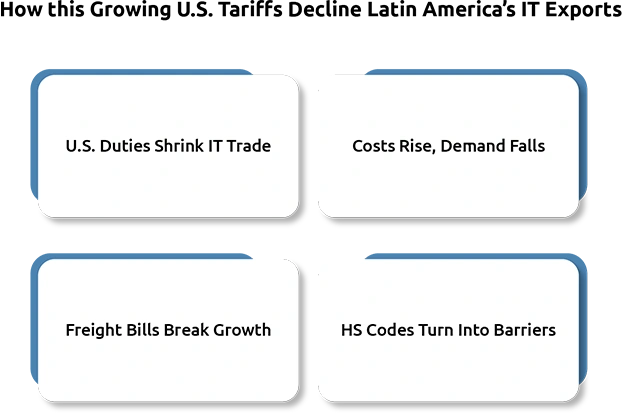
How this Growing U.S. Tariffs Decline Latin America’s IT Exports
Rising tariffs effectively work as a tax on exported goods, making them more expensive in global markets. For Latin American IT exporters, this results in higher prices for their logistics in the United States, which can continuously reduce demand for inventory and order management. Because the U.S. is frequently the largest or second-largest destination for regional exports, increased duties can directly cut into shipment volumes and long-term agreements.
Even in areas where Latin America has secured competitive positions, such as software development services, automotive systems, aviation electronics modules, and specialized medical equipment IT solutions, tariff barriers weaken costs using the HS code. Growth projections for tech exports, which for many organizations were strong before the tariff changes, could increase by double-digit percentages if these costs continue with International freight services.
How U.S. Trade Policies Are Reshaping Latin America’s IT Industry
The way Latin American companies export technology services and IT goods is being changed by U.S. trade policies. The cost of exporting goods in the U.S. market could increase due to higher import taxes, more strict trade compliance requirements, and changing customs laws. Industries including IT, telecom, medical devices, aviation, and automotive technologies are all affected by this. Many companies are improving their supply chain, verifying the correct HS code, and following to all customs documents in order to reduce these difficulties. In order to reduce their reliance on the U.S. market and support strong export growth, businesses are also reaching out into new markets in Europe, Asia, and other Latin American countries.
Why U.S. Tariffs Have a Higher Impact on Mexico and Venezuela’s IT Exports
Mexico’s IT export sector is particularly vulnerable due to its deep commercial integration with the United States. A large share of Mexico’s technology exports, especially those linked to automotive electronics, industrial software systems, and manufacturing-based IT services, is designed specifically for U.S. customers. When tariffs rise, Mexican exporters feel the impact almost immediately through reduced orders, margin pressure, and renegotiated supply agreements with Incoterms using DAP and DAPs. In Venezuela’s case, the overall export environment is already limited, and any variations in technology products or services face structural challenges.
Why U.S. Tariffs Medium Impact on Argentina and Brazil IT Exports
Argentina and Brazil experience a more moderate impact. Both countries have developing IT sectors with strengths in software services and specialized technology support for global exports. Brazil, in particular, has a large and varied export base, which helps to reduce some of the tariff issues in the premium delivery service. While U.S. tariffs do create challenges for Brazilian and Argentine IT exporters, especially those targeting North American clients, local markets and alternative international partnerships provide limited Issues.

Why U.S. Tariffs Have a Lower Impact on Chile, Colombia, and Peru IT Exports
Chile, Colombia, and Peru see comparatively lower exposure to export. Their export profiles remain more varied, and their IT sectors, while growing, are less dependent on U.S. demand than those of Mexico or Brazil. In addition, long-standing trade relationships and broader global trade reduce dependence on any single destination market in International shipping terms. Technology organizations in these countries are increasingly exploring Europe, Asia, and regional Latin American markets. Also, although higher U.S. tariffs introduce tension, they do not add the same level of pressure on national export performance or technology sector expansion.
Conclusion
Rising U.S. tariffs add a serious challenge for Latin America’s exporters, and the IT sector, a crucial role in modernization and economic development, is not secure. Mexico and Venezuela see the highest impact on exports, Argentina and Brazil come across medium-level impacts, while Chile, Colombia, and Peru remain less affected by rising tariffs. For businesses gets customs clearance for import-export space, specifically across IT, aviation, medical equipment, and automotive industries, this changing environment demands major adjustments across global trade.
DID YOU KNOW?
Argentina experienced an 18.1 percent increase over the previous year, due in part to economic reforms. In Peru, this helped increase exports by 15.8 percent.
FAQs
1. How do rising U.S. tariffs affect Latin America’s IT exports?
Rising tariffs increase the cost of entering the U.S. market, reducing price competitiveness, lowering demand, and pressuring profit margins for Latin American IT exporters.
2. Why are Mexico’s IT exports more affected by U.S. tariffs?
Mexico is deeply integrated with U.S. supply chains, and a large share of its IT and technology-related exports are specifically designed for U.S. customers, making them more vulnerable to tariff changes.
3. Why is the impact considered medium for Argentina and Brazil?
Argentina and Brazil have growing IT sectors, but their exports are more diversified across global markets, which helps soften the overall effect of U.S. tariff increases.
4. Why are Chile, Colombia, and Peru less exposed?
These countries have more varied export destinations and less reliance on the U.S. market for IT services, reducing the direct impact of higher U.S. tariffs.
5. What should Latin American IT exporters do to reduce tariff risks?
They can diversify export markets, optimize supply chains, review trade compliance strategies, and explore alternative regions such as Europe, Asia, and intra-Latin American trade.