Overview
Vietnam has grown as one of the most important manufacturing and export hubs in Asia, supplying everything from electronics and automotive components to medical devices and aviation equipment. Also, growing trade variance and increasing scrutiny from U.S. authorities have placed Vietnam under tariff pressure. As the United States tightens rules of origin enforcement, Vietnamese exporters and global import–export businesses must now pay closer attention to providing clarity, documentation accuracy, and approval systems.
Why Vietnam Faces Tariffs on Imports and Exports
Vietnam’s export growth has risen over the past decade, supported by foreign direct investment and its role as an alternative manufacturing base in Asia. From semiconductors to medical tools and vehicle parts, valuable goods are increasingly under review. When customs officials detect inconsistencies between the announced origin and the actual manufacturing work, shipments face higher inspection rates, delays, and potential tariff recategorizations. This affects not only Vietnamese exporters but also U.S. importers who depend on predictable landed costs.
Trade Variance and Approval Gaps
The pressure is not completely about volumes. It also shows approval gaps in how origin is documented, how supplier data is tracked, and how multi-country production processes are reported. In difficult global supply chains, mainly in aviation and automotive manufacturing, components may cross borders many times before final assembly. Without correct documentation, these goods can become at risk of regulatory action.
Why the U.S. is Tightening Rules of Origin Enforcement
The U.S. administration is improving enforcement to confirm that trade rules show manufacturing work rather than the simple rerouting of goods. Rules of origin show where a product is mainly to be made, which directly impacts tariffs, duty benefits, and regulatory approval.
Protecting Trade Integrity
By increasing enforcement, U.S. officials are looking to stop difficult methods, protect local industries, and preserve the integrity of tariff schedules. Advanced data analytics, closer work with customs authorities abroad, and good audits of production records are becoming standard tools.
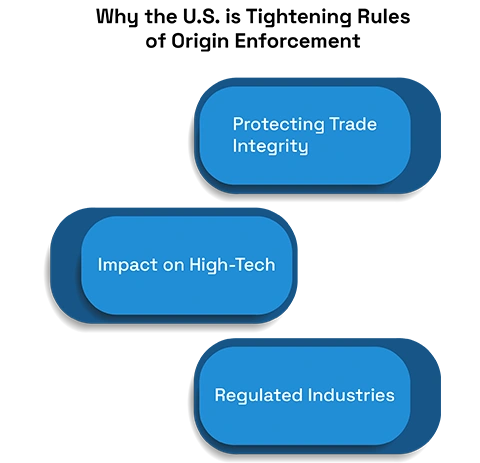
Impact on High-Tech and Regulated Industries
This change specifically affects IT hardware, aviation parts, medical devices, and the automotive industries, where regulatory problems are already high in global trade. Any inconsistency in bills of materials, production stages, or supplier declarations can now give complete reviews, affecting time-to-market and cost structures.
Strict Rules of Origin Enforcement in Vietnam
Vietnamese manufacturers and foreign-invested businesses working in the country are upgrading their internal approval systems. This includes better tracking of raw goods, clearer records of value addition, and stronger work between factories, suppliers, and trade service partners.

Documentation and Process
Organizations are looking for how they manage shipping documentation and tariff categorizations. Processes related to Customs clearance, product categorizations, and shipment structuring are no longer back-office tasks; they are now major priorities. Many organizations are investing in digital trade management tools and approval audits to confirm their exports can withstand regulatory scrutiny.
The Role of Trade and Logistics Infrastructure
For import–export businesses, mainly those working with multinational clients, this moment highlights the importance of combined operations. A typical export flow today may involve logistics planning, correct HS code identification, alignment with the HTS harmonized tariff Schedule, and contract structuring under clearly defined International shipping terms and Incoterms. Organizations are also paying closer attention to roles such as exporter of record services and Importer of record services to reduce problems and maintain responsibilities.
When combined with strong Inventory and order management, these systems help maintain traceability from production to the final destination. For high-value cargo in the aviation and medical sectors, value-added services such as Premium delivery service are also gaining relevance.
Conclusion
Vietnam’s growing tariff pressure is not a temporary disruption; it shows a structural change in how global trade is governed or change. As the U.S. tightens rules of origin enforcement, businesses working in IT, aviation, medical, and automotive supply chains must accept a reality where transparency, documentation, and approval are central to competitiveness. For import–export organizations, this environment creates both risk and opportunity. Those who invest in approval systems, accurate categorization systems, and a flexible logistics chain will be better positioned to support clients through regulatory difficulty.
DID YOU KNOW?
A 20 percent tariff was imposed on Vietnam, which is higher than the 10 percent rate applied during the 90-day grace period, but significantly lower than the 46 percent rate initially imposed in early April.
FAQs:
1. Why is Vietnam facing increased tariff pressure from the United States?
Vietnam is facing greater tariff pressure because U.S. authorities are tightening rules of origin enforcement to ensure products genuinely meet origin requirements and are not simply rerouted through third countries.
2. What are the rules of origin, and why are they important?
Rules of origin determine where a product is primarily manufactured. They affect tariff rates, duty benefits, regulatory approvals, and whether goods qualify for trade preferences.
3. Which industries are most affected by stricter enforcement?
High-tech and regulated industries such as IT hardware, aviation parts, medical devices, and automotive components are most impacted due to complex, multi-country supply chains.
4. How does stricter enforcement impact exporters and importers?
It increases inspection rates, documentation requirements, risk of shipment delays, and potential tariff reclassification, affecting landed costs and delivery timelines.
5. What can businesses do to reduce compliance risks?
Businesses can invest in stronger documentation systems, digital trade management tools, supplier data tracking, approval audits, and integrated logistics and inventory management.