Introduction
High-precision logistics plays a vital role in the aviation and automotive industries; small delays or issues can result in huge economic losses and working issues. These sectors depend on difficult global change involving suppliers, manufacturers, and service providers across various countries. From handling sensitive aircraft parts to managing just-in-time automotive parts, logistics must work with accuracy, approval, and speed. As global trade grows more regulated and customer trust grows, organizations are increasingly looking to improve logistics processes while guiding customs clearance, import duties and tariffs, and developing regulatory requirements.
Understanding Supply Chain Complexity in Aviation and Automotive
The aviation and automotive supply chains are among the most difficult in the world because of the components required and the strict quality and safety guidelines. Aviation parts frequently move across borders multiple times before final assembly, making import export documentation and correct HS code or HTS Harmonized Tariff Schedule classification necessary. Also, automotive manufacturers depend on complete supply chain management systems to confirm unwanted production lines. Any mismatch in documentation, delays in customs clearance, or incorrect tariff-related related can lead to production shutdowns. Managing transportation and warehousing effectively across global locations further adds to the challenge, mainly when working with valuable and urgent cargo.

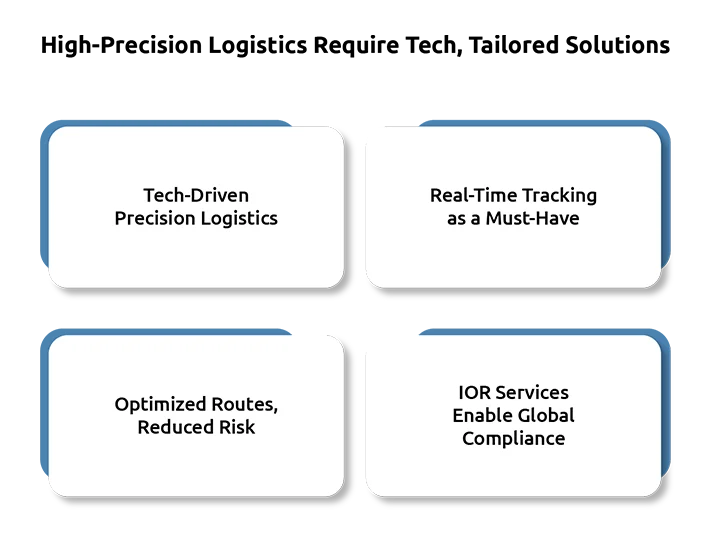
High-Precision Logistics Require Tech, Tailored Solutions
To meet these challenges, high-precision logistics increasingly depends on advanced technology and customized service methods. Real-time shipment tracking has become a necessity rather than a allowing organizations to track cargo shipments, anticipate delays, and make informed decisions. In the aviation and automotive sectors, warehousing solutions for import and export goods must be used to manage special storage requirements, such as temperature control, secure handling, and serialized inventory tracking. Customized international freight services, combined with supply chain optimization plans, allow businesses to reduce shipping times and reduce risk. Many organizations also depend on IOR services to confirm agreement when importing goods into global trade, specifically when they lack a local legal entity.
Common Challenges in Aviation and Automotive Supply Chains
Having technological improvements, many problems continue in aviation and automotive supply chains. One major issue is regulatory approval, as each country has its own customs rules, import duties and tariffs, and documentation guidelines. Operational variance in Incoterms, such as Delivered Duty Paid service or DAP agreements, can lead to uncertainty over customs issues. Also, the difficulty of managing various suppliers increases the risk of delays, mainly when last-mile delivery services fail to work with production schedules. Transportation problems, storage issues, and geopolitical unwanted further difficult international freight services, making flexibility and contingency planning necessary.
Another common challenge depends on the warehousing system. Aviation and automotive parts frequently require correct management and storage situations, and ineffective warehousing can lead to damage or inventory errors of critical parts. Transportation and warehousing must work in close cooperation to support inclined manufacturing methods and avoid excess inventory costs. Also, inaccurate supply chain data can limit visibility and unwanted effective decision-making. Integrated systems for real-time shipment tracking and supply chain optimization, organizations struggle to have the high level of accuracy these industries demand.
Conclusion
High-precision logistics is no longer optional for aviation and automotive supply chains; it is a major necessity. The growing difficulty of global trade, combined with strong approval requirements and growing customer trust, demands a more combined and technological approach to logistics. Focusing on correct import export documentation, customs clearance, and improved transportation and warehousing, organizations can reduce risks and improve working efficiency. Customized warehousing solutions for import and export goods, new tracking technologies, and dependable international freight services allow businesses to remain relevant in urgent trades. Also, controlling these problems requires a combination of expertise, innovation, and work across the complete supply chain.
DID YOU KNOW?
According to the latest report published by Global Market Insights Inc., the global spare parts logistics market size was valued at $23.2 billion in 2025. This market is expected to grow from $24 billion in 2026 to $37.9 billion by 2032, at a compound annual growth rate (CAGR) of 5.2%.
FAQs:
What is high-precision logistics in the aviation and automotive industries?
High-precision logistics refers to highly accurate, time-critical logistics operations designed to support aviation and automotive supply chains, where delays or errors can cause production shutdowns or safety risks.
Why are aviation and automotive supply chains so complex?
These supply chains involve thousands of specialized components, strict quality standards, global sourcing, and multiple customs regulations, making coordination and compliance extremely challenging.
How does real-time shipment tracking improve supply chain efficiency?
Real-time tracking provides visibility into cargo movement, helps anticipate delays, improves decision-making, and ensures alignment with just-in-time production schedules.
What role do customs clearance and documentation play in high-precision logistics?
Accurate import-export documentation and customs clearance are essential to avoid delays, penalties, and production disruptions, especially when parts cross multiple international borders.
How can technology help overcome logistics challenges in the aviation and automotive sectors?
Advanced technology, such as integrated supply chain systems, serialized inventory tracking, and optimized warehousing solutions, improves accuracy, compliance, and overall operational efficiency.