Overview
In international trade, duty calculation plays a vital role in showing the last landed cost of imported goods. Even a small error can result in economic loss, shipment delays, or legal issues. That is why duty calculation is checked multiple times by different customers before goods are shipped through customs clearance. These continuous checks to get confirmed accuracy and clarity in global trade, which requires international freight services, an Importer of Record service, and international shipping terms.
What is Customs Duty and Types of Customs Duties?
Customs duty is a tax added by the government administration on goods when they are transported across global borders. It is a main source of revenue and also a tool to regulate trade, protect local industries, and track restricted products.
Understanding Customs Duty
The amount of customs duty depends on factors such as product value, product category, and country regulations. It is usually calculated before shipment and verified again upon arrival.
Common Types of Custom Duties
- Basic Customs Duty
- This is the systematic duty charged on most imported goods.
- Countervailing and Anti-Dumping Duties
- These are applied to counter unfair trade methods and protect domestic manufacturers.
- Integrated and Special Duties
- Extra taxes may apply depending on national regulations, good sensitivity, and trade guidelines.
Multiple duty types may apply at the same time; calculations frequently require inspections at different levels by customs clearance officials and logistics service providers.

Why is duty calculation important in international trade?
Duty calculation is important because it decides how much tax must be paid on imported or exported goods. Accurate calculation helps avoid fines, delays, and legal issues. It also ensures smooth customs clearance, as correct duty payments reduce the chances of shipments being held or rechecked.
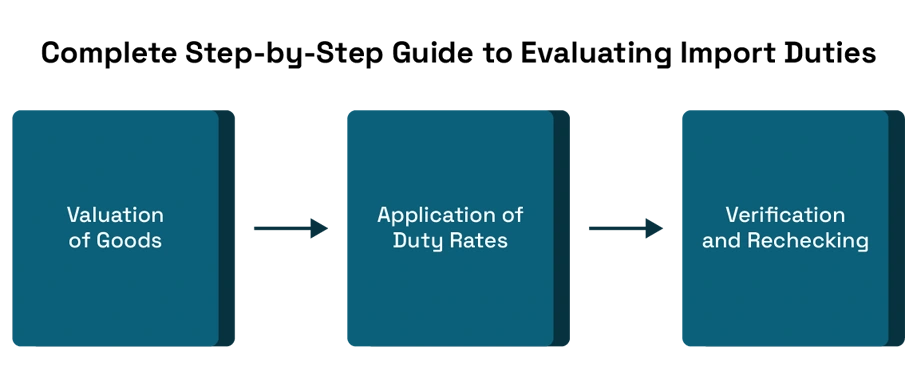
Complete Step-by-Step Guide to Evaluating Import Duties
Product Classification
Every imported product is categorized under a recognized tariff system. This determines the applicable duty rates and regulatory requirements.
Valuation of Goods
The evaluatable value is calculated using the good price, insurance, and shipment costs. This step is critical because duty is charged as a percentage of this value.
Application of Duty Rates
The appropriate rates are applied based on product classification and origin.
Calculation of Other Charges
Other required taxes, port fees, and government fees are added to show the final payable amount.
Verification and Rechecking
Authorities, brokers, and freight forwarding companies near me frequently recheck calculations to confirm there are no errors before and during customs clearance.
Key Reasons Why Duty Calculations Are Subjected to Multiple Checks
Stopping Financial Discrepancies
Incorrect calculations can lead to underpayment or overpayment of duty, both of which can get audits, penalties, or shipment holds.
Confirming Legal Agreement
Multiple checks help confirm that import declarations work with national laws, trade agreements, and goods regulations.
Reducing the Risk of Misclassification
Product miscategorizations can change duty rates hugely. Rechecking confirms goods are exactly categorized.
Supporting Transparent Trade
Repeated verification creates a documented chain that supports responsibilities among importers, customs authorities, and international freight services providers.
Avoiding Operational Delays
Early detection of errors helps prevent goods from being stopped at ports, improving efficiency in customs clearance and overall logistics flow.
Challenges and Benefits of Duty Calculation Are Checked Multiple Times
Common Challenges
Time Consumption
Multiple reviews can slow down shipment processing, mainly when documentation is incomplete.
Complexity
Different rules across countries make correct calculation more demanding.
Dependency on Documentation
Issues with invoices or shipping paperwork can affect the calculation process.
Major Advantages
Increased Accuracy
Repeated checks hugely reduce the risk of mistakes.
Legal Protection
They safeguard businesses from agreement violations and possible fines.
Cost Control
Accurate calculations help importers manage budgets and optimize inventory and order management.
Stronger Supply Chains
Dependable duty evaluation supports smoother coordination across logistics chains and international shipping terms.
Conclusion
Duty calculation is not a one-time activity; it is a staged process involving importers, customs officials, and logistics professionals. The reason duty calculation is checked multiple times is simple: accuracy protects revenue, confirms approval, and stops costly trade disruptions. In today’s interconnected global economy, where international freight services and customs clearance operations are tightly regulated, repeated verification is necessary. Multi-level checks not only avoid legal issues but also improve their trade operations, cost management, and long-term dependability in global trade.
DID YOU KNOW?
India imported medical equipment worth ₹12,552 crore from the United States, which is 66.3 percent more than the ₹7,547 crore worth of equipment imported in the financial year 2020.
FAQs:
1. Why is duty calculation checked multiple times?
Duty calculation is checked multiple times to prevent financial errors, ensure legal compliance, avoid misclassification, and reduce the risk of shipment delays or penalties.
2. Who verifies customs duty calculations?
Importers, customs brokers, freight forwarding companies, and customs authorities all review duty calculations at different stages of the import process.
3. What happens if customs duty is calculated incorrectly?
Incorrect duty calculation can lead to overpayment, underpayment, shipment holds, audits, penalties, or even legal action.
4. What factors affect customs duty calculation?
Product classification, declared value, country of origin, applicable duty rates, and additional government taxes all impact the final duty amount.
5. How can businesses reduce errors in duty calculation?
Businesses can reduce errors by using accurate documentation, correct product classification, professional customs clearance support, and repeated verification.