AI is developing the international technology supply chain. Demand for GPUs, AI servers, processors, networking equipment, storage systems, & other high-performance hardware is growing quickly. Product verification, export controls, paperwork, location rules, & end-user checks can all affect whether equipment can move easily. Recent changes in semiconductor export controls show why this matters.
Why AI Hardware Needs More Customs Planning
AI hardware differs from basic computer hardware.
High-performance GPUs, servers, CPUs, switches, connections, storage units, cooling equipment, or entire AI racks could all be included in a shipment. Additionally, certain products could have technology or controlled parts.
A mistake in any of these areas can lead to extra checks, delays, additional costs, or the need for an export license.
Product Classification Comes First
The Harmonized System code is the international system used to classify products. Its first six digits are common across countries, while countries can add more digits for their own rules. The HTS code is the detailed tariff code used in the United States. Other countries also use their own national tariff extensions and country-specific tariff codes. The HS system is updated from time to time, with the next major update taking effect in 2028.
An incorrect product classification can affect more than the duty paid on one shipment. Duty overpayment can increase costs, while duty underpayment may lead to back payments and customs penalties if the error is found later.
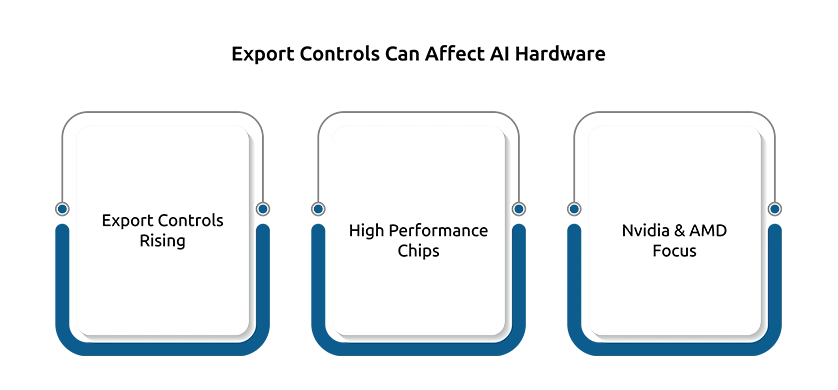
Export Controls Can Affect AI Hardware
Export controls are becoming one of the biggest considerations for organizations shipping updated computing equipment globally.
Some high-performance chips & computing systems may need additional checks before they can be exported to certain countries or customers.
In January 2026, the U.S. Bureau of Industry & Security changed its licensing review policy for certain Nvidia and AMD advanced chips. The updated policy introduced case-by-case review under specified conditions.
This means an importer or exporter cannot simply look at the product name and assume that the shipment is ready to move.
The Final Destination Matters
AI hardware may pass through some countries before reaching its final user.
Equipment could be manufactured in one country, purchased by a company in another country, stored in a third country, & mainly installed at a data center somewhere else.
This creates additional compliance questions. Authorities are also paying close attention to attempts to move restricted technology through third countries.
Understanding the AI Hardware Boom
The AI hardware development is a huge growth in demand for specialized computing components, mainly Graphics Processing Units & Application-Specific Integrated Circuits needed to train & run difficult artificial intelligence models. This, as of May 2026, is driving an unmatched investment in data center networks to support Generative AI, making AI hardware a critical bottleneck & driver of international technological growth.
Artificial intelligence has become an important backbone of the global economic outlook, confirmed by the unprecedented scale of announced investment commitments aimed at developing an AI-related network. The growth of AI is also mainly changing international trade by developing demand for important inputs & between goods needed to build data centers. This surge in AI-related investment has already supported global trade since early 2025, with strong demand for important components developing exports in main supplier economies.
What Importers Should Do
For companies importing AI equipment, customs inspections ought to be part of the procurement and logistics process.
Before placing an international order, review the products, supplier, destination, end user, customs classification, pertinent regulations, documentation, and expected duties and taxes.
For large AI network projects, this planning can be done before equipment is purchased. That gives procurement, logistics, customs, & compliance teams a chance to work from the same information.
Conclusion
The fast development of artificial intelligence is not only changing digital progress but also driving international trade, logistics, & network development. As AI adoption works in the whole world, the demand for specialized hardware such as GPUs, ASICs, servers, & semiconductor components continues to grow, driving significant investment in hyperscale data centers & updated computing environments.
AI infrastructure has enhanced air freight into a strategic component of the international technology supply chain. The speed, security, & usability of air cargo make it essential for transporting high-value, time-sensitive AI hardware across global markets. AI-powered logistics solutions are enhancing shipment visibility, route optimization, customs processing, & whole supply chain improvement.
Did you know?
More than 200 countries and economies use the Harmonized System (HS) as the basis for classifying goods in international trade. The World Customs Organization says that more than 98% of merchandise traded internationally is classified using the HS. For AI hardware, correct classification is important because the product code can affect customs duties, trade controls, and other import requirements.
FAQs
Why is customs planning important for AI hardware?
AI hardware can be subject to specific classification, export-control, documentation, and import requirements. Planning these requirements before shipping can help reduce delays and compliance problems.
Which AI hardware products may require additional checks?
GPUs, advanced processors, AI servers, accelerator cards, networking equipment, and other high-performance computing products may require additional review depending on the country and transaction.
Can AI hardware require an export license?
Yes. Certain advanced computing products may require an export license depending on the product, destination, customer, end use, and applicable export-control rules.
Why is the final destination important?
Export controls and customs requirements can depend on where the equipment will ultimately be used. A shipment routed through another country does not necessarily change its compliance obligations.
When should customs planning begin?
Ideally, customs planning should begin before purchasing or dispatching the equipment. Early review gives the importer time to identify classification, licensing, documentation, and import requirements.