
Overview
In today’s global trade conditions, regulatory compliance has become more difficult than ever. Businesses often assume that logistics partners can resolve all documentation and approval issues. Also, the reality is different for logistics providers, who play a vital role in logistics and warehousing; they cannot fix regulatory issues that legally belong to the importer or exporter. Matters such as customs clearance, tariff treatment under the Generalized System of Preferences (GSP), or errors in an HS code or HTS Harmonized Tariff Schedule categorizations fall outside the authority of most service providers.
Understanding this classification helps businesses avoid delays, penalties, and shipment holds that no amount of International freight services can instantly solve.
Why Logistics Providers Cannot Fix These Issues
The Legal Responsibility Does Not Belong to Them
Regulatory agreement is connected to the legally responsible party, not the service agent. Logistics companies can arrange transport, manage inventory and order management processes, but they are not the organizations responsible to customs authorities.
Compliance Is Not the Same as Transportation
Even though logistics providers work closely with border agencies, they cannot alter legal filings, correct ownership declarations, or override regulations related to International shipping terms, such as DAP or other Incoterms. They may guide you, but they cannot work as the regulatory decision-maker.

Why It’s Difficult to Solve Regulatory Issues for Logistics Providers
Regulations Are Country-Specific and Continuously Changing
Trade rules vary by country and change frequently due to new trade restrictions or security guidelines. Keeping up with GSP updates, product restrictions, or changes in exporter of record services requires legal and regulatory authority, not just working expertise.
Documentation Comes from the Shipper, Not the Provider
Documents such as invoices, certificates of origin, and approval statements originate from the business. If these are incorrect, even the best logistics or freight forwarding companies cannot legally change them without authorization.
Operational Control Has Its Limits
Logistics providers can support Supply chain optimization, but they cannot redesign regulatory systems or recategorize goods once customs has approved them. Their role is execution, not regulatory ownership.
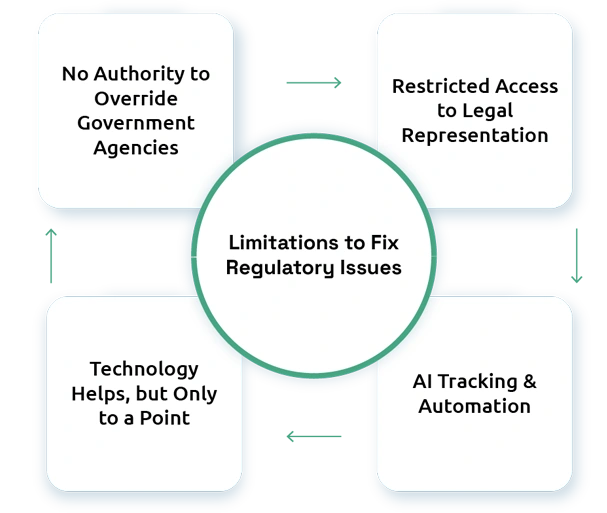
Limitations to Fix Regulatory Issues
No Authority to Override Government Agencies
Customs departments, port authorities, and trade ministries make the final decisions. If a shipment is held due to improper Importer of Record Service setup or incorrect use of International shipping terms, logistics providers cannot simply “clear” it.
Restricted Access to Legal Representation
Most logistics companies are not licensed legal or compliance advisors. While they can give expertise, they cannot indicate your organization in issues, audits, or execution.
The Importance of Proactive Trade Compliance Planning
In global trade, the most effective way to avoid costly delays & fines is to focus on proactive trade compliance planning. Businesses must ensure that key elements like HS code classification, product valuation, paperwork accuracy, & correct use of Incoterms like DAP are verified before shipment. Depending only on logistics or International freight services after goods are in transit usually leads to shipment holds, demurrage charges, & regulatory risks. A well-planned compliance strategy, supported by a proper Importer of Record Service & exporter of record services, helps companies to align with customs requirements from the beginning. This not only improves Customs clearance efficiency but also strengthens overall Supply chain optimization and reduces unexpected disruptions in international operations.
How One Union Solutions Helps You in This
An Agreement Support Method
One Union Solutions works at the intersection of compliance and operations. Rather than attempting to “fix” regulatory problems after they happen, their approach focuses on prevention through proper Importer of Record Service, exporter of record services, and systems approval systems.
Completing the Gap Between Operations and Regulations
By aligning Customs clearance processes with regulatory best practices, we help businesses prepare correct documentation, understand Incoterms like DAP and DAPs, and manage HS code categorizations before shipments are delivered.
Allowing Smarter Supply Chains
Through combined International freight services and Supply chain optimization strategies, we support clients in building complete workflows. This reduces dependence on reactive fixes and improves long-term trade stability.
Conclusion
Logistics providers are necessary partners in global trade, but they are not regulatory authorities. They cannot change legal filings, override customs decisions, or assume responsibility for approval failures. Issues related to GSP eligibility, HTS Harmonized Tariff Schedule categorizations, or Importer of Record issues must be addressed at the business and compliance level. Working with specialized partners like One Union Solutions, organizations can move beyond the misconception that logistics alone can solve regulatory problems. The future of international trade depends not just on shipping goods effectively, but on building complete systems that stop regulatory issues before they stop the supply chain.
DID YOU KNOW?
The global HS code system is maintained by the World Customs Organization, and it is used by more than 200 countries to classify traded goods for customs purposes. However, the WCO does not resolve shipment-level disputes or correct filing errors—those responsibilities remain with importers and exporters.
FAQs:
1: Why can’t logistics providers fix regulatory issues?
Logistics providers manage transportation and operational execution, but regulatory compliance legally belongs to the importer or exporter. They cannot change filings, correct declarations, or override customs authority decisions.
2: Are logistics companies responsible for customs compliance?
No. While they support customs clearance processes, the legal responsibility for accurate documentation, valuation, and product classification rests with the business shipping the goods.
3: Can a freight forwarder correct HS code or tariff errors?
Freight forwarders may highlight potential errors, but they cannot legally change HS codes or tariff classifications without direction and authorization from the responsible party.
4: How do regulatory issues impact international shipments?
Regulatory errors can lead to customs holds, shipment delays, penalties, increased duties, and even cargo seizure, regardless of how efficient the logistics provider is.
5: How does One Union Solutions help prevent regulatory problems?
We support businesses through Importer of Record services, Exporter of Record solutions, and compliance-focused systems that help prepare accurate documentation before shipping.