Overview
The global aerospace industry is once again facing issues as new United States tariff policies change US–Europe trade relations. European aircraft manufacturers, specifically organizations like Airbus, are facing growing working costs, delivery uncertainties, and supply chain issues. Although aviation has mainly benefited from FTA under international trade terms, recent policy revisions and negotiations between the United States and the European Union have introduced uncertainty across trade, logistics, and pricing methods. These developments are changing everything from aircraft deliveries to maintenance operations globally after the new tariff.
US Tariffs’ Impact on Global Trade of Aircraft?
For decades, aircraft and aviation components traded under near-zero-duty arrangements supported by global agreements and preferential programs such as the generalized system of preferences (GSP). Also, it got tariff increases of up to 20–30% on some aerospace imports during 2025, which created huge problems across the aviation ecosystem. In April 2025, Delta Air Lines warned that adding a 20% tariff could make aircraft purchases financially unviable, forcing delivery delays and cost restructuring decisions. Tariffs directly change categorization systems such as the HS code and the HTS Harmonized Tariff Schedule, determining how aircraft parts are taxed during customs clearance. Also, exporters and importers increasingly depend on trade approval solutions, exporter of record services, and importer of record service providers to confirm regulatory accuracy. Incoterms such as DAP and DAPs are also becoming necessary, as responsibility for duties and logistics costs changes between buyers and sellers depending on the agreement systems.
Impact on European Aircraft Manufacturers After New US Tariff
European manufacturers exporting aircraft to the United States manage a complex and evolving cost structure. Even when aircraft are released under bilateral agreements, tariffs on upstream goods continue to increase manufacturing expenses. Industry analysts note that Section 232 trade measures maintained tariffs as high as 25–50% on certain industrial inputs, indirectly growing aircraft production costs.
Pricing Pressure and Delivery Risks
Airbus executives acknowledged that tariff load is frequently passed to airlines rather than taken by manufacturers. Also, carriers, including Delta and American Airlines, have refused to accept higher prices, creating delivery delays and revised contractual terms. This situation complicates inventory and order management planning, forcing manufacturers to rethink production scheduling and global sourcing plans.
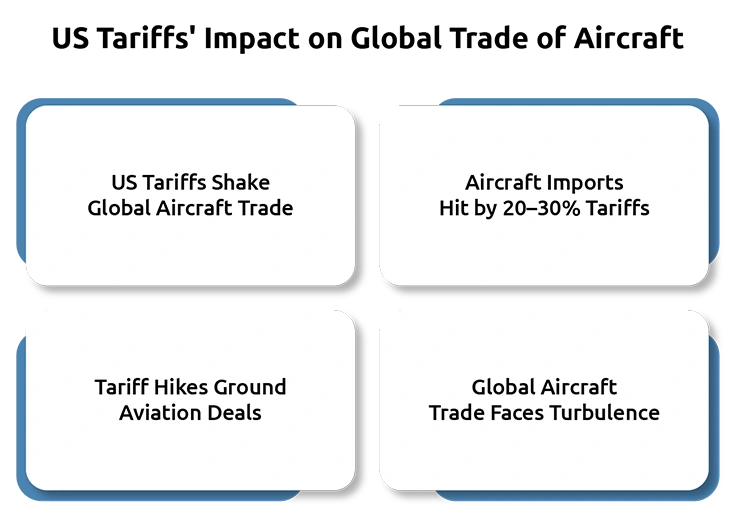
Global Aircraft Manufacturer Supply Chains Under Pressure After New US Tariff Revisions
Modern aircraft production depends on highly combined international freight services and cross-border logistics trade. A single aircraft may include components sourced from more than 30 countries.
Supply Chain Optimization becomes necessary in shipments
Tariff uncertainty has accelerated supply chain optimization initiatives, including:
- Changing suppliers outside tariff-sensitive regions
- Expanding trading hubs in Asia and India
- Increasing dependence on specialized logistics partners
Questions such as can a freight forwarder be an exporter of record or can a customs broker handle both import and export documentation are becoming mainly relevant as organizations simplify approval operations.
Approval and Digital Transformation
Organizations are investing heavily in the best trade compliance software for import export rules to manage tariff categorizations, documentation validation, and risk tracking or management. These tools help avoid penalties while confirming faster customs clearance and regulatory approval.
Global MRO Sector: Adapting to a New US Tariff
The Maintenance, Repair, and Overhaul (MRO) sector is equally affected by the new US tariff. Tariffs applied to replacement parts and engine components increase service costs, directly impacting airlines and leasing companies. According to industry reports, tariff-related surcharges on engine components can add hundreds of thousands of dollars per maintenance cycle, forcing MRO providers to adjust procurement methods and warehouse plans. Logistics providers are responding by restructuring international freight services routes and using bonded warehousing to delay duty payments where possible in the supply chain.

Conclusion
The revised US tariff environment highlights how interconnected the aerospace industry has become in the supply chain. Even partial tariff changes across manufacturing, logistics, and aftermarket services. While recent EU-US agreement discussions restored zero-for-zero tariffs on aircraft and parts, uncertainty surrounding trade policy continues to change long-term investment decisions. European aircraft manufacturers must now balance approval, cost management, and working flexibility. Major use of Incoterms, stronger logistics partnerships, and advanced trade agreement technologies will be necessary to maintain competitiveness in a mostly regulated global aviation market.
DID YOU KNOW?
The recent wave of US import tariffs ranging from 10% to 25% on aerospace goods from countries such as China, the European Union, and Turkey.
FAQs:
1. Why did the United States introduce new tariffs on European aircraft?
The tariffs were introduced as part of broader trade policy adjustments and industrial protection measures connected to ongoing trade with the European Union. These policies aim to balance trade competitiveness but have increased uncertainty in aerospace markets.
2. How do new tariffs affect aircraft purchasing decisions?
Higher import duties increase aircraft acquisition costs. Airlines may delay deliveries, renew contracts, or change expansion strategies to manage financial risks.
3. Why did Delta Air Lines raise issues about aircraft tariffs?
The airline warned that tariff increases could make new aircraft purchases economically challenging, potentially leading to postponed deliveries and revised investment planning.
4. Are aircraft device tariff costs to passengers?
In many cases, airlines attempt to absorb some costs, but long-term tariff pressure may change ticket pricing, maintenance expenses, and operational efficiency.
5. How are carriers responding to tariff-related price increases?
Major carriers are resisting higher aircraft pricing and bilateral agreements with manufacturers, which have contributed to delivery delays and adjustments in management strategies.