
Overview
Global aviation trade is entering a new phase of regulatory scrutiny as the United States improves export controls on advanced aviation components, seeing growing geopolitical tensions. Since 2022, export execution has increased, specifically sensitive aircraft technologies, avionics systems, and dual-use components that could support aviation components trade. Recent enforcement actions by the U.S. Department of Commerce and its Bureau of Industry and Security show that aviation supply chains are now closely tracked through licensing requirements, screening systems, and stronger approval checks. As the global logistics chain becomes more interconnected, exporters, freight forwarders, and customs brokers must be used to developing trade agreement expectations in global trade.
The Fundamentals of US Export Controls for Aviation Components
US export controls mainly work under the Export Administration Regulations (EAR), which govern the shipment of trade and dual-use aviation goods. Aircraft engines, navigation systems, sensors, and electronic flight controls are categorized using an HS code and tracked through the HTS Harmonized Tariff Schedule to determine licensing problems in the supply chain.
How Classification and Approval Work
Exporters must evaluate:
- Product categorizations under ECCN categories
- Destination country risks
- End-user verification globally
- Applicable Incoterms such as DAP or DAPs
Licensing requirements before international freight services start
Accurate documentation during Customs clearance is necessary for trade. Many organizations now depend on the best trade compliance software for import export rules to automate screening and stop violations.
Role of Logistics customers
Modern trade approval extends beyond manufacturers in global trade. Questions like can a freight forwarder be an exporter of record or can a customs broker handle both import and export documentation have become increasingly relevant in the supply chain. Organizations frequently use exporter of record services and Importer of record Service providers to confirm regulatory responsibility while maintaining operational efficiency in shipments.
Why the US is tightening export control regulations on Aviation Components
The stronger controls are largely driven by national security issues and sanctions execution. Russia has attacked Ukraine, and thousands of industrial goods, including aircraft parts, were added to the controlled export lists of goods. In 2025, more than 2,600 goods required export permits for shipments connected to Russia or Belarus, hugely growing mistakes across aviation supply chains. Also, investigations revealed attempts to illegally ship aircraft components through broker companies, with cases involving parts worth over $2 million exported without authorization. At the same time, export restrictions have also chosen competing aerospace programs. The US suspended licenses supplying critical avionics and engine technologies to China’s COMAC C919 aircraft program, aiming to limit major technological delivery.
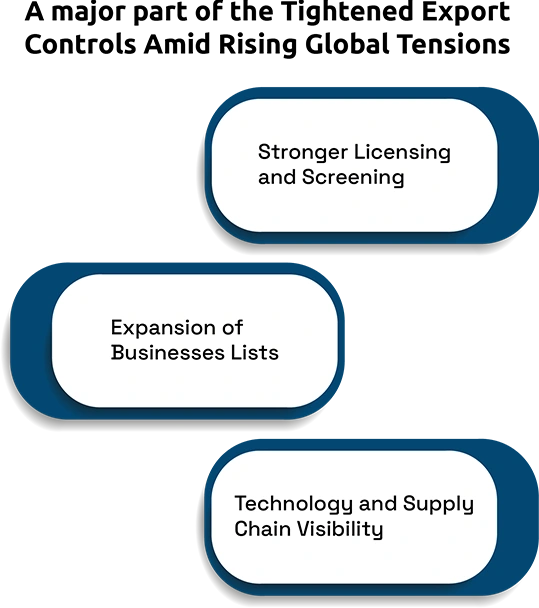
A major part of the Tightened Export Controls Amid Rising Global Tensions
Stronger Licensing and Screening
Authorities now require proper scrutiny of buyers, including supply chain tracing and beneficial ownership checks. Violations increasingly result in rejected orders and penalties.
Expansion of Businesses Lists
Organizations connected to sanctions avoidance networks are quickly added to restricted lists, forcing exporters to adopt proactive approval intelligence systems.
Technology and Supply Chain Visibility
New analytics and Inventory and order management platforms help businesses track sensitive components across borders. These systems support Supply chain optimization, confirming shipments remain complete while reducing delays. Although trade systems such as the generalized system of preferences (GSP) still support economic growth, national security considerations now require more complete trade advantages in sensitive aviation exports.
How Export Controls Are Disrupting Aviation Industries
Export controls are changing global aviation logistics in many ways:
- Airlines in restricted markets struggle to obtain spare parts, affecting active maintenance cycles.
- Manufacturers face a longer clearance schedule and higher approval costs.
- Logistics providers must redesign routing strategies to avoid unauthorized administration.
Global exporters, approval failures can stop complete logistics operations, making coordinated trade documentation and importer/exporter of record service responsibility necessary in the supply chain.
Conclusion
US export controls on advanced aviation components show a broader change toward security-driven trade policy. As geopolitical tensions rise, aviation organizations must seek regulatory approval while maintaining operational efficiency. Businesses involved in global logistics, aviation manufacturing, or aircraft maintenance must invest in strong approval systems, correct categorization systems, and dependable exporter and importer of record solutions. In an era where supply chains are closely scrutinized, proactive trade approval is no longer optional; it is a major necessity for sustainable global aviation trade.
DID YOU KNOW?
According to Marks, 30% of incidents involving aircraft grounding and irregular operations are related to parts and maintenance issues, which cost airlines an estimated $1 million per tail annually.
FAQs:
1. What are US export controls for aviation components?
US export controls regulate the international shipment of aircraft parts, avionics, and dual-use aviation technologies under the Export Administration Regulations (EAR) to protect national security and prevent unauthorized technology transfers.
2. Why has the US tightened export controls on aviation components?
The tightening is mainly driven by geopolitical tensions, sanctions enforcement, and concerns about sensitive aviation technologies being used for military or strategic purposes.
3. How do export controls affect aviation supply chains?
Export controls can delay shipments, increase licensing requirements, raise compliance costs, and force logistics providers to redesign routing and documentation processes.
4. Do freight forwarders or customs brokers play a role in export compliance?
Yes. Freight forwarders and customs brokers often assist with documentation, screening, and regulatory procedures, while exporter and importer of record services help manage legal responsibility.
5. What challenges do aviation manufacturers face under stricter export rules?
Manufacturers may experience longer approval timelines, restricted market access, higher compliance investments, and difficulty sourcing or supplying critical aircraft components.