
Introduction
In today’s era of global trade facilitation, creating resilient supply chains has become necessary for global businesses. As cross-border trade expands under evolving Incoterms, organizations are turning toward a smarter and quicker logistics approach. Air cargo network optimization plays a vital role in confirming goods move effectively across borders, meeting the growing demands of industries such as IT, aviation, automotive, and healthcare. By combining freight forwarding services, Customs clearance support, and Comprehensive import-export support, air freight continues to work as the support of global supply chain stability.
How to Optimize Your Supply Chain with Air Freight?
Improving your supply chain through air freight requires strategic work between freight forwarding companies and customs officials. Businesses should first analyze their HS Codes and HTS harmonized tariff schedules to confirm approval with International export regulations. Partnering with a dependable importer of record service provider helps simplify import processes by managing import export registration, duty payments, and documentation under various delivery terms such as DAP (Delivered at Place) or DDP shipping (Delivered Duty Paid logistics). Using air forwarding for high-value or urgent goods increases efficiency, reduces shipping time, and minimizes disruptions. Export customs brokerage also confirms that your goods are classified correctly under the Generalized System of Preferences (GSP) when applicable, reducing tariffs and promoting cost savings in trade.

What Makes a Resilient Supply Chain with Air Cargo?
A strong supply chain grows on visibility, flexibility, and adaptability. Air cargo provides the speed and dependability required to manage issues in sea or land logistics. Combining White Glove Delivery for sensitive or valuable shipments, such as medical devices or IT parts, further increases supply chain performance. Also, a digital approach, such as live tracking, allows freight forwarding services to anticipate delays and reroute cargo effectively. Contain Delivered Duty Paid logistics confirms that shippers have complete control and clarity over their global deliveries, making global work smoother.
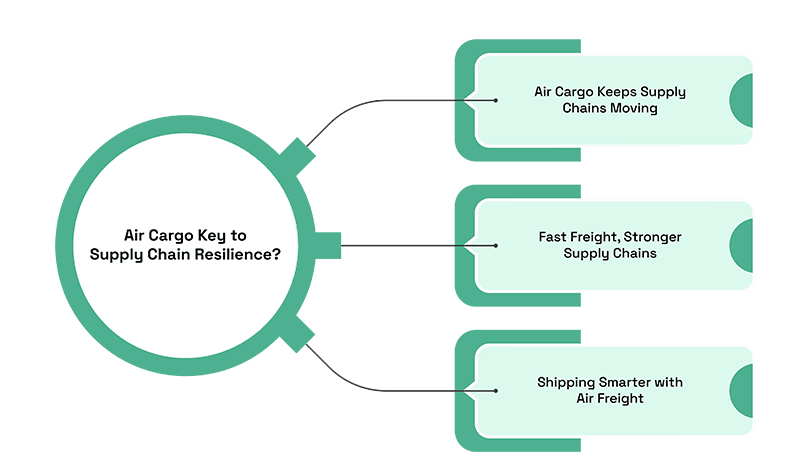
Air Cargo Key to Supply Chain Resilience?
Yes, air cargo remains a major part of global supply chain resilience. Its unmatched speed and connectivity empower businesses to maintain working continuity even in uncertain times. By working with experienced cargo freight forwarders who provide importer of record services and Export customs brokerage, organizations can guide difficult International export regulations without friction. The integration of Global supply chain services with optimized freight forwarding service chains confirms effective inventory management, timely compensation, and minimal downtime across global trades. This is mostly important for industries requiring urgent shipping, such as aviation and medical.
Major Challenges for Air Cargo
While air freight gives flexibility, in 2025 guide shows different problems. Growing shipping costs, sustainability mandates, and evolving Incoterms may change air logistics strategies. Also, approval with Customs clearance support and HTS harmonized tariff classifications will demand closer coordination with import export business partners. As trade networks change, confirming consistency in export register documentation and optimizing DAPs agreements will be crucial. The growing complexity of DDP shipping methods also requires businesses to collaborate with experienced freight forwarding companies capable of managing Global supply chain services from start to finish.
Conclusions
In 2025, Air cargo network optimization will define how organizations build and sustain resilient supply chains. From using freight forwarding services and importer of record services to confirming full approval with International export regulations, air freight remains the preferred mode for speed, precision, and reliability. By combining Delivered Duty Paid logistics, Customs clearance support, and White Glove Delivery into their operations, businesses can increase global reach and working stability. As trade continues to develop under the Generalized System of Preferences and various Incoterms, organizations investing in optimized air cargo networks will remain best positioned for global growth.
DID YOU KNOW?
A leading aerospace manufacturer reported strong financials in Q1’25 but cut its annual guidance mid-year after supply chain issues and tariff-related uncertainty led to a 20% decline in aircraft deliveries in April 2025 compared to the previous month.
FAQs:
Q1: What is air cargo network optimization?
A1: Air cargo network optimization involves designing efficient air freight routes, coordinating with freight forwarders, and integrating customs compliance to confirm fast, dependable, and cost-effective international shipments.
Q2: How does air freight improve supply chain resilience?
A2: Air freight provides speed, flexibility, and visibility, allowing businesses to handle disruptions in land or sea logistics. It confirms timely delivery, supports high-value shipments, and integrates with white glove and DDP logistics.
Q3: What role do HS Codes and HTS harmonized tariffs play in air cargo?
A3: HS Codes and HTS tariffs help classify goods for customs, confirming approval with international trade regulations, reducing tariffs through the Generalized System of Preferences (GSP), and avoiding shipment delays.
Q4: Why is partnering with an importer of record (IOR) service beneficial?
A4: An IOR manages import documentation, duty payments, and regulatory agreements, simplifying cross-border shipments and confirming smooth delivery under terms such as DAP or DDP.
Q5: What are the main challenges for air cargo in 2025?
A5: Key challenges include rising shipping costs, sustainability mandates, evolving Incoterms, customs clearance complexities, and the need for coordination with global supply chain partners for DAP/DDP shipments.