
Overview
Free Trade Agreements (FTAs) are related to simplifying global trade by reducing tariffs and improving market access. On paper, they promise faster cross-border shipment of goods and lower trade costs. Also, in real-world trade work, many businesses experience the opposite effect: an increase in paperwork, approval checks, and official difficulties. This inconsistency is mainly visible in customs clearance processes, inventory and order management, and supply chain optimization efforts, where paperwork requirements grow rather than reduce trade. One Union Solutions is a global trade approval and cross-border trade expertise with hands-on experience supporting businesses across multiple industries, including IT hardware, aviation, industrial equipment, and medical goods in more than 190+ countries.
Why do Free Trade Agreements increase paperwork?
Free Trade Agreements can increase paperwork because businesses must provide detailed documents like certificates of origin, compliance records, and product classifications to qualify for reduced tariffs. These agreements do not automatically apply to all goods. Companies must prove that their products meet specific rules before they can receive benefits.
What Is a Free Trade Agreement (FTA)?
A Free Trade Agreement is an agreement between two or more countries purpose of which is to reduce trade barriers such as import duties and quotas. FTAs mainly provide preferential tariff treatment to eligible goods, provided exporters meet specific origin and approval requirements. While FTAs are intended to simplify global trade, they introduce new stages of regulatory documentation that exporters and importers must manage carefully to qualify for benefits under international shipping terms and trade regulations.

How a Free Trade Agreement (FTA) Works?
Preferential Access Comes with Conditions
To claim FTA benefits, organizations must prove that their goods originate within trade countries. This involves detailed product classification, origin verification, and transaction-level documentation, working with the harmonized tariff Schedule and related approval standards.
Increased Documentation and Verification
Each shipment under an FTA requires additional declarations, supplier certifications, and audit-ready records. For businesses using international freight services or working as an exporter of record service provider, this can mostly increase paperwork and approval risk. Also, inconsistency between countries in interpreting trade rules frequently leads to delays in customs clearance, even when tariffs are reduced.
The Free Trade Agreement Advantage in Supply Chain and Global Trade Management
Benefits for Systematic and Complete Businesses
For organizations with expert systems, FTAs can support long-term supply chain optimization by lowering landed costs and improving cost flexibility. When combined with accurate inventory and order management, FTAs may increase consistency in cross-border trade.
Hidden Administrative Burden
However, these advantages come at the cost of expanded documentation. Importer of record service must maintain detailed records, respond to post-clearance audits, and manage multiple regulatory frameworks across regions. This frequently balances the recognized simplicity of FTAs and the difficult logistics planning and premium delivery service responsibility. In practice, businesses face a trade-off between lower tariffs and higher official effort.
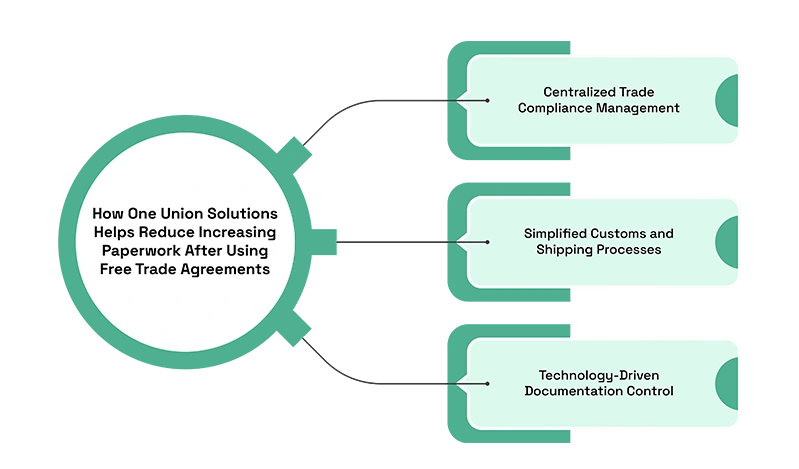
How One Union Solutions Helps Reduce Increasing Paperwork After Using Free Trade Agreements
Centralized Trade Compliance Management
We simplify FTA-related complexity by providing end-to-end importer of record service and exporter of record services. This confirms that documentation, approval issues, and regulatory guidelines are managed centrally, reducing duplication and errors.
Simplified Customs and Shipping Processes
By combining customs clearance processes with global shipping terms, we reduce delays caused by missing or inconsistent paperwork. Their expertise in international freight services helps businesses to have agreements while meeting delivery schedules.
Technology-Driven Documentation Control
Through combined systems for inventory and order management, we allow real-time tracking of shipments, documentation status, and approval checkpoints. This reduces manual intervention and supports flexible supply chain optimization for businesses working across multiple FTA regions.
Conclusion
Free Trade Agreements are necessary tools for expanding global trade, but they do not automatically reduce working difficulties. In many cases, they increase paperwork, approval requirements, and administrative oversight, mainly for businesses without dedicated trade expertise. To truly benefit from FTAs, organizations must use systematic agreement plans and dependable partners. With complete importer of record service, exporter of record services, and expertise in customs clearance and international freight services, One Union Solutions helps businesses unlock FTA benefits while keeping paperwork under control, turning regulatory difficulty into a competitive advantage.
DID YOU KNOW?
The United States has free trade agreements (FTAs) with 20 countries, while the European Union has concluded more than 40 trade agreements, and other major economies have also entered into similar agreements. According to the WTO, 375 regional trade agreements are expected to be in effect by mid-2025.
FAQs:
1. Why do Free Trade Agreements increase paperwork instead of reducing it?
Although FTAs reduce import duties, they require proof of origin, product classification, and regulatory compliance. These requirements add extra documentation, verification, and audit obligations for each shipment.
2. What documents are required to claim FTA benefits?
Common FTA documents include certificates of origin, supplier declarations, HS code classifications, shipment invoices, and country-specific compliance records required during customs clearance.
3. How do FTAs affect customs clearance timelines?
Differences in how countries interpret FTA rules often lead to shipment inspections, approval delays, and post-clearance audits, increasing customs clearance time despite lower tariffs.
4. Who should use importer of record and exporter of record services under FTAs?
Businesses shipping across multiple countries, especially IT hardware, medical devices, aviation parts, and industrial equipment, benefit from IOR and EOR services to manage compliance and reduce risk.
5. How does One Union Solutions help reduce FTA paperwork?
One Union Solutions centralizes trade compliance, manages documentation digitally, supports customs clearance, and provides importer and exporter of record services to minimize errors and administrative workload.


