Insight
Middle East transport conditions stay complex for importers in 2026, with delays affecting major maritime routes, cargo ship schedules ,insurance costs,& port operations. The Strait of Hormuz, Red Sea, Bab el-Mandeb and Suez-linked routes can impact cargo transporting between Asia, Europe, the Gulf & other global markets.
The impact is not same for every shipment. Some cargo keep to move, while others are rerouted, delayed or handled across alternative ports and transport corridors. UN Trade and Development UNCTAD has reported that the delay around the Strait of Hormuz has also increased pressure on shipping, energy and wider trade costs.
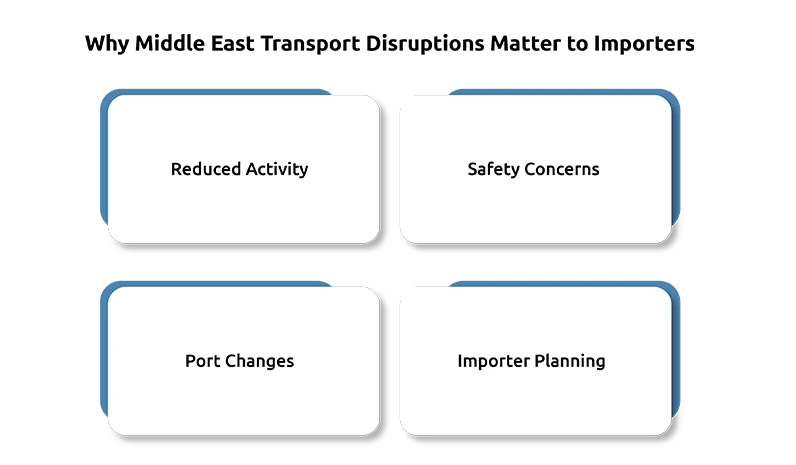
Why Middle East Transport Disruptions Matter to Importers
A Transport delays can affect a cargo flow even when the final destination is outside the Middle East. A shipment shipping from Asia to Europe, for example, may depend on the Suez Canal or Red Sea route. Gulf-bound cargo can face extra risk around the Strait of Hormuz.
Recent transport data has shown greatly reduced cargo activity across the Strait of Hormuz, while carriers & shippers have used alternative routing and operating arrangements. The Global Maritime Companies has also highlighted the safety risks affecting seafarers or shipping activity in the region.
For importers, this can translate into longer transit times, revised sailing schedules, additional freight costs, emergency surcharges, higher insurance costs or changes to the discharge port. A booking that appears straightforward at the quotation stage can therefore require additional planning before cargo is handed to the carrier.
Check the Actual Shipping Route Before Booking
Do not depend only on the destination shown on a freight quotation. Ask the shipping lines or freight forwarder which route the cargo is expected to use and whether the service depend on the Red Sea, Bab el-Mandeb , Suez Canal or Strait of Hormuz.
This matters because carriers can shift routing after a booking has been confirmed. Some services may bypass affected waterways and sail around the Cape of Good Hope, adding distance and voyage time. UNCTAD has documented how Red Sea diversions can increase voyage distances, vessel demand, fuel consumption and operating costs.
For time-sensitive equipment, importers should record the planned route, transshipment points, expected sailing schedule and alternative routing options before approving the shipment.
Review Transit Time and Delivery Commitments
Importers should avoid treating a standard transit time as a fixed delivery date during periods of shipping disruption.
A rerouted ship can require extra sailing days, while port delays or cargo transfer changes can add further delays. Earlier Red Sea delays showed how diversions around Africa affected voyage distances or shipping schedules.
If the cargo is have for a factory installation, data-centre deployment, customer launch or scheduled upkeep activity, developed a practical delivery window around the current operating conditions.
Recheck Incoterms® 2020 and Import Duties
The shipping disruption does not change the meaning of the agreed Incoterms® 2020 rule.
However, the commercial impact of a route change can depend heavily on the selected term. The parties should confirm who is responsible for freight, insurance, import clearance, duties, taxes and delivery costs under the agreed transaction.
For example, a shipment sold under DDP may leave the seller responsible for costs and import arrangements that become more expensive after a diversion. Under other Incoterms® 2020 rules, additional transport or destination costs may fall differently between the seller and buyer.
Importers should therefore review the commercial contract before booking rather than assuming that the carrier’s revised charges automatically belong to one party.
Check Customs and Import Documentation Before Dispatch
A route change does not remove the need for correct customs documentation. If cargo is rerouted to another port or country, the customs process may need extra management.
Before dispatch, confirm the importer, declarant, customs representative, goods recipient, goods classification, customs value, origin & required permits. The commercial invoice, packing list or shipping documents should also match the actual shipment.
For technology equipment, this can be specifically important when shipments contain servers, GPUs, networking equipment, telecom hardware or other controlled products. Export-control, end-use and destination requirements should also be reviewed where applicable.

Prepare an Alternative Routing Plan
A useful backup plan plan should identify what happens if the original cargo , port or route becomes unavailable.
Relies on the shipment, alternatives may include another vessel service, a different transshipment hub, another discharge port, an overland connection or air freight for critical components. These options have different costs, capacity and customs implications.
For high-value technology or medical equipment, importers may also divide a deployment into shipment waves. Critical components can move separately while less time-sensitive equipment follows the standard route.
The objective is not to create multiple logistics plans for every possible event. It is to know which alternative can be activated if the original booking changes.
Conclusion
Middle East shipping disruptions require importers to look beyond the freight rate and estimated sailing time. The route, cargo, port, insurance, customs process and commercial responsibilities can all change the final cost and delivery outcome.
A shipment-based pre-booking review helps companies identify these factors before cargo moves. For valuable technology, telecom, data-centre, automotive or medical equipment, this is especially essential because a delay or route change can affect setup schedules, customs planning & customer promises.
Did You Know?
Ship transits through the Strait of Hormuz fell by about 95% during the 2026 disruption, according to UN Trade and Development (UNCTAD). The decline increased pressure on shipping, energy and wider trade costs.
Frequently Asked Questions
How are Middle East shipping delays affecting importers?
They can affect cargo routing, transit times, freight costs, insurance, port operations & delivery schedules. The effect rely on the cargo, route, carrier or origin rather than using equally to every shipment.
Should importers prevent the Red Sea or Strait of Hormuz?
There is no single transport planning decision that applies to every shipment. Importers should review the carrier’s current routing, security conditions, expected transit time, cost and available alternatives before booking cargo.
Can a shipping disruption affect customs clearance?
Yes. A change in discharge port, transit country or transport arrangement can require additional coordination. Importers should confirm that customs documents, importer details, declarations and destination requirements remain correct after any route change.
Who pays additional costs when a vessel is diverted?
The answer depends on the freight contract, Incoterms® 2020 rule, carrier terms and the reason for the additional charge. Importers should establish responsibility for diversion, storage, handling and additional transport costs before booking.
What should importers check before booking cargo?
At minimum, check the planned route, vessel schedule, destination port, transit time, freight and insurance costs, customs requirements, product restrictions and an alternative routing or transport option. Recheck these details if the carrier issues a routing or schedule change.