Overview
Many importers support that once customs duty is paid, goods will be released without further issues. Also, in real-world international shipping terms, duty payment is only one part of the customs clearance process. Customs officials have the legal right to inspect, delay, or even reject cargo if regulatory, documentation, or approval requirements are not met. From incorrect HS code declarations to unresolved customs clearance delays, many unwanted risks can delay inventory and order management, cause financial losses, and delay premium delivery service responsibilities. Knowing why customs can reject goods even after duty is paid is necessary for importers looking for expected and complete cross-border trade.
Major Reasons Why Goods May Be Rejected After Duty Payment
Even after completing the duty payment, customs may refuse cargo entry due to agreement gaps. These rejections are mainly related to regulatory violations rather than tax issues. Below are the most common reasons importers see rejection despite paying customs duty.
Misclassification of HS Code Can Reject Goods After Duty Is Paid
One of the most frequent issues of rejection is incorrect categorizations under the HS code or the HTS Harmonized Tariff Schedule. If customs officials show that the declared HS code does not match the actual product specifications, they may reevaluate the shipment.
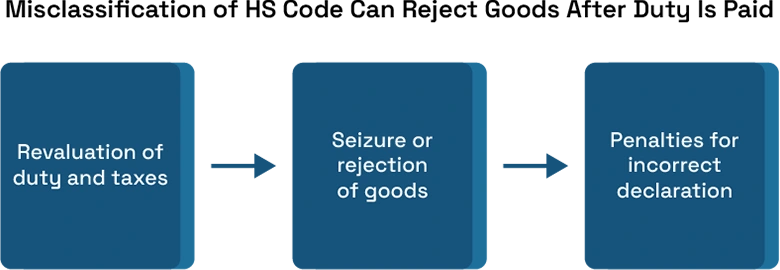
Misclassification can trigger:
- Revaluation of duty and taxes
- Seizure or rejection of goods
- Penalties for incorrect declaration
Even if duty has already been paid, customs can reject goods if they believe the categorization was inaccurate or misleading about the goods. This risk is especially high for high-value electronics, machinery, or regulated products moved through international freight services.
Regulatory and Documentation Non-Compliance
Customs clearance depends massively on correct documentation. Missing licenses, expired certificates, or various invoices can result in cargo rejection. Common issues include:
- Product standards non-compliance
- Missing import permits
- Incorrect importer of record service details
Customs authorities prioritize agreement over speed, regardless of duty status. This is why exporters and importers must work with documentation, international shipping terms, and country regulations.
Customs Clearance Delays May Lead to Rejected Goods
Extended customs clearance delays can also lead to rejection, particularly for time-sensitive or regulated goods. If shipments remain under customs hold for too long, authorities may:
- Order re-export
- Impose storage penalties
- Reject perishable or sensitive cargo
Delays frequently arise from inspection backlogs, risk profiling, or discrepancies identified during cargo examination. Without strong work between logistics partners and customs officials, these delays can affect supply chain optimization goals.
Valuation Discrepancies and Under-Declaration
If customs suspects under-valuation, they can reject goods even after duty is paid. Payment based on a declared value does not guarantee acceptance if officers later find inconsistencies with market pricing or related-party transactions.
This is regular when Incoterms such as DAP are misunderstood or incorrectly used during shipment, leading to uncertainty over freight, insurance, or delivery cost responsibilities.
How does One Union Solutions Help You with This Issue?
Guiding customs rejection risks requires more than basic logistics support. One Union Solutions provides end-to-end importer of record service and exporter of record services, confirming shipments follow local customs regulations from origin to destination.
By combining approval expertise with international freight services, we help businesses:
- Avoid HS code and valuation errors
- Reduce customs clearance delays
- Maintain compliant inventory and order management
- Improve predictability in premium delivery service responsibilities
Their structured approach to supply chain optimization minimizes the risk of cargo rejection while supporting smooth global trade work.
Conclusion
Paying customs duty does not confirm cargo release. Goods can still be rejected due to misclassification, documentation issues, valuation issues, or customs clearance delays. These issues highlight the importance of approval planning across international shipping terms. Working with experienced partners that provide Importer of Record services and Exporter of Record services, businesses can reduce rejection risks, protect shipment schedules, and have dependable global trade operations. In today’s difficult customs environment, proactive agreement is not optional; it is a competitive advantage.
DID YOU KNOW?
Accordingly, the service tax demand of ₹80.23 lakh, including interest and penalties under sections 76 and 78, was cancelled. However, the penalty imposed under section 77 for failing to register and file the ST-3 return was upheld.
FAQs:
Can customs reject goods even after customs duty is paid?
Yes. Customs duty payment only covers taxes. Authorities can still reject goods due to incorrect HS codes, missing documents, regulatory violations, or valuation discrepancies.
What is the most common reason goods are rejected after duty payment?
HS code misclassification is one of the most common reasons. If the declared HS code does not match the actual product, customs may reassess or reject the shipment.
Do customs clearance delays lead to shipment rejection?
Yes. Extended customs clearance delays, especially for regulated or perishable goods, can result in re-export orders, penalties, or outright rejection.
How does incorrect valuation affect customs clearance?
If customs suspects under-declaration or incorrect valuation, they may reject goods even after duty is paid, especially when pricing does not match market standards.
How can importers prevent customs rejection after duty payment?
Importers can reduce risk by ensuring accurate HS classification, complete documentation, correct valuation, and by using professional importer of record and exporter of record services.