Overview
Global airlines are facing rising technical servicing costs as export control, trade tensions, & supply chain delay affect the availability of aircraft components. According to the International Air Transport Association (IATA), parts shortages & supply chain challenges could add more than $11 billion in extra costs to airlines in 2025. As the aviation industry adapts to these changes, airlines and maintenance providers must strengthen supply chain planning, regulatory compliance, & sourcing planning to reduce operational and financial risks.
Why Are Airlines Rethinking Their Maintenance Strategies?
Airlines are changing their maintenance strategies as global trade delay makes it harder to source critical aircraft components on time. Export controls, longer supplier lead times, and changing trade policies are increasing repair costs & reducing maintenance flexibility. To maintain working reliability, many airlines are expanding supplier networks, improving stock planning, & investing in more resilient maintenance and procurement processes.
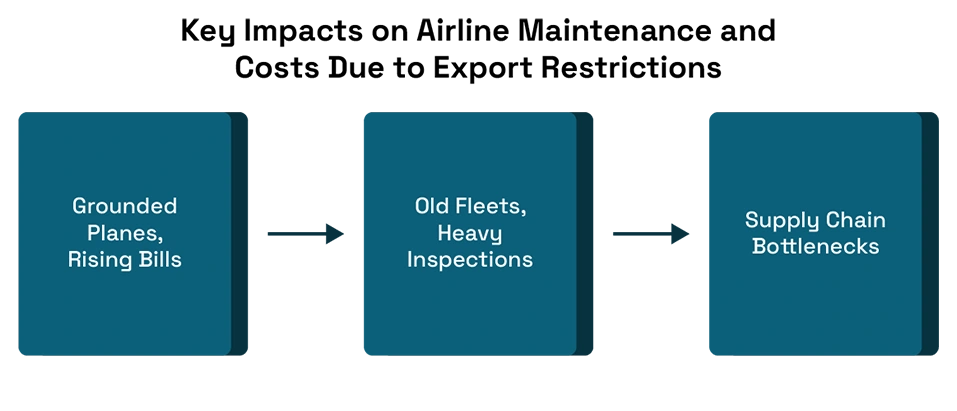
Key Impacts on Airline Maintenance and Costs Due to Export Restrictions
Growing Spare-Parts Costs and Delays
Export restrictions have slowed cross-border shipments of aviation components, extending repair timelines. Limited availability of engines and critical parts of aircraft remains grounded longer, forcing airlines to take on contract replacement equipment at higher prices. IATA shows that extra maintenance costs could reach $3.1 billion globally, largely driven by old parts and delayed aircraft deliveries.
Old Fleets Increase Maintenance Frequency
Because new aircraft deliveries are delayed due to trade unpredictability, airlines are keeping older planes in service. Older aircraft require heavier inspections, more component replacements, and increased engineering labor, all of which increase working costs. Maintenance costs are continuing to grow through 2026 as spare-part availability remains inconsistent and production problems continue in the supply chain.
Approval and Trade Documentation Pressure
Export rules also increase administrative load. Airlines and aviation suppliers must guide customs clearance procedures, HS code categorizations, and trade approval systems while working in international freight services and importer of record service requirements. These additional approval steps slow maintenance cost changes, times, and add indirect working costs.
Global Airlines Brace for Tariff Uncertainty on Maintenance Costs
Trade Barriers Challenge Global Airlines Maintenance Costs
Tariffs on metals, electronics, and aviation technology connected to geopolitical problems are increasing maintenance expenses. Even small tariff adjustments can mostly affect airlines because aircraft components are sourced globally through difficult supply chains. Trade barriers also increase dependance on alternative suppliers, frequently located farther away, growing logistics fees, and difficult supply chain optimization plans. Airlines must now change sourcing while confirming regulatory agreement across multiple administrations.
Increased Dependence on Aftermarket Providers
Restricted access to original equipment manufacturers has sent airlines toward third-party maintenance providers globally. While this improves sourcing flexibility, it frequently results in higher costs due to limited certified repair capacity globally. Industry experts note that opening services for a main product could ease pricing pressure, but export regulations continue to limit access to some technologies and repair approvals.

Global Airlines Cut 2025 Profit Forecast Over Trade Tensions and Export Restrictions
Rising maintenance expenses are already affecting airline profitability estimation. IATA projects that although airline revenues remain strong, operating costs, mainly maintenance, are increasing faster than expected, improving across the industry. In recent outlook reports, maintenance expenses have been identified as a major factor behind reduced profitability expectations, alongside workforce shortages and ownership costs. Labor now represents about 28% of airline working costs, while maintenance spending continues growing due to supply problems and old aircraft. Some airlines have begun revising fleet expansion timelines and delaying route growth to control costs. Others are investing in inventory and order management systems to stock spare parts, even though this increases short-term capital costs.
Conclusion
Export restrictions and trade tensions are changing the economics of global aviation maintenance. Limited access to aircraft parts, growing tariffs, and regulatory difficulty are forcing airlines to rethink procurement, approval, and working plans. While passenger demand remains strong, airlines must balance growth objectives with growing maintenance costs and uncertain trade guidelines. Improving customs agreement processes, improving logistics processes, and using advanced trade compliance software will become necessary for managing future risks. Also, the airlines that successfully use their supply chains, change maintenance costs, and improve international freight service will be better prepared for ongoing geopolitical changes and protect long-term trade.
DID YOU KNOW?
In May 2025, the U.S. imposed 10%–25% tariffs on certain aerospace imports from countries including China, the EU, and Turkey. These measures increased costs for aviation manufacturers, MRO providers, and airlines, prompting many companies to reassess their global supply chain strategies.
FAQs:
1. Why are airline maintenance costs increasing globally?
Airline maintenance costs are rising due to export restrictions, spare-parts shortages, higher tariffs on aviation components, and delays in aircraft deliveries that force airlines to operate older fleets longer.
2. How do export restrictions affect aircraft maintenance?
Export restrictions slow cross-border shipments of engines, avionics, and aircraft components, causing repair delays, grounding aircraft longer, and increasing working costs.
3. Why are airlines using older aircraft instead of new ones?
Trade tensions and supply chain disruptions have delayed new aircraft deliveries, pushing airlines to extend the life of existing aircraft, which require more frequent inspections and repairs.
4. How do tariffs impact airline operating costs?
Tariffs increase the price of imported aviation parts, metals, and electronics, growing maintenance expenses, forcing airlines to adjust sourcing and logistics strategies.
5. What strategies are airlines using to manage maintenance cost increases?
Airlines are various suppliers, investing in spare parts inventory, improving trade approval processes, and partnering with aftermarket maintenance providers to reduce disruptions.