Overview
In the aviation industry, maintenance of aircraft parts can give huge economic losses and working issues. When an aircraft is grounded due to a technical issue, the urgency to deliver change parts becomes important in global trade. Organizations required of special air freight handling play an important role in global trade. Also, regular cargo and aircraft parts demand accuracy and strong approval with safety guidelines. Shipping of fragile avionics devices and large systematic parts, each shipment requires a customized logistics approach to confirm safe and on-time shipments of parts.
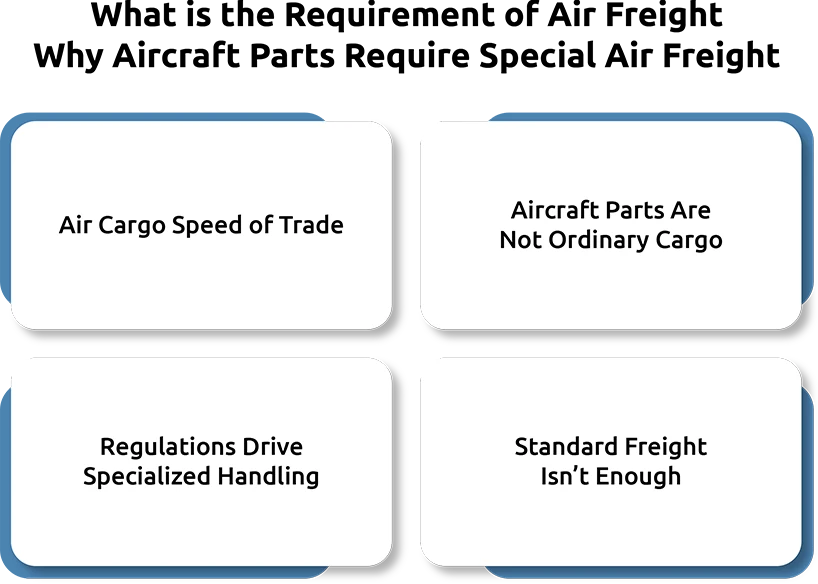
What is the Requirement of Air Freight? Why Aircraft Parts Require Special Air Freight
What is Air Cargo?
Air freight refers to the logistics of goods through aircraft, providing the fastest method of global shipping. It is hugely used for high-value, time-sensitive, and perishable goods. In aviation, air freight becomes even more important as it directly supports working continuity in global trade.
Why Aircraft Parts Require Specialized Air Freight
Aircraft parts are not ordinary cargo for organizations. They are highly engineered components that must meet strong regulatory and safety standards. Even small damage or delays can affect flight safety or lead to extended aircraft maintenance.
Major Reasons for Specialization
Time Sensitivity: Aircraft on Ground (AOG) service situations require on-time delivery of parts to start work.
- High Value: Many aircraft components are cost-effective, making secure handling of shipments necessary.
- Fragility and Correction: Sensitive equipment, such as avionics and sensors, requires complete packaging and management of shipments.
- Regulatory Approval: Strong aviation and international shipping regulations must be followed in shipments.
Because of these factors, standard freight approaches are frequently insufficient, making special air freight management a necessity for shipments.
Aircraft Maintenance Parts: The Importance of Air Freight
Air cargo confirms that downtime expert teams are shipping important parts quickly, reducing the downtime of airlines. If it’s maintenance or urgent repairs, speed and dependability are necessary in logistics.
Types of Aircraft Parts Shipped
- Engine components
- Landing gear systems
- Avionics and electronic systems
- Aircraft parts such as wings and the main body sections
Efficiency and Dependability
Air freight provides extraordinary speed compared to sea or land logistics. This efficiency is specifically important in the global aviation chain, where parts may be required to be shipped across borders within hours with air freight. In the broader context of logistics, businesses depend on advanced planning and work to confirm the smooth shipment of goods. This includes elements such as supply chain optimization, inventory and order management, and international freight services, which collectively help simplify aircraft parts delivery without unnecessary delays in logistics.
Ensuring Safe and Efficient Aircraft Spares Shipments with Air Freight Handling
Specialized Packaging and Handling of Cargo
Aircraft parts frequently require a custom packaging approach to protect them from damage during logistics. For example:
- A Shock-absorb packaging for fragile devices is required in shipments
- Climate-controlled shipments for temperature-sensitive parts
- Anti-static goods for electronic equipment
Regulatory Compliance and Documentation
Shipping aircraft parts globally involves following various regulations and documentation requirements. Proper categorization using systems such as HS code and the HTS harmonized tariff schedule confirms smooth customs processing. Also, approval of Incoterms helps define responsibilities between buyers and sellers during logistics. Shipment services such as exporter of record services and importer of record services play an important role in confirming approval with international trade terms. Also, organizations are looking for whether a freight forwarder can be an exporter of record or if a customs broker can handle both import and export documentation to simplify work in countries.
Advanced Tracking and Working
New air freight handling incorporates real-time tracking systems, allowing customers to track shipments throughout the logistics. This clarity confirms better work and faster response in case of supply. Also, organizations are mostly accepting the best trade compliance software for import export rules to automate processes, reduce issues, and maintain regulatory approval.
Risk Management of shipments
Given the high value and critical nature of aircraft parts, risk management is a top priority. This includes:
- Insurance coverage for high-value shipments
- Secure handling procedures
- Contingency planning for delays or disruptions

Conclusion
Aircraft parts require special air freight management due to their important role in confirming aviation safety and working efficiency. With strong regulatory approval for advanced packaging and fast delivery, every part of the process is used to reduce risks and delays. As the aviation industry continues to grow, the demand for effective and dependable air freight solutions will only increase in global trade. By combining strong logistics plans, using international freight services, and confirming the correct customs clearance process, businesses can maintain smooth shipments even in time-critical situations in countries.
DID YOU KNOW?
The company has processed transactions exceeding US$6 billion, including US$1.3 billion in 2025 alone.
FAQs:
1. Why do aircraft parts require specialized air freight handling?
Aircraft parts require specialized air freight handling because they are high-value, sensitive, and regulated components. They need secure packaging, fast delivery, and strict compliance with aviation and international trade regulations.
2. What is AOG in aviation logistics?
AOG (Aircraft on Ground) refers to a situation where an aircraft cannot operate due to technical issues. In such cases, time-critical air freight is used to deliver replacement parts quickly to minimize downtime.
3. What types of aircraft parts are shipped via air freight?
Common aircraft parts shipped via air freight include engine components, landing gear systems, avionics, sensors, and large structural parts like wings and fuselage sections.
4. How are fragile aircraft components protected during shipping?
Fragile aircraft components are protected using specialized packaging such as shock-absorbing materials, anti-static coverings, and climate-controlled containers to prevent damage during transit.
5. What documents are required for shipping aircraft parts internationally?
Shipping aircraft parts requires documents like commercial invoices, airway bills, HS codes, and compliance with Incoterms. Exporter of Record (EOR) and Importer of Record (IOR) services are also often required for customs clearance.