
Introduction
In recent years, the global trade service has changed, driven largely by geopolitical tensions, changing alliances, regional issues, and developing economic guidelines. These international trade changes are how countries and corporations plan trade routes, source goods, select suppliers, and have competitiveness. How Geopolitical change is impacting Global Export and Import plans is now a core issue for global trade supply chains, mainly in highly regulated and developing industries such as IT, aviation, medical devices, and automotive manufacturing.
Geopolitical variability is pushing organizations to long-term trade requirements, varying their global presence, and using new plans to protect organizational continuity while confirming affordability.
Key Impacts of Geopolitical Change on Export and Import
Geopolitical developments are growing trade plans in multiple ways. For many companies, mainly those working globally, conventional trade entry assumptions can no longer be taken for granted. Governments are increasingly using trade guidelines as major tools, resulting in new regulatory requirements, changing supplier dependability, and market entry conditions. These changes have huge effects on industries involved in the global production chain. In IT and semiconductor manufacturing, recent geopolitical pressures are changing access to critical technologies and components. The medical sector is experiencing growing demand for compliant and traceable supply routes to confirm continuity in sensitive healthcare deliveries during problems. Automotive and aviation companies are modifying sourcing plans to avoid dependence on single regions and build redundancy across their supply chain.
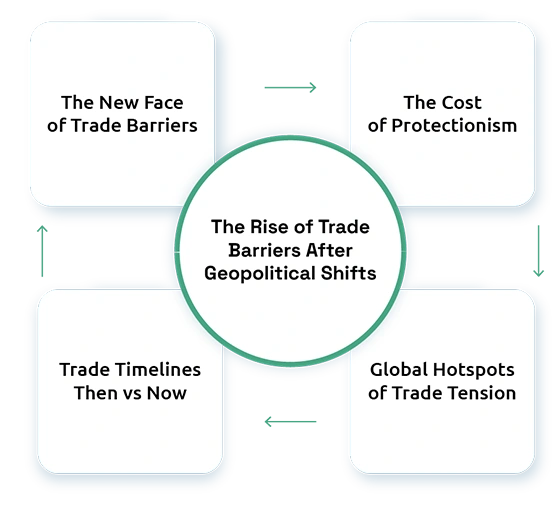
The Rise of Trade Barriers After Geopolitical Shifts
Trade barriers have seen a clear increase over the past decade. While globalization brought decades of declining tariffs and trade liberalization, the current environment has changed toward protectionism, sanctions, investment controls, and competitive local guidelines. These issues are creating higher working costs, more approval requirements, and the requirement for a longer trade planning schedule. Organizations exporting and importing high-value or sensitive goods, such as IT system parts, avionics systems, medical technology, and connected automotive platforms, face greater analysis and approval processes.

Technological and Policy Adaptations in Export and Import
As geopolitical pressures change global trade, organizations are using new approaches to improve dependability, regulatory agreements, and working efficiency. Digital tools are now necessary to support trade planning, guidelines interpretation, and live visibility across the supply chain. Businesses are also incorporating predictive analytics and automation to expect disruptions such as sanctions updates, local manufacturing shutdowns, or changing export-control guidelines. Organizations are investing more heavily in risk management plans, such as supplier diversification, enhanced supply monitoring systems, and a systematic trade governance system. Manufacturers in industries such as medical and aviation are also supporting quality assurance through digital recordkeeping and product traceability to maintain uninterrupted cross-border shipments even under difficult regulatory environments.
Supply Chain Restructuring and Nearshore Trends
One of the biggest results of global trade change is supply chain restructuring. Organizations are increasingly reducing single-country dependencies and moving toward nearshoring, starting production and warehousing systems closer to their main markets or within politically well-worked trade blocs. For IT hardware, automotive electronics, and medical equipment, this trend not only reduces geopolitical exposure but also improves lead times, reduces logistics costs, and strengthens working predictability. Aviation manufacturers are also developing multi-country supplier portfolios to avoid risks related to intense sourcing. This reset is creating new manufacturing hubs while reducing dependence on conventional global hubs, showing a permanent change in how global trade works.
Conclusion
Geopolitical changes are growing the global trade environment and transforming how organizations approach imports and exports. From growing trade barriers to digital uses and nearshoring strategies, organizations must now work within a more difficult, uncertain, and strategically sensitive ecosystem. For businesses in the IT, aviation, medical, and automotive sectors, staying competitive requires proactive planning, various sourcing methods, and the use of technology systems to manage uncertainty. The organizations that hold flexibility, risk management, and long-term trade will be best positioned to succeed in a quickly changing global trade service.
DID YOU KNOW?
Trade growth would increase the current global trade value by about 35 percent to $45 trillion.
FAQs:
- How are geopolitical changes affecting global export and import planning?
Geopolitical instability is pushing companies to rethink sourcing, supplier reliability, market entry rules, and regulatory compliance, making trade planning more strategic and risk-sensitive.
- Which industries are most affected by geopolitical trade shifts?
IT, medical devices, aviation, and automotive sectors are among the most affected due to strict compliance requirements, sensitive technologies, and dependence on cross-border supply chains.
- Why are trade barriers increasing in recent years?
Many governments are adopting protectionist measures such as tariffs, sanctions, and investment controls to secure national interests and reduce reliance on international competitors.
- How are companies using technology to manage geopolitical risks?
Businesses are implementing digital platforms, real-time supply chain tracking, predictive analytics, and automated compliance systems to anticipate disruptions and maintain regulatory alignment.
- What is nearshoring, and why is it becoming popular?
Nearshoring involves shifting manufacturing or warehousing closer to primary markets. It reduces geopolitical exposure, shortens lead times, enhances predictability, and lowers operational risks.