
Overview
When an aircraft becomes grounded due to technical issues, mainly referred to as Aircraft on Ground (AOG), airlines face sudden economic losses, operational disruptions, and trust risks for organizations. This is where time-critical logistics for AOG shipments play an important role in global trade. The requirement for logistics aircraft parts across the global chain within tight deadlines has led to the evolution of a highly specialized logistics approach that prioritizes fast, accurate, and approval. AOG logistics requires smooth work between airlines, suppliers, freight forwarders, and customs authorities. From shipping parts to confirming quick Customs clearance, every step must be improved for efficiency.
The Importance Of Aircraft on Ground Time-Critical Logistics In Aviation
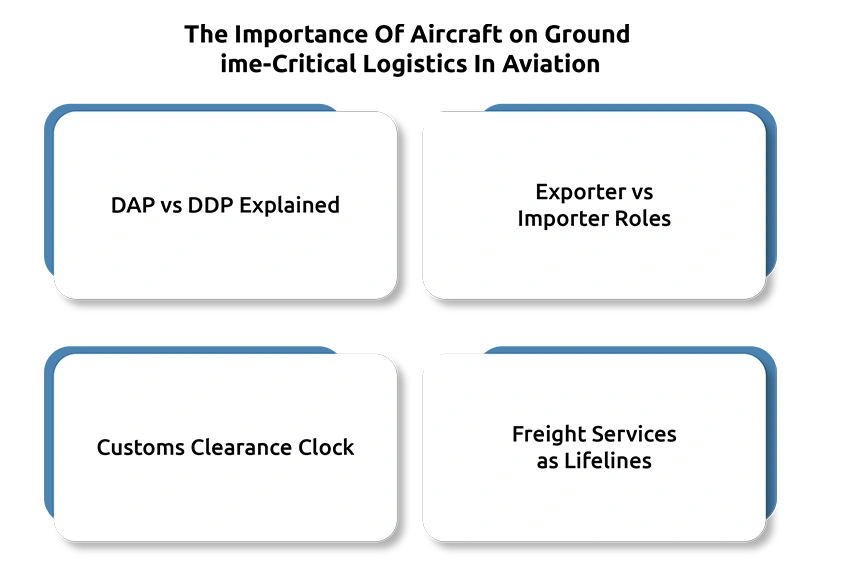
Aircraft maintenance can cost airlines thousands of dollars per hour, making AOG logistics one of the most important parts of the aviation trades. Time-critical logistics of aviation confirm that necessary aircraft parts are delivered as quickly as possible, reducing maintenance and restoring shipments. The difficulty of global aviation logistics means that shipments frequently cross various international borders. This is where Incoterms such as DAP and DDP Shipping become related to trade, defining responsibilities between buyers and sellers during logistics.
Importance of Documentation and Approval
Also, correct paperwork, such as HS code and HTS harmonized tariff Schedule categorizations, is necessary for faster Customs clearance. Even minor errors can lead to shipment delays, which can mostly affect AOG situations. Another important part is the role of International freight services and the exporter of record services. Also, the Importer of record Service helps manage import agreements, taxes, and duties effectively, confirming that parts reach their destination without unnecessary hold-ups at airports.
The Growth in Aircraft on Ground (AOG) Service and Its Impact on Aviation Logistics
In recent years, the number of AOG crises has increased due to many aspects, such as aging aircraft fleets, supply chain disruptions, and difficulties in global trade. The introduction of trade guidelines such as the Generalized System of Preferences (GSP) has changed how aircraft parts are traded globally. While such systems can reduce tariffs, they also require strict agreement, adding another layer of difficulty to AOG logistics.
Advancements in Supply Chain Optimization
Also, the growing demand for faster delivery has led organizations to invest in advanced Supply chain optimization plans. Real-time tracking, predictive analytics, and digital sources are now being used to simplify shipments and reduce response times.
Regulatory Questions in AOG Logistics
A common question in this industry is: Can a freight forwarder be an exporter of record? The answer depends on regulatory systems in specific countries. Also, many logistics providers now give combined solutions where they manage both logistics and agreement responsibilities, reducing dependency on multiple customers. Also, organizations frequently ask whether a customs broker can handle both import and export documentation. In many cases, customs brokers can manage both processes, confirming consistency and reducing the chances of errors in approval processes.
AOG Logistics: Time Critical Strategies for Working Efficiency
To manage AOG shipments effectively, organizations must accept a combination of major planning and advanced technology. One of the major plans is effective Inventory and order management. Maintaining a well-organized inventory system allows airlines and MRO providers to quickly check and dispatch required parts. Also, an important part is using the best trade compliance software for import export rules. These tools help automate the documentation process, confirm regulatory approval for shipments, and reduce the risk of delays. Strong responsibilities of logistics providers give end-to-end logistics solutions that are also necessary for global trade. These providers work with logistics, documentation, and Customs clearance, confirming smooth shipments of goods across borders.

Conclusion
Time-critical logistics for Aircraft on Ground (AOG) shipments are at the center of modern aviation trade. As the industry continues to grow and develop, the demand for faster service and more dependable logistics solutions will only increase in shipments. Understanding Incoterms and managing HS code categorizations to using advanced Supply chain optimization techniques, every element plays a role in confirming efficiency. The combination of services, such as exporter of record services, importer of record services, and International freight services, further increases the ability to respond to urgent situations. Also, success in AOG logistics depends on speed, accuracy, and coordination.
DID YOU KNOW?
According to ‘The Business Research Company’s’ ‘Aerospace Logistics Services Global Market Report 2025’, the global value of this sector stands at US$ 14.7 billion and is expected to grow to reach US$ 19.9 billion by 2029.
FAQs:
1. What is Aircraft on Ground (AOG) in aviation?
Aircraft on Ground (AOG) refers to a situation where an aircraft is unable to operate due to technical issues, requiring immediate repair and urgent delivery of spare parts to minimize downtime.
2. Why is time-critical logistics important for AOG shipments?
Time-critical logistics ensures the rapid transportation of aircraft parts, reducing operational delays, financial losses, and maintaining airline schedules and customer trust.
3. What are the key challenges in AOG logistics?
Major challenges include tight delivery deadlines, complex customs clearance, documentation errors (HS codes, HTS), and coordination between multiple global stakeholders.
4. Can a freight forwarder act as an exporter of record?
Yes, in some countries, a freight forwarder can act as an exporter of record, depending on local regulations and compliance requirements.
5. How do Incoterms impact AOG shipments?
Incoterms like DAP and DDP define responsibilities for shipping, customs clearance, duties, and risk transfer between buyers and sellers, ensuring smooth international logistics operations.