Overview
The aviation industry works within a highly connected global ecosystem where aircraft parts and aviation technologies are shipped across various countries. Also, increasing trade barriers in the aviation industry due to geopolitical tensions, national security issues, and secure guidelines are changing these services. These restrictions affect aircraft manufacturing, maintenance, repair, and overhaul (MRO) service. As a result, airlines are getting huge costs, working inefficiencies, and delays that grow across the global air travel chain. Also, factors such as logistics difficulty, customs clearance requirements, and approval with international trade regulations have become necessary for airlines and aviation suppliers. Managing these challenges requires supply chain optimization and effective inventory and order management systems.
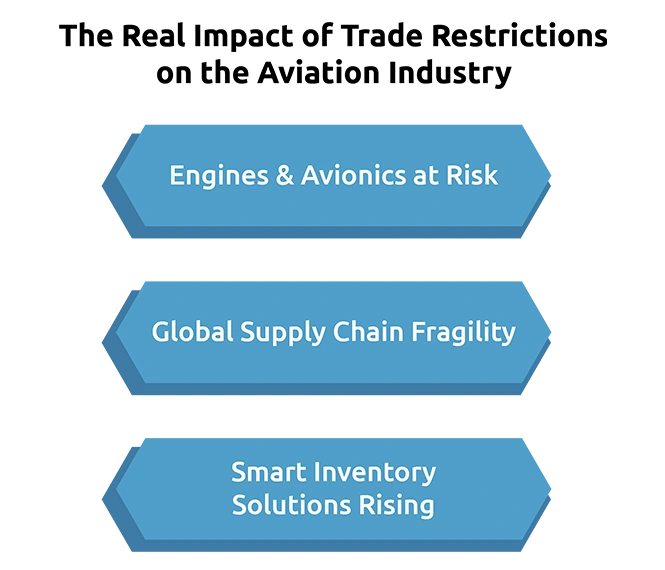
The Real Impact of Trade Restrictions on the Aviation Industry
Trade restrictions on aviation technology directly impact the availability of critical aircraft components such as engines, avionics, and semiconductors. Many of these parts are manufactured with a minimum number of suppliers, making the industry highly vulnerable to disruptions.
Export controls and licensing requirements can delay shipments, mainly when the exporter of record and importer of record service responsibilities are not clearly defined during global trade. This creates problems in international freight services, increasing shipping times for aircraft maintenance.
Also, airlines frequently depend on just-in-time inventory plans to reduce costs. Also, with growing trade barriers, maintaining minimum stock levels has become difficult in logistics. Organizations are now investing in advanced inventory and order management solutions to confirm continuity of shipments.
Aviation organizations must guide difficult systems such as HS code categorizations and HTS harmonized tariff schedule requirements, which can change across countries. Failure to follow can give shipment delays, penalties, or even seizure of goods.
Global Trade Tariffs: Implications for the Aviation Industry
Tariffs imposed on aviation components mainly increase buying costs for airlines and MRO providers. These additional costs are frequently passed on to passengers through higher shipping prices, indirectly affecting the demand of the aviation parts supply chain.
Trade terms defined under Incoterms, such as DAP and DAPs, play an important role in determining cost responsibilities between buyers and sellers. Misinterpretation of these terms can lead to unexpected fees related to duties, taxes, and customs clearance.
In many cases, an organization depends on freight forwarders and customs brokers to manage trade compliance. However, questions such as whether a freight forwarder can be an exporter of record or whether a customs broker can handle both import and export documentation show the difficulty of global trade logistics.
To solve these challenges, aviation organizations are mostly accepting the best trade compliance software for import export rules. These tools help automate documentation, confirm regulatory agreement, and reduce the risk of costly errors in categorizations of goods.

Trade Restrictions and Plane Delays Challenge Global Airlines
One of the most visible effects of trade restrictions is the increase in aircraft delivery delays and extended maintenance cycles. When critical parts are held up due to export controls or customs clearance issues, aircraft remain grounded longer than expected in logistics.
This has an issue effect on airline operations, leading to flight cancellations, schedule disruptions, and reduced fleet availability. For airlines working on shipment schedules, even small delays can give huge financial losses.
Supply chain disruptions also strengthen airlines to depend on alternative suppliers of logistics, which may not always meet the same quality or certification standards. This increases working risks and makes approval with aviation safety regulations difficult in the supply chain.
To counter these challenges, airlines are focusing on supply chain optimization plans such as changing suppliers, creating regional supply hubs, and improving their work with logistics partners. Effective collaboration with the exporter of record services and importer of record service providers is necessary to simplify cross-border shipments.
Conclusion
Trade restrictions on aviation technology are changing the global aviation industry, creating challenges that extend far beyond the manufacturing of parts. From increased costs and regulatory difficulties to supply chain disruptions and working delays, airlines must guide a quickly developing trade environment of goods. To remain competitive, aviation organizations are required to invest in strong logistics plans, advanced approval tools, and resilient supply chain systems.
DID YOU KNOW?
IATA has stated that the number of deliveries scheduled for 2025 is 26 percent lower than the commitments made a year earlier.
FAQs:
1. What are trade restrictions in the aviation industry?
Trade restrictions in the aviation industry refer to export controls, tariffs, licensing requirements, and regulatory barriers that limit the movement of aircraft parts, aviation technology, and related services across borders.
2. How do trade restrictions affect airlines?
Trade restrictions increase costs, delay aircraft maintenance, and disrupt supply chains. This can lead to flight delays, higher ticket prices, and reduced fleet availability for airlines.
3. Why are aircraft parts affected by global trade barriers?
Aircraft parts are often sourced globally from limited suppliers. Trade barriers such as tariffs, customs clearance delays, and export restrictions interrupt this supply chain, making parts less accessible.
4. What role do Incoterms like DAP play in aviation trade?
Incoterms such as DAP define the responsibilities of buyers and sellers in international shipping, including delivery, duties, and risk transfer. Misunderstanding these terms can lead to unexpected costs and delays.
5. How can airlines overcome trade restriction challenges?
Airlines can adopt supply chain optimization strategies, diversify suppliers, invest in trade compliance software, and improve inventory and order management to reduce risks and delays.