
Overview
National security reviews on foreign-made medical technology imports have become a growing priority for governments globally. Medical technologies such as diagnostic imaging systems, monitoring devices, surgical tools, and digital healthcare platforms are necessary for modern healthcare delivery. Also, as countries mostly depend on imported medical equipment, administrations are showing that healthcare systems are closely connected to national dependence and major security. Governments now evaluate whether imported technologies could expose sensitive patient data, disrupt emergency response systems, or create long-term dependence on politically unstable regions.
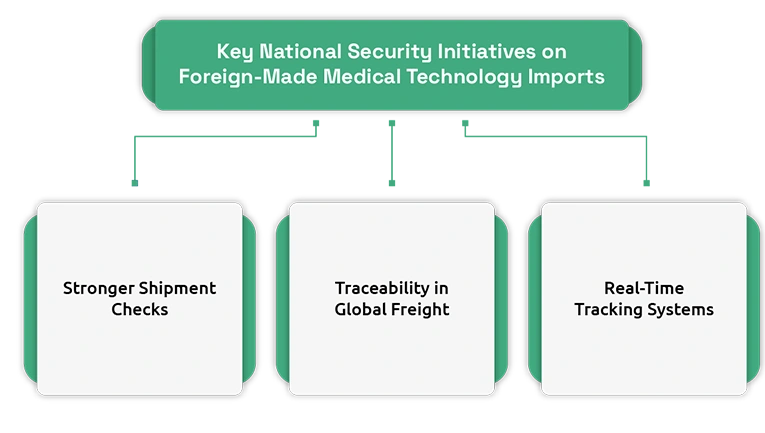
Key National Security Initiatives on Foreign-Made Medical Technology Imports
Improving Regulatory Checking during Shipments
Many countries have introduced stronger approval processes before foreign medical devices enter local markets. Regulatory administration now conducts ownership analysis, manufacturing origins, software integrity, and integrated communication systems. These evaluations go beyond product safety and check strategic risks. Governments are also improving transparency throughout international freight services to confirm traceability from manufacturing organizations to healthcare providers in the global trade.
Supply Chain Tracking and Resilience
National security initiatives increasingly focus on supply chain optimization. Governments aim to stop shortages during crises by supporting various suppliers and partial local production. Trade compliance technologies and inventory and order management systems are being integrated into national monitoring programs. These tools help authorities track imports in real time and identify dependencies that could threaten healthcare continuity during geopolitical tensions or trade restrictions.
Digital and Data Security Measures
Modern medical equipment frequently includes cloud connectivity and software updates, making cybersecurity a critical problem. National reviews now evaluate whether foreign devices could allow unauthorized access to health databases or hospital networks. Countries increasingly require secure software checking before approving imports, confirming that sensitive data remains protected during shipments.
Critical Concerns for Foreign-Made Medical Technology Imports with National Security Reviews
Dependency on External Suppliers
Dependence on a required number of foreign manufacturers can create problems. If diplomatic relations degrade or export restrictions affect shipments, hospitals may have issues to maintain trades or obtain replacement parts.
Documentation and Approval Risks
Complex international trade processes can lead to a misunderstanding of regulations or incomplete documentation. Governments are improving their importer of record service responsibilities to confirm responsibility for regulatory approval. Also, the exporter of record services is being scrutinized to confirm that products meet national standards before shipment. Questions such as whether a freight forwarder can be an exporter of record or whether a customs broker can handle both import and export documentation are becoming more relevant as authorities take clearer responsibility across supply chains. Correct categorizations under HS code and HTS harmonized tariff schedule systems also help regulators track sensitive technologies.
Major Economic Problems
Country trade guidelines to get an advantage with the generalized system of preferences (GSP) may improve trade decisions in global trade, but national security checks confirm that economic reasons do not reduce safety standards. Governments mostly balance affordability with major independence in the supply chain.
Why Countries Launch National Security Reviews on Foreign-Made Medical Technology Imports
Protection of Critical Infrastructure
Healthcare systems are now considered a critical national security system. Disruptions caused by compromised equipment or restricted imports could directly affect national stability. Reviews help to confirm continuity of medical services during emergencies. Advanced medical devices may contain dual-use technologies that could be repurposed or utilized in the shipments. National inspections help to stop unauthorized data transfer or integrated vulnerabilities that could threaten public institutions in countries.
Increasing Trade Approval and Clarity
Governments also look for standardized trade approval processes. Businesses mainly depend on the best trade compliance software for import export rules to meet developing regulatory expectations. Systematic standards reduce delays, improve responsibility, and address problems across global trade operations governed by Incoterms and related contractual arrangements.

Conclusion
National security reviews on foreign-made medical technology imports show broader changes in how governments check healthcare systems, not only as public services but as major devices. While global trade remains necessary for innovation and affordability, unchecked devices from foreign suppliers can add approval and geopolitical risks. As healthcare technology continues to develop, these guidelines become more difficult, confirming that imported medical equipment supports both patient care and national security goals at the same time in the supply chain.
DID YOU KNOW?
Medical technology manufacturers emphasized that 70% of medical products used in hospitals in the United States are already produced locally in manufacturing facilities in all 50 states.
FAQs:
1. Why do governments review foreign-made medical technology imports?
Governments conduct national security reviews to protect the healthcare system, stop cybersecurity risks, and reduce dependence on unstable foreign suppliers.
2. How do national security checks affect medical device imports?
These checks may increase approval timelines, require additional documentation, and increase compliance related to data protection and supply chain transparency.
3. What risks are associated with importing foreign medical equipment?
Key risks include data security vulnerabilities, supply disruptions, regulatory non-compliance, and dependency on limited overseas manufacturers.
4. What role does an Importer of Record play in the medical technology trade?
An Importer of Record confirms regulatory compliance, manages documentation, and takes legal responsibility for meeting national import requirements.
5. How do national security reviews impact global healthcare supply chains?
They improve varied sourcing, improved traceability, and stronger approval systems to maintain healthcare continuity during geopolitical or trade disruptions.