Brief overview of advanced AI hardware
Advanced AI hardware is mainly used for specialized computing components that manage to cover the huge, similar processing demands of training & deploying artificial intelligence models more easily than past CPUs. This hardware focuses on maximizing speed, reducing delays, & improving energy efficiency in both data centers & edge devices.
Understanding Advanced AI Hardware
What is AI hardware?
AI hardware mainly includes specialized components used for artificial intelligence systems or adapted from high-performance computing to manage the huge demands of training & deploying AI models.
AI systems, such as large language models or neural networks, need high-bandwidth hardware to process the types of large datasets used by machine learning (ML), deep learning (DL), & other types of AI algorithms to copy the way human beings think, learn, & solve problems.
The common central processing unit (CPU) can carry out most computational tasks, but an AI network needs increasing computational power. For heavy AI workloads, such as the kind associated with AI development & AI training, AI hardware like AI works & AI chips offers some optimizations better suited for scalability & ecosystem usability.
Benefits of AI hardware
As the industry continues to advance rapidly, AI breakthroughs are making headlines almost every day. As we appear to be entering an AI age, AI hardware makes up the critical infrastructure components powering these impressive AI applications.
Facial recognition, for example, an AI application we almost take for granted, relies heavily on AI hardware to be able to work. It must locally process your image, check it against approved images, and recognize and identify any normal variations to unlock your phone or tablet. Without AI hardware, technology such as face ID or smart assistants would be less practical and more expensive.
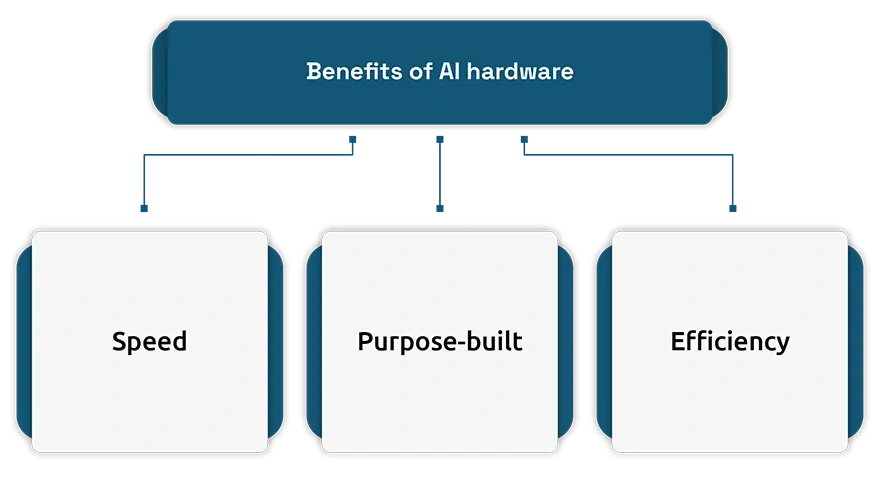
The following are some of the main benefits of AI hardware:
Speed
AI hardware is mainly used for running difficult & resource-intensive AI workloads at high speeds. While different AI chips take different approaches to increase speeds, mainly, they all benefit from parallel computing, a process that divides large, heavy tasks into smaller, simpler steps.
While general-purpose CPUs use successive processing to complete tasks in sequence, one step at a time, AI chips use parallel processing through specialized hardware architecture to perform thousands, even billions, of calculations simultaneously. By dividing complex AI workloads into smaller pieces that can be performed in parallel, AI hardware can increase processing speeds exponentially.
Purpose-built
If not designed specifically for operating within a specialized AI system, most AI hardware is at least purpose-built for the types of demanding operations common among AI applications.
Certain types of AI hardware are reprogrammable on the hardware level. This capability means that they can be easily tweaked, tested, and recalibrated for highly specialized use-cases. Others are engineered specifically for niche AI applications. Though some AI hardware was originally built for other purposes, it is built to meet the high-performance benchmarks for challenging AI tasks in ways general-purpose hardware simply isn’t designed to accomplish.
Efficiency
Historically, AI technology has been notoriously energy-intensive. The same was true of many of the types of AI hardware that are either developed or repurposed for AI operations. However, over time, AI hardware has grown more energy efficient, and it is already much more efficient than traditional hardware, which is naturally less suited to completing demanding AI workloads.
Modern and next-generation AI hardware, with features such as low-precision arithmetic, enables AI hardware to complete workloads with fewer transistors and thus less energy consumption. These improvements are not only better for the environment but also benefit the bottom line.
Exporting Advanced AI Hardware: Trade Compliance Challenges
Exporting advanced AI hardware has become more important due to the developing global demand, strict regulatory frameworks, & geopolitical tensions. As AI chips, GPUs, & accelerators power updated data centers & cloud ecosystems, governments have introduced secure export controls to handle how these important technologies change across borders. Trade compliance has therefore developed as an important need for organizations operating in the AI hardware supply chain.
Export Control Regulations on AI Hardware
Updated AI hardware is mainly classified as dual-use technology because it can serve both commercial & military applications. This classification uses strict export control rules that require companies to obtain licenses before shipping some high-performance chips to specific regions. Regulatory limits based on processing power, bandwidth, or architectural capabilities determine whether a product is restricted, making compliance a highly technical & detail-driven process.
Geopolitical Tensions & Trade Fragmentation
Geopolitical issues have mainly changed the export of AI hardware, mainly in the semiconductor industry. Increasing restrictions between major economies have resulted in supply chain splitting & technological splitting. Governments are prioritizing national security, which has led to heavy controls on advanced computing exports & developing global trade routes for AI networks.
Licensing & Documentation Complexity
Exporting advanced AI hardware needs extensive documentation & regulatory approvals. Businesses must provide end-user certificates, product classification details, & licensing applications before shipment. These procedures often involve lengthy approval timelines, which can delay product delivery & increase operational costs.
Supply Chain Transparency Issues
AI hardware supply chains are highly globalized, adding many suppliers, manufacturers, & logistics partners. These difficulties make it difficult to track the origin & movement of components. Limited visibility increases the risk of indirect non-compliance, especially when third-party vendors are involved in production or supply.

Conclusion
Trade compliance difficulties in developing updated AI hardware highlight the growing challenges at the junction of technology, regulation, & geopolitics. As growing chips, GPUs, & AI accelerators become important to global digital infrastructure, governments continue to secure export controls, licensing requirements, & sanctions frameworks to address national security concerns. This developing regulatory framework makes compliance a highly changing responsibility for manufacturers & exporters.
Did you know?
The AI chip and wider semiconductor ecosystems have come under scrutiny as the DOJ, in coordination with BIS, has conducted enforcement actions targeting the unlawful diversion of AI chips and other key technologies.
FAQ
1. What are the main trade compliance challenges in exporting advanced AI hardware?
Exporters face challenges such as strict export control regulations, sanctions compliance, licensing requirements, and rapidly changing global trade policies affecting AI chips and GPUs.
2. Why is AI hardware subject to export restrictions?
AI hardware is considered dual-use technology, meaning it can be used for both civilian and military applications, which makes governments regulate its export for national security reasons.
3. Which countries have strict export controls on AI chips?
Several major economies impose restrictions on advanced semiconductor exports, especially for high-performance computing chips, due to geopolitical and security concerns.
4. How do export sanctions affect AI hardware companies?
Sanctions restrict companies from selling or shipping hardware to specific individuals, organizations, or regions, forcing firms to implement strict compliance screening systems.
5. What is dual-use technology in AI hardware exports?
Dual-use technology refers to products like advanced chips and GPUs that can be used for both commercial AI applications and military or surveillance systems.