Introduction
AI supply chains need speed, but getting high-end hardware through customs is a major hurdle.While smart software tracks your cargo, it can’t handle the legal side of global trade.This is why an Importer of Record (IOR) is a must-have for your business.They take full legal responsibility, sorting out the tricky taxes and paperwork needed for GPUs. They help stop the red tape and errors that usually leave tech equipments stuck at the border. By bridging the gap between automated digital planning and physical border requirements, an IOR ensures that AI infrastructure is deployed without friction. Ultimately, having a dedicated partner keeps large-scale projects on schedule and within budget.
Modern Supply Chains recognize the significance of AI hardware.
AI hardware, consisting of GPUs, technical processors, and quantum computing devices, is at the core of today’s AI revolution. This equipment enables AI models, machine learning algorithms, autonomous systems, and more to run effectively across industries such as healthcare, automotive, and finance – requiring importation into supply chains worldwide as demand grows for this technology.
Supply chains that deal with AI hardware must address several unique challenges, including high-value items and precise delivery timelines while adhering to international regulations. Businesses dealing with such equipment must ensure shipments are handled with care, cleared through customs swiftly, and delivered without further delay
Understanding Importer of Record (IOR): Definition and Functions
Importer of Record (IOR) refers to the legal entity responsible for assuring imports conform with all relevant laws and regulations of their destination country. They oversee every step in the import process, from clearing goods through customs to paying duties and meeting safety standards, whether this be done directly by an importer themselves or through third-party logistics providers acting on their behalf.
Businesses importing AI hardware need an Importer of Record (IOR) to handle more than just customs rules. The IOR makes sure all paperwork is complete, duties and fees are paid, and shipments follow local laws. Simply put, the IOR acts as a trusted guide to ensure goods enter the country legally and reach their destination without delays.
IOR Contributes to Effective AI Hardware Imports
Importing AI hardware requires careful coordination due to its sensitive nature and complex regulatory environment. The IOR plays an instrumental role in streamlining this process by ensuring all paperwork is filed accurately, tariffs paid properly, and goods clear customs without delays – particularly since AI hardware tends to be high value and time-sensitive, leading to costly financial losses should customs clearance delays occur.
An experienced IOR can assist businesses in avoiding common missteps such as incorrect classification of goods, underpayment of customs duties, or failure to adhere to local certifications. They can also help navigate international trade agreements and regulations so imports adhere to both global and local standards – this expertise is especially invaluable when dealing with AI hardware import restrictions in industries like defense or telecommunications.
Advantages of Employing IOR Services in AI-Powered Supply Chains
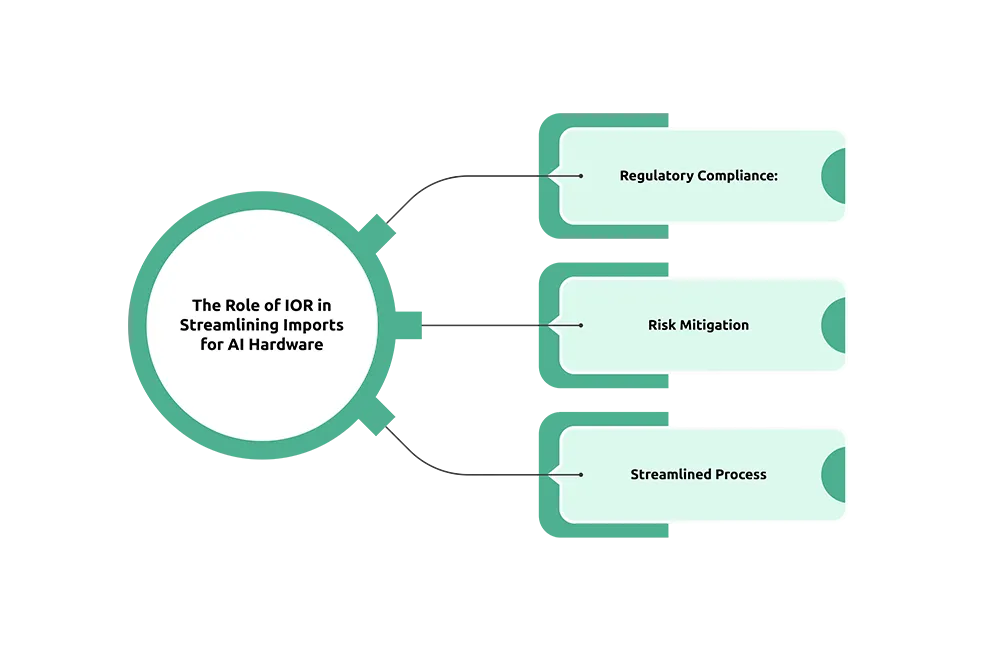
Utilizing IOR services has many advantages for AI-powered supply chains, where the complexity of logistics increases due to the importation of technological products. One key advantage is streamlining operations. By assigning managing imports to an experienced IOR, businesses can focus on the core actions rather than worrying about regulatory compliance or customs delays.
IOR services help businesses mitigate risks by ensuring compliance with ever-evolving international trade regulations, which change with innovation in AI hardware imports. An IOR with expertise in AI hardware imports can stay notified of these developments to ensure smooth shipment processes and compliance.
By using an IOR, businesses can reduce costs by avoiding fines and penalties that arise as a result of late deliveries and delivery bottlenecks. A trusted IOR partner can make all the difference in improving operational performance while simultaneously decreasing supply chain bottlenecks and speeding delivery times.
Challenges and Considerations in Implementing IOR in AI-Driven Logistics Systems
While the benefits of IOR services are apparent, some challenges and considerations must be kept in mind when implementing them in AI-driven logistics systems. Integration is one of the biggest hurdles. AI-driven supply chains rely heavily on complex software systems to track inventory levels, optimize shipping routes, predict demand forecasting, etc. Customs compliance management services provided by an IOR must work seamlessly alongside these systems for seamless shipping processes.
Another challenge lies in the need for real-time data. AI-powered supply chains count on timely access to accurate data to make informed decisions. At the same time, IORs need actual customs data and regulatory updates to stay compliant with ever-evolving rules and ensure timely decisions can be made without delays or violations that disrupt the entire supply chain.
Due to the increasing intricacy of global trade and scrutiny over the importation of AI hardware, finding reliable IOR partners may prove challenging for businesses. Businesses should ensure that their IOR provider has expertise in handling high-tech imports efficiently and be aware of any regulatory hurdles they might encounter during importation.
Future Prospects: Increase Efficiency by Integrating IOR and AI Technologies
Looking ahead, AI and IOR technologies promise great benefits to global supply chains. AI-powered supply chains should become even more efficient over time; their integration will improve transparency, reduce errors, and streamline importation processes even further.
Soon, we may witness more automation in customs clearance powered by AI algorithms that can anticipate probable issues and address them before they arise. This will result in faster processing times, reduced human errors, and enhanced decision-making capabilities. Furthermore, as AI improves its capacity for analyzing large datasets, it may help businesses better understand global trade patterns and anticipate disruptions more quickly.
As businesses become more dependent upon AI hardware, the integration of IOR services into AI-driven logistics systems will become ever more vital. Reliable, efficient, and compliant importation processes become ever more essential. Those companies that successfully incorporate AI into their supply chain management will gain a substantial competitive edge over rivals who don’t.
Conclusion:
Ultimately, AI technology combined with Importer of Record (IOR) services offers a powerful combination for streamlining AI hardware importation. As AI continues to shape global trade, the role of an Importer of Record becomes ever more essential in ensuring smooth, compliant, and efficient imports. Leveraging IOR services helps businesses reduce risks, save costs, and navigate international trade more easily than ever.
One Union Solutions is leading the charge toward innovation in global logistics with its AI-powered supply chains. Offering cutting-edge import solutions that streamline import operations efficiently, One Union Solutions helps businesses stay at the forefront of an ever-evolving world of AI and international trade – and remain competitive within it. By adapting the operations to these advancements, they help optimize supply chain operations while remaining globally competitive.
Did You Know,
The importance of supply chain management proved crucial during the COVID-19 pandemic for importing essential medical supplies. Similarly, in today’s AI revolution, a streamlined supply chain supported by an Importer of Record (IOR) is vital for the seamless import of high-demand AI hardware like GPUs and processors.
FAQs
1. What is the Importer of Record(IOR)
An importer of record IOR is a legal entity that takes full responsibility for your AI hardware and follows all the local import rules. They take care of the taxes and paperwork so your shipment doesn’t get stuck at the border. Basically, they handle all the legal risk to make sure your equipment reaches safely and without delay.
2. How does an IOR help with importing AI Hardware?
AI hardware has very tricky import rules. An IOR handles all the technical paperwork and licenses so your equipment gets through customs easily without any legal trouble.
3. What happens if a business imports AI hardware without an IOR?
Without an IOR, your equipment could get stuck at the border for weeks or face heavy penalties. This wastes money and causes missed deadlines, especially if customs refuse to let your shipment in.
4. Can technology improve AI hardware supply chains?
Yes. Technologies like AI and automation help forecast demand, optimize shipping routes, manage inventory efficiently, and reduce human errors, making imports faster and more cost-effective.
5.What is the 30% rule in AI-Powered Supply Chains?
Let AI do the first 70% of the work, but a human must finish the last 30%. This means a human finishes the work by checking for mistakes to make sure everything is completely right