Overview
Supply chain security remains a challenge: Clean energy technology manufacturing is highly geographically concentrated, with China as the main supplier in most supply chain stages. China accounts for around 85% of solar and 80% of lithium-ion battery supply chain production capacity, and even higher shares for PV wafers (95%) and anode materials (97%). Cybersecurity considerations further enhance the importance of addressing security of supply.
This analysis refreshes our 2024 assessment of the supply chains for key renewable technologies, both national and international, which aimed to:
-identify potential supply chain constraints which could thwart the UK’s renewables ambitions
-recommend potential industry or policy-based interventions that could address those constraints for the period up to 2035.
Critical minerals have moved to the forefront of energy, economic and national security agendas in recent years. This reflects growing concerns about supply chain concentration and the expanding use of trade restrictions. Although the adequacy of supply remains a major concern, notably for copper, governments are now placing greater attention on resilience, diversification and the security of supply in an increasingly complex geopolitical environment.
Dependence on International Raw Material Suppliers
Critical mineral prices rebounded in 2025 and early 2026 after declining in recent years. Driven by tight supply conditions, prices for base metals such as aluminium, copper and tin rose by one-third between January 2025 and April 2026, with copper prices reaching record highs. Battery material prices also recovered following a downturn in 2023 and 2024. Lithium prices more than doubled amid strong demand from energy storage applications and constrained supply, while cobalt prices rose by around 130%, largely due to export restrictions imposed by the Democratic Republic of the Congo (DRC).
Limited Availability of Specialised Manufacturing Components
An “N-1” assessment, which models the impact of losing the largest exporter in each supply chain, shows that for the final downstream stages of most of the four technologies examined – solar PV, wind, batteries and heat pumps – capacity outside China could, in theory, have met most non-Chinese demand in 2024. Yet each of these supply chains contains several steps where production outside the largest exporter is not sufficient to meet demand, and at least one step where it covers less than one-quarter. A supply chain is only as secure as its weakest link.
For several steps in the battery supply chain, less than one-quarter of global demand could be met by suppliers outside China.
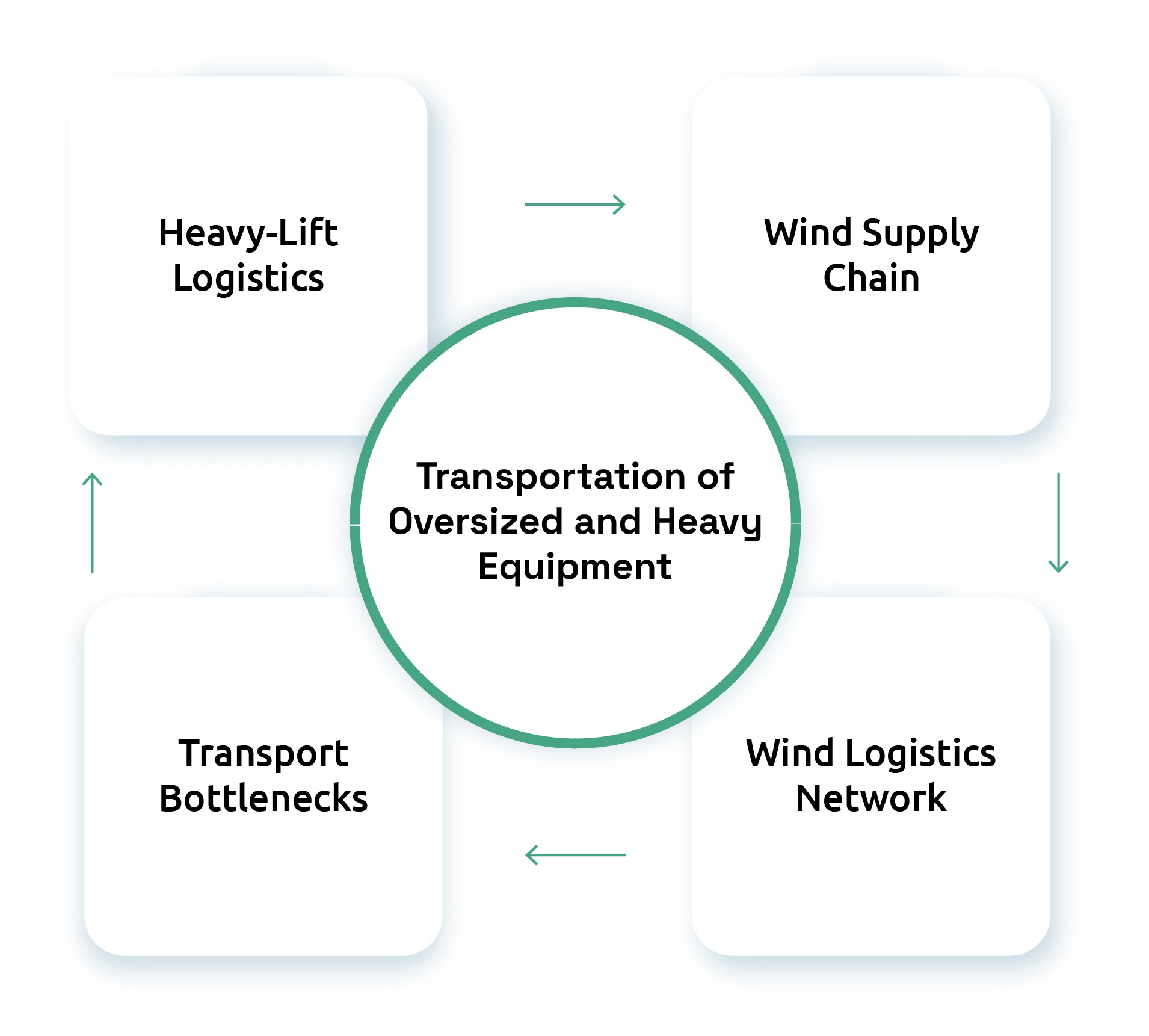
Transportation of Oversized and Heavy Equipment
Modern turbines can have blades up to 100m long, tower sections with diameters exceeding 6m, and other components that can weigh over 200 tonnes.
The capacity of ports to handle these components are influenced by the availability of berths, their ability to accommodate larger vehicles, heavy-lift offloading capability, and the availability of laydown areas to accommodate extended storage requirements across multiple projects.
Throughput of components at ports is also constrained by how quickly components can be unloaded from vessels, transferred onto vehicles, and other restrictions arising from curfews, availability of logistic resources and restrictions on permitted movements per day.
Freight operations, regulations and infrastructure needed for transporting over-size, over-mass (OSOM) wind turbine components are essential enablers for the efficient and timely roll-out of onshore wind infrastructure.
International Customs and Regulatory Requirements
Items under HS Code 70071900, 85414200 and 85414300 which are exclusively used for solar energy projects, must be mandatorily registered on Renewable Energy Equipment Import Monitoring System (REEIMS) of Ministry of New and Renewable Energy, prior to import.
Items under HS Code 73082019, 84833000, 84834000, 85016420, 85016430, 85023100, 85030090, having end-use in the area of wind-operated electricity generation, will require REEIMS registration.
This Policy condition shall apply to imports through air cargo, sea cargo and land route.
Applications for registration must be submitted at least two days in advance for air cargo, five days in advance for sea and land route shipments.
Geopolitical Changes and International Trade Restrictions
Geopolitical rivalry can affect mineral availability through export controls, tariffs, licensing requirements and other forms of state intervention. Rather than outright supply cut-offs, these measures often introduce uncertainty, delays & higher costs, which can slow down the investment in and deployment of renewable energy infrastructure.
Critical Raw Materials are important to economic security and prosperity, but export restrictions are undermining their stable supply. The latest update shows that restrictions remain at historically high levels following sharp increases in 2022–2023. New export restrictions introduced in 2024 were implemented by a more diverse group of countries than in previous years, specifically in Africa and Asia.
Port Congestion and Infrastructure Limitations
Renewable energy projects often depend on the timely arrival of large equipment shipments. However, congestion at major ports can affect vessel schedules, container availability, cargo handling, and inland transportation.
Although not modelled, according to the interviewees, the UK is still facing a shortage of deep-water port capacity, which puts offshore wind asset deployments at risk. To meet expected fixed and floating demand, significant and well-coordinated investment is required to increase quayside and laydown area size and load capacity, as well as channel depth and width. This is particularly critical for floating offshore wind due to the larger dimensions of floating foundations.
Strategies for Building More Resilient Supply Chains
The report highlights supply chain risk mapping, diversification, trade facilitation and international cooperation, alongside renewable energy deployment, industrial and beneficiation policies, finance, skills development, innovation and circular economy measures.
The report includes a new chapter examining the policy implications of building resilient and diversified supply chains, including emergency preparedness, policy and market frameworks, and technology, equipment and workforce issues.The findings underscore the importance of strengthening industrial competitiveness and diversification.
Conclusion
China’s global dominance of solar PV supply chains persists amid high financial strains and mounting bankruptcies, while India is emerging as an important source of diversification. Over 90% of major Chinese solar PV manufacturers have reported losses in 2026, and more than 70 companies have filed for bankruptcy since 2024, as overcapacity and falling prices have eroded margins. Despite this industry turmoil, solar PV supply chains remain highly concentrated in China at every stage, from polysilicon to modules. However, by 2031, India is expected to be the only country besides China capable of manufacturing every major component of the solar PV supply chain at scale, contributing to supply chain diversification.
Did You Know?
India’s wind turbine manufacturing capacity reached approximately 24 GW by March 2026, with 70–80% indigenisation across key components.
Frequently Asked Questions
What is the biggest challenge in switching to renewable energy?
The biggest challenge in switching to renewable energy is electric grid joining & network modernization, compounded by the intermittency of sources like solar and wind
Which country gets 99% of its energy from renewable sources?
Several countries generate around 99% of their electricity from renewable sources—most notably Costa Rica, Uruguay, and Norway, alongside nations like Iceland, Albania, Bhutan, Nepal, Paraguay, and Ethiopia
How does transportation affect renewable energy equipment delivery?
Large wind turbine components require specialised transport vehicles, suitable port facilities, heavy-lift equipment and suitable road routes. Infrastructure limitations can delay the movement of equipment from ports to project sites.
How do renewable energy supply chain global trade restrictions?
Access may be constrained by strategic minerals, industrial parts, tariffs, and other trade arrangements. This can increase the cost & uncertainty of buying foreign equipment.
What can firms do to build more resilient renewable energy supply chains?
Businesses can also track other sources of supply, availability of raw material and alternative resources, and even think about the routing of transportation. Upfront investments also bring resilience through better visibility in the supply chain, better manufacturing capacity, and global collaboration.