Introduction
The high rate of electric vehicles (EVs) economic process is changing global markets, logistics, and regulations. EV batteries are the core spine of the globalization process. With nations introducing strict emissions targets and battery-making businesses rained with orders to fill this skyrocketing demand, the EV battery trade is changing, establishing novel complexities and opportunities in the worldwide compliance and supply chains.
In 2023, more than 250,000 electric vehicles were sold around the globe every week compared to a single-year sale of a decade ago. Since more citizens are purchasing electric vehicles (EVs), the demand for EV batteries is also rising. Global battery sales will skyrocket to increase about fourfold over the 2023 demand by 2030 due to the expected future growth of EVs.
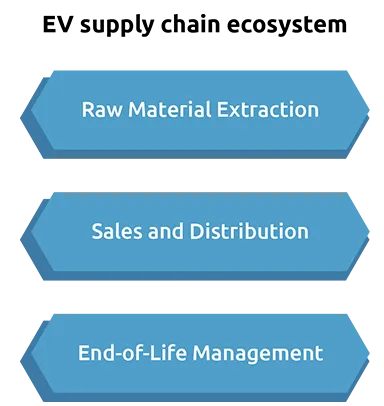
EV supply chain ecosystem
EV Logistic ecosystem is a multi layered, entangled system that critically impacts the dynamically developing automotive industry. It involves several processes & stakeholders, from the extraction of raw materials to battery manufacture, assembly, and end-of-life management. It plays a significant role in the innovation and sustainability of transportation, which is associated with the global realization of a more environmentally friendly and technologically advanced mobility system.
The EV supply chain ecosystem is an elaborate, interfering system of performers in all sections of an electric vehicle lifecycle, including raw material extraction and end-of-life recycling. Sourcing of the key constituents, such as lithium and rare earth minerals, is mined using this network, which is followed by processing, transportation, and manufacturing, where battery cells, modules, and important vehicle parts are manufactured and assembled.
The ecosystem goes beyond manufacturing to a wide range of parts, proxies, evolution and upkeep of the charging framework, and assembly of advanced software solutions to work and interface with the vehicle. It also comprises sales and distribution systems that supply EVs to customers and industries. The complexity of this ecosystem finally underscores the multi-lateral and symbiotic process of fostering an increasing EV market.
Scale of the EV Logistic Ecosystem: Key Insights
High Market Growth: The EV market is showing stupendous growth. Sales and revenues on a global scale have been increasing incredibly over the recent years, and experts believe that the market may exceed close to 2 trillion dollars by 2032. The high consumer demand, improved technology, favourable government policies and the global motive towards cleaner air and emissions have contributed to this boom.
A Multi-Dimensional, Growing Supply Chain: This EV boom will demand a huge supply chain to support its growth. It begins with mining important raw resources such as lithium and cobalt. It goes through the high-tech battery and vehicle plants. A broad net of suppliers and service providers supports it. The scope of this network is observable in how many cars have been made, what trucks travel with materials, and how far charging points and maintenance facilities provide EVs with energy to travel.
Teamwork and Creativity: Team reworking and innovativeness push EV ecosystems forward and make them successful. Partnerships can be utilised to enhance battery efficiency, increase the charging network, and make EVs cheaper and convenient for all people.
The Transition to Electric: Steering to EVs: Moving to EVs from the old cars driven with gas is an immense task. It implies reconsideration of all processes, the introduction of smart technologies, and the acquisition of new regulations. The collaboration between the stakeholders in the industry and the policymakers is relevant to the direction in which the world is looking to achieve a smooth and sane transition.
The Future of EV Logistics | Challenges & Solutions in 2025
Electric vehicle growth is increasing, so the logistics industry has several significant threats in 2025. There is an increasing challenge to provide enough access to the so-called critical minerals, including lithium and cobalt, and to deliver the batteries safely, as shipping procedures are complex and restricted by strict policies. The rate at which EVs have increased and are increasing in number is higher than the increase in the charging infrastructure, and the rate at which technology is changing is very high, thus necessitating a continuous upgrade. New sustainability policies also require superior monitoring and reporting, as well as responsible battery and component recycling.
To address these challenges, businesses are domesticating the logistics by building factories nearer markets and tightening contracts with suppliers to stabilise them. They are building and enhancing charging infrastructure with mobile and fast charging options, whereas tracking systems that have gone digital aid in optimising the fleet management and maintenance processes. The new partnership and flexible business models are sustaining the process of battery reuse and recycling. All these are proactive solutions that can modernise EV logistics ecosystems, which can be believed to be becoming more resilient, efficient, and future-ready.
Looking Forward: EV Logistics in 2025
By 2025, transportation of electric vehicles (EVs) and their components will still be quite complex, from manufacturing to delivery. Nevertheless, the multifaceted industry faces this problem squarely, using new concepts and cooperative efforts; moreover, the industry is conscious of sustainability. At One Union Solutions, we are proud to drive such a change. Our stacked logistics solutions increase the effectiveness of the supply chain, apply the latest digital tracking techniques, and establish a network of trustworthy charging and storage facilities trading with the EV market.
Our approach also emphasizes responsible recycling and circular economy practices to minimize environmental impact. By localizing supply chains and optimizing routes, we reduce costs and shipping risks for EV manufacturers. Advanced digital tools provide real-time visibility, ensuring timely and transparent deliveries. Together, these efforts help make EV logistics more efficient, sustainable, and ready for the growing global demand.
Check it out!
The International Energy Agency estimates that more than 14 million electric cars will be purchased globally in 2023, or close to one in every five new automobile sales, and notes that the world’s EV market will grow above $2 trillion by 2032.
FAQs
1. Why will the EV battery trade be complex in 2025?
The EV battery trade faces challenges like global supply chain disruptions, strict compliance rules, rapidly growing demand, and the need for sustainable end-of-life management.
2. How can One Union Solutions support EV logistics?
One Union Solutions provides end-to-end logistics with digital tracking, supply chain optimization, and responsible recycling solutions to ensure efficient and transparent EV and battery transport worldwide.
3. Why should EV manufacturers localize their supply chains?
Building factories and sourcing materials near main markets reduces shipping risks, lowers costs, and helps prevent supply disruptions amid global uncertainties.
4. What are the main challenges in scaling EV charging infrastructure?
The rapid growth of EVs requires fast construction of charging facilities, especially in shipping and transit hubs, to keep up with increasing demand.
5. How is One Union Solutions promoting sustainability?
The company focuses on recycling programs, circular economy initiatives, and green logistics processes to minimize environmental impact and meet global sustainability standards.