Understanding the Global Impact of Air Cargo Transport
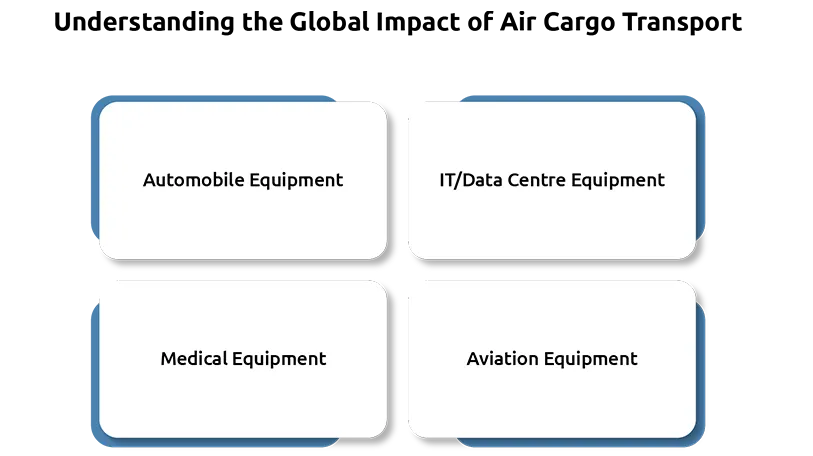
Air cargo transportation is used in many specific industries, such as IT/data centre equipment, aviation equipment, automobile equipment, and even medical equipment. These industries rely on air transportation to handle the growing needs of urgent deliveries, the safe transportation of valuable goods, and supply emergency the speedy transfer of sensitive goods internationally. High-tech, high-value parts, medical equipment, aerospace aviation parts, and much more are just a few of the high-tech products that could be transported with air cargo efficiently and rapidly, maintaining a worldwide supply chain that is flexible to world events.
Air freight is vital to industries where delivery must be fast and international. The willingness to deliver these goods speedily and safely is crucial to construct data centres, create vehicles, support aviation fleets, or supply emergency medical assistance.

Key Statistics on Global Air Cargo Traffic and Volume
Cargo Volume: By 2025, the total niche cargo sum is expected to accumulate 200 million metric tons in air cargo traffic worldwide. The growth is equivalent to 4.8% since last year because there is more demand for faster and safer transportation of these valuable goods.
Growth Rate: The market for air cargo, particularly in businesses, will expand by 5% to 8% by 2025. The world is becoming increasingly globalized, so connectivity & delivery solutions must be timely. As a result, the air cargo business will experience an outburst in demand, especially in particular regions or markets such as the Asia-Pacific and North America markets, with the industry of technology and production rising.
Cargo Capacity: The cargo moved using the air cargo industry will exceed 200 million metric tons by 2025. The cargo space and logistics optimization are required as the average load factor in such specific areas as IT/data centre components and medical equipment within the industry is projected to be 50% and 50% respectively.
Airline Revenue: The air cargo industry will generate more than 100 billion in 2025, which will be earned in IT equipment and equipment, aviation supplies, automobile parts, and healthcare equipment. This can be attributed to how vital air transport is in international business, particularly in businesses that involve the swift and safe transportation of products of high value.
The Economic Influence of Air Cargo Transport Worldwide
Air cargo transportation, especially in the IT/data centre equipment, aviation, automobile, and medical sectors, plays an important role in the economy of the whole world. The air cargo industry is expected to earn over $100 billion in 2025. This shows how important it is for quickly and safely delivering important items like high tech parts, car components, medical supplies, and aircraft equipment on time. It creates economic growth in the manufacturing, healthcare, and technology sectors. The nature of these industries is correlated, and the effectiveness of air transport enables businesses to have competitive global supply chains with minimized delays and the costs of carrying inventories.
Environmental Conduct: Carbon Footprint and Sustainability of Air Cargo
With its 2.5 per cent contribution to total carbon dioxide emissions on earth, the air cargo industry is trying to mitigate its environmental footprint, especially in industries that require a green environment, where green practices are gaining more and more importance. As the need for these specialty goods increases, the aviation industry has vowed to become carbon neutral by 2050. In 2025, the EU will roll out standardized CO2 footprint information on air freight, becoming more assertive in encouraging the industries to set a more sustainable resolution regarding logistics and transportation.
What are airlines doing to make air cargo more sustainable and eco-friendly?
Airlines are using several methods to reduce environmental impact in air cargo operations. They are adopting sustainable aviation energy that produces fewer carbon emissions compared to traditional energy. Energy efficient aircraft are also being introduced to lower energy consumption. Carbon offset programs help balance emission by supporting environmental projects. AI and automation are used to optimize flight routes, which reduces unnecessary energy use and emission. Companies like medical, IT are encouraging greener logistics due to their fast delivery needs. These industries are pushing airlines to adopt cleaner practices.
Ongoing Changes in Air Cargo and How One Union Solutions Can Come to the Rescue
Air cargo transport remains an evolving industry in terms of meeting the rising demand for fast, reliable, and efficient transportation worldwide, especially in various industries such as IT, aviation, automobile, and medical equipment. The future of world logistics is characterized by the continued investments of the industry in technological achievements, sustainability, and digital infrastructures. One Union Solutions will also assist the air cargo industry with finely designed solutions to achieve efficiency and better safety to ensure sustainability. Through specialization in these industries, One Union Solutions gives businesses the strength to keep up with the changing global logistics trends and succeed in the long run in an ever-globalized world.
Did you know?
Airlines transport over 62 million cargo tonnes of goods a year, representing more than 33% of global trade by value but less than 1% of world trade by volume.
FAQ’s
What is the expected volume of air cargo in 2025?
Air cargo shipments are expected to reach around 200 million metric tons by 2025, covering goods like IT and data center equipment, aviation parts, automobile components, and medical supplies.
What are the economic impacts of the air cargo industry?
Air cargo plays a key role in global trade for industries such as IT, automotive, aviation, and healthcare. It generates over $100 billion in revenue annually.
Is air freight environmentally friendly?
Air freight is not fully environmentally friendly because it produces high carbon emissions. However, airlines are working to reduce its impact by using sustainable aviation fuel, fuel-efficient aircraft, and carbon offset programs, with a goal of net-zero emissions by 2050.
What are the latest technology trends in air cargo?
New trends include AI for predictive maintenance, automated cargo handling, eVTOL aircraft for urban deliveries, and innovations in sustainable aviation, particularly for IT, medical, and aviation equipment.
What does the future hold for the air cargo industry?
The air cargo sector is evolving with investments in AI, green operations, autonomous aircraft, and next-generation cargo management systems to meet rising demand for fast, reliable, and environmentally friendly transport.