Insight
The airline business is rapidly changing, and new sustainability standards are becoming popular. More specifically, sustainable blending in air transport has significantly improved the logistics and transport activities of special goods. With the global industries’ requirement to deliver high-value, time-sensitive goods faster and more efficiently, air cargo is moving toward more sustainable solutions. Not only is this change needed to achieve international standards, but it also needs to decrease the environmental impact and keep the supply chain efficient.
Air cargo is important in moving different high-technology goods. It could be delivery of delicate IT components, life-saving medical equipment, highly priced automobile equipment, or aviation operating gear; air freight has become the most secure and quickest way of delivery. But under pressure to minimise carbon footprints in the world has come the need for the industry to change and innovate regarding the needs that the environment demands.
The Role of Sustainable Blending in Air Cargo
Sustainable blending embodies environmentally friendly solutions for the transportation industry to allow the cutting down of its environmental profile. In the air freight industry, this will include sustainable aviation fuels, optimisation of flight trajectories, and the use of aircraft with high technology to minimise fuel usage and emissions. In the case of industries, there is no other option but to deliver at the right time and safely.
This means that the airline industry is learning to compromise between sustainability and efficiency in operation. An example is the implementation of sustainable aviation fuel (SAF), one of the greatest actions the airline industry will take to fight carbon emission targets in the world. SAF minimizes the carbon emission potential of air transport, and it is at the center of the long term sustainable transformation of the air cargo business.
Some recent developments in air cargo airplane design, like lighter and more aerodynamic airplanes, are assisting in lowering fuel consumption without jeopardizing the integrity of the products being flown. Such innovations are of special significance in those industries where sensitive and high-priced equipment, such as medical devices and IT servers, should be provided quickly and safely.

The Economic Impact of Sustainable Logistics
The move towards a sustainable solution in air transport is a calculated step that benefits industries. The economic advantages of efficient and sustainable logistics are more understandable as the demand grows. Green air cargo solutions are friendly to the environment and economically beneficial. Companies can achieve the operation cost minimization through low fuel consumption, maximization of profit margins, and relaxation of supply chain problems. Moreover, using green logistics solutions may correspond to the regulations of the whole world, preventing some fines and enhancing a corporation’s reputation on the market.
These efficiency improvements help businesses stay competitive in industries that need fast delivery, like medical equipment, automotive, and aviation. Sustainable air cargo also creates jobs and helps reduce costs in logistics and aviation. New technologies, such as carbon-neutral fuels and advanced logistics tools, are important for managing operations and supporting research and development. As companies adopt these solutions, they are expected to have a big positive impact on the global economy.
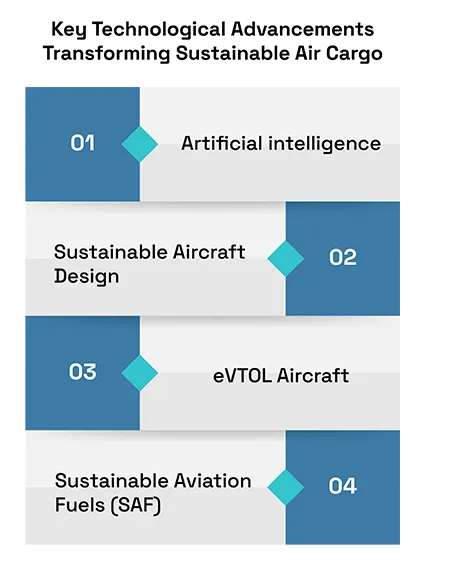
Key Technological Advancements | Transforming Sustainable Air Cargo
Technological development is the cardinal pillar of sustainable change occurring in the air cargo sphere. Some key advances transforming the sector include incorporating AI-based systems, better utilization of fuel, and creating electric vertical takeoff and landing (eVTOL) plane models.
Artificial intelligence: AI is being deployed to reduce the workload in air cargo by automating Flight scheduling, cargo handling, etc. In particular, predictive maintenance technology and automatic inventory management programs help to ensure that high-tech equipment such as IT servers and medical equipment are transported in the most efficient and safe modes available.
Sustainable Aircraft Design: Airline companies invest in future-generation aircraft, which contain lightweight airframe materials and new, sophisticated aerodynamic designs and use much less fuel. Besides making plant operation extremely cost-effective, such aircraft also make deliveries of such products as aviation and automobile components, which can be conducted with less environmental damage.
eVTOL Aircraft: Shorter-range cargo transportation could also change with the design and creation of electric vertical takeoff and landing (eVTOL) aircraft. These aircraft will allow the efficient, fast transportation of goods like medical resources and automobile parts across cities, decongesting the traffic and providing a cleaner energy alternative to conventional aircraft.
Sustainable Aviation Fuels (SAF): SAF can be considered one of the most promising ways of decreasing the carbon impact of air transport. The usage of SAF in many airline operations has already commenced, and it forms a clean fuel option, but still maintains the needed performance of high-value goods transportation.
Market Research Insights
According to the latest market studies, sustainable air cargo is rapidly expanding. The high demand for high-tech and high-value goods, such as IT equipment, aviation parts, medical equipment, and automobile spares, with improved delivery speed, fuels this market expansion. The worldwide air freight market should increase by 5% – 8% annually, and sustainable solutions are on the frontline of such growth.
Specifically, in Asia-Pacific and North America, there are more investments in green logistics solutions as industries seek opportunities to minimize their environmental footprint or environmental burden on the one hand and to cope with their growing demand on the other hand. Sustainability adoption is very important in an industry where transit time and safety of goods are key factors. Using sustainable air cargo solutions is an option and a requirement as governments and international bodies further advocate for strict environmental policies.
Why Choose Sustainable Air Cargo Solutions
With the air cargo business being further developed, sustainable logistics is becoming increasingly necessary to satisfy the global market and sustain future development. Incorporating AI-powered technologies, green fuels, and advanced aircraft design will ensure the industry is hitting a spot between climate responsibility and operational profitability.
One Union Solutions knows how complicated it is to transport air cargo, especially in comparatively busy businesses such as IT, aviation, automobile, and medical equipment. Our innovative solutions can help make your logistics operations more efficient and keep your business competing in the fast-paced, global marketplace.
Did You Know,
The air cargo industry emphasizes rapid and secure delivery, which comprises almost 35% of the world’s commerce by value, even though the air cargo sector only has 1% of the overall cargo volume.
FAQ
What are environmentally and economically friendly air cargo alternatives?
Sustainable air cargo focuses on reducing emissions and using fuel efficiently. Technologies like sustainable aviation fuels (SAF) and more efficient aircraft designs help achieve this.
How does AI improve air cargo logistics?
Artificial intelligence helps optimize flight schedules, automate cargo handling, and enhance aircraft maintenance, making operations faster, safer, and more efficient.
How will eVTOL vehicles be used for air cargo delivery?
eVTOL aircraft can move cargo quickly within cities, reducing road congestion and delivery times while being energy-efficient.
Why is sustainable aviation fuel (SAF) important?
SAF allows air cargo companies to reduce their carbon footprint and move toward greener operations.
What environmental regulations affect air cargo, and how are they evolving?
The air cargo industry is adopting greener technologies, such as SAF, AI, and fuel-efficient aircraft, to meet stricter environmental standards and improve sustainability.