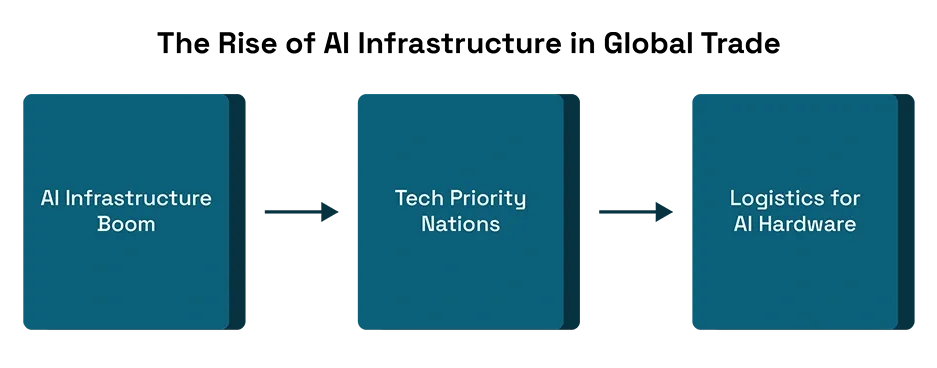
The Rise of AI Infrastructure in Global Trade
Artificial intelligence is rapidly transforming global trade dynamics as countries and businesses invest heavily in AI infrastructure, including data centers, semiconductors, cloud computing systems, GPUs, and high-performance networking equipment. What was once considered a technology upgrade has now become a strategic economic priority for nations aiming to strengthen digital capabilities and industrial competitiveness. As demand for AI systems grows, advanced hardware and tech parts are being traded internationally. This change is creating trade routes for semiconductors, cloud providers and digital economies. It is connecting places that make semiconductors provide cloud services and growing areas.
The expansion of AI infrastructure is also reshaping supply chains in industries such as IT, automotive, aviation, and medical equipment. Automotive manufacturers are integrating AI-enabled production systems and smart vehicle technologies, while aviation companies are investing in predictive analytics and automation tools. In the healthcare sector, AI-powered diagnostic equipment and advanced computing systems are driving higher demand for imported technology components.
At the time businesses that do global logistics and international freight services are changing to meet the need for faster transportation, secure handling and efficient customs clearance of high-value AI hardware. AI hardware is very important and as more money is being invested over the world AI infrastructure is having a big impact on future global trade routes and supply chain strategies, for businesses that do global logistics and international freight services especially for the transportation of high-value AI hardware.
Why AI Infrastructure Is Reshaping International Commerce
The fast growth of Artificial Intelligence infrastructure is changing the way the whole world does business. This is happening because Artificial Intelligence needs a lot of computer parts like semiconductors and advanced servers and processors and special cooling systems and fiber connectivity systems. As governments and enterprises invest heavily in AI-ready data centers and digital ecosystems, countries such as the United States, India, China, Singapore, and the UAE are emerging as key manufacturing and distribution hubs for high-value technology equipment.
This shift is not only accelerating cross-border trade but also redefining global logistics strategies and supply chain optimization practices. Businesses in IT, automotive, aviation and medical fields need international shipping services and smooth customs processes. This helps them move AI hardware on time. Companies in these areas use freight services to send and receive AI hardware. At the time companies are working on their inventory and order management to make things better. They want to reduce delays and make their operations stronger. This will also help them deal with the growing complexity of trade networks that are driven by Artificial Intelligence. Companies are doing this to support Artificial Intelligence driven trade networks.
How AI Investments Are Creating New Trade Routes
The rapid expansion of AI infrastructure investments is reshaping global import-export corridors and creating new trade opportunities across multiple industries. Rising demand for semiconductors, GPUs, servers, and AI-ready networking equipment has strengthened U.S.–Asia semiconductor trade routes, while India is emerging as a major regional hub for AI infrastructure and digital transformation. Eastern countries are spending a lot of money on data centers that are ready for Artificial Intelligence. At the time Europe is buying more advanced Artificial Intelligence computing systems. They need these systems to support automation in industries and to expand their cloud services. Eastern countries and Europe are really focusing on Artificial Intelligence.
These developments are also driving growth in air cargo demand for high-value and sensitive AI hardware that requires secure and time-critical transportation. The aviation companies need systems that use intelligence to analyze things and make their work easier. The medical sector is buying machines that use artificial intelligence to help doctors diagnose problems. The IT industry is still the buyer of artificial intelligence equipment and other things that are needed to make artificial intelligence work.

How Businesses Are Building Resilient AI Supply Chains
Businesses that deal with AI infrastructure and global trade are changing the way they do things. They are not just looking at how to save money but instead they want to make sure their supply chains are strong and can handle problems. Companies across automotive manufacturing, aviation systems, medical equipment distribution, and IT infrastructure deployment are adopting diversified supplier networks to reduce dependency on single-region sourcing. They also improve inventory and order management for AI hardware and semiconductor parts. This approach is especially useful for value AI hardware and semiconductor components. Nearshoring and regional warehousing enable management of these components.
At the time tracking shipments in real-time and using AI planning tools are helping businesses see what’s happening across their international operations. This means they can prepare for delays and keep things running smoothly. Getting customs clearance faster and coordinating trade better are also crucial, for companies that move tech equipment across borders. As global trade relies more on technology businesses are wondering if a customs broker can handle import and export paperwork efficiently. They want to make cross-border operations easier and keep their supply chains strong.
Many organizations are also teaming up with logistics providers and compliance specialists to deal with changing rules and paperwork. As the world of trade gets more into technology businesses want to know if a customs broker can handle the paperwork for both imports and exports.
Conclusion
AI investments are changing trade fast and they are creating trade routes for things like semiconductors, cloud computing, data centers and digital tech. Industries like IT, automotive, aviation and medical equipment now rely on AI systems. So businesses need to change their import and export plans to keep up with trade changes. Businesses must adapt to these changes to stay ahead because the need for import-export strategies is growing. Semiconductors, cloud computing and data centers are driving this change.
Logistics planning is really important for companies that ship high tech stuff to countries. They need to make sure they are doing things the way and following all the rules. Supply chain management is really important for these high-value technology shipments. Companies that are flexible and can adapt to changes will be in a position to handle problems that come up with their technology shipments. Technology shipments need care. They need to have a system in place to track their technology shipments and get help when they need it with their technology shipments.
DID YOU KNOW
“This surge, largely driven by US investment, saw over ($272) billion in trade for AI-related products in the first half of 2025 alone, representing a 65% increase over 2024 ”
FAQs
1. How AI Infrastructure Transforms Global Logistics
Agentic AI systems are being deployed to monitor, predict, and, in some cases, autonomously reroute shipments in response to global disruptions.
2. What is the impact of AI infrastructure on 2026 economic growth?
The IMF estimates that AI-related investment could lift global growth by 0.3 percentage points in 2026.
3. Where is AI infrastructure being built most rapidly?
Investment is highly concentrated in data centers, high-end chips, and power infrastructure, with significant growth in the US and Asia.
4. What are the risks of the AI boom?
There is a risk of widening the global development divide, as capital and technology become concentrated in fewer, developed nations.
5. How does AI affect international logistics?
AI helps reduce trade costs by 40-50% by automating customs clearance, optimizing maritime routing, and enhancing inventory management.