Companies often need to bring IT, medical, and technical equipment into another country for a short period. This may be for a trade show, product demonstration, testing, repair, maintenance, or a project. Because the equipment is expected to leave the country later, a temporary import may differ from a regular commercial import. Depending on the country, equipment, purpose, and period of stay, the proper process can involve temporary entry, an ATA Carnet, or an IOR. Companies can select the correct customs process & correctly plan the re-export by being informed of these options before shipping.
What Is a Temporary Import of Equipment?
Bringing equipment into a country for a short period of time and then removing it is known as a temporary import. This procedure can be used by companies to temporarily import medical equipment, IT equipment, or technical equipment required for short-term projects, testing, display, inspections, or repairs. Unlike a permanent commercial import, the goods are not normally intended to stay in the country.
One customs process that may allow eligible products to enter for a short period and purpose is temporary admission. The destination country, the type of product, & the purpose of the equipment all impact the correct customs process for temporary imports. Customs can also set a re-export restriction or time limit before the goods must leave the country, as well as demand specific equipment details like model or serial numbers.
When Do Companies Temporarily Import IT, Medical and Technical Equipment?
Companies may use temporary imports when equipment enters a country for a short-term purpose and will leave again. IT equipment for exhibitions may be brought for trade shows, while IT equipment demonstration and medical equipment demonstration may support customer trials. Companies may also use temporary import for testing for technical checks or laboratory work, and temporary import for repair when equipment needs servicing before re-export. For short-term projects, project equipment temporary import can cover engineering equipment, installation tools, data center project equipment, and field service equipment. The correct process depends on the equipment, purpose, country, and customs rules.
IOR vs ATA Carnet vs Temporary Admission: What Is the Difference?
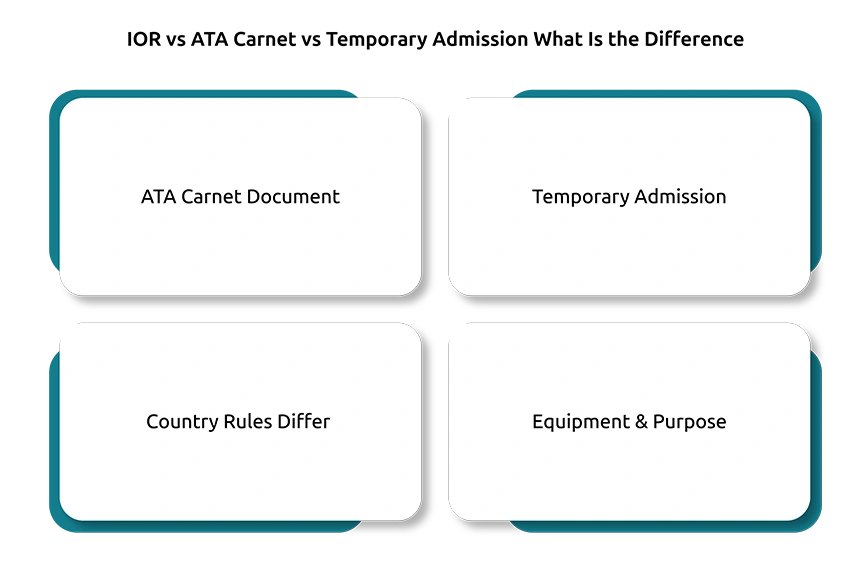
IOR, ATA Carnet, and temporary admission are different parts of the temporary import process. An IOR handles the importer role, while an ATA Carnet is a customs document for eligible temporary movements. Temporary admission is a customs procedure for qualifying goods entering a country for temporary use. An IOR vs ATA Carnet decision depends on the destination country, equipment, purpose, local importer rules, and re-export requirements. An ATA Carnet does not automatically replace an IOR or remove product regulations.
What Is an ATA Carnet and When Can It Be Used?
A customs document known as an ATA Carnet is used for approval of products that temporarily enter a country before being exported again. Exhibitions, trade exhibitions, demonstrations, quality work, & business samples frequently use ATA Carnet temporary import. ATA Carnet equipment may include eligible tools or display equipment, while an ATA Carnet for trade shows can support temporary event shipments. An ATA Carnet for professional equipment may also be used for certain business equipment. Before shipping, companies should check whether the destination country and goods qualify, as a carnet does not cover every product or remove local product regulations, permits, or approvals.
How to Choose Between IOR, ATA Carnet and Other Temporary Import Options?
Choosing the right option starts with the purpose of the shipment, such as exhibition, demonstration, testing, repair, project use, or evaluation. Companies should then check the destination country’s temporary admission rules, ATA Carnet availability, local importer requirements, customs requirements, and product regulations. The type of goods also matters, including IT equipment, medical equipment, technical equipment, regulated products, or controlled products.
It is also important to confirm the temporary import period, customs time limit, re-export deadline, and extension requirements. Before shipping, plan the re-export plan and check the return shipment, customs closure, and proof of re-export. This makes it easier to select the right temporary import option for the shipment.
What Happens When Temporarily Imported Equipment Is Re-Exported?
When companies re-export temporary equipment, they usually need to complete the customs process for the temporary import. Temporary import re-export means sending the equipment back out of the country within the allowed time. To verify that the equipment has left, Customs may request proof of re-export and re-export documents.
The equipment may be matched with the original import using serial numbers, model details, and inventory data. The company may then complete customs closure. If the equipment stays beyond the allowed period, customs or financial issues may occur. The exact requirements depend on the country and the temporary import procedure used.

Conclusion – Choose the Temporary Import Method Based on the Shipment
A temporary import does not follow one single customs solution. The right choice depends on the country, equipment, purpose, and period of the shipment because IOR, ATA Carnet, and temporary entry serve different needs. Before the equipment enters the country, companies should plan for the re-export regulations. Regulated IT, medical and technical equipment may need extra checks, permits, or approvals. Before shipping, it is important to confirm the customs procedure and importer structure that fit the shipment.
Did you Know
Global goods trade is estimated to have reached approximately US$13.7 trillion in the first half of 2026, up 12.5 % from the same period in 2025. Services trade grew by 10.5 %.
FAQ
Can IT equipment be temporarily imported for a trade show?
Yes, eligible IT equipment can be temporarily imported for a trade show if the destination country’s customs rules allow it.
Does an ATA Carnet remove the need for an IOR?
Not always. An ATA Carnet and an IOR serve different purposes, so local importer rules still need to be checked.
Can medical equipment enter a country temporarily for demonstration?
It may be possible, but medical equipment can have additional product regulations, permits, or approvals.
What happens if temporary equipment is not re-exported on time?
Missing the allowed period may create customs or financial issues, depending on the procedure and country.
Can regulated IT equipment use temporary import procedures?
It may be possible, but temporary customs treatment does not automatically remove product approvals or other regulatory requirements.