A Bill of Lading is an important document in the import-export process, a legally compulsory document in import-export, used as a receipt of goods, contract of carriage, & document of title. The four key types to understand are the Straight B/L, Order B/L, House B/L, & Master B/L.
Each type of Bill of Lading uses many purposes in the movement of goods. A Straight B/L is non-negotiable & used when goods are delivered directly to a named client, making it suitable for secure, pre-paid shipments. A House B/L is issued by a freight forwarder to the shipper, managing individual shipments, while a Master B/L is issued by the main carrier to the freight forwarder, managing the whole cargo. Understanding these types helps businesses to select the right document for an easy, secure, & complete shipping process.
Understanding the bill of lading
A bill of lading is an important legal document made by a carrier, like a shipping company, that works as a detailed receipt for goods being transported. It outlines the terms & conditions of the contract of carriage, with the type & quantity of goods, their origin, destination, & the responsibilities of the carrier. A Bill of Lading also acts as evidence of the title or ownership of the goods. It has three main functions of a bill of lading:
Receipt: It accepts that the carrier has received such goods in the stated condition, ready for transportation.
Contract: It is used as a contract between the shipper, the carrier, & the buyer. It defines the terms & conditions of the transportation service.
Document of Title: It can be negotiable or non-negotiable. A negotiable bill of lading can be used as a document of title, meaning that the goods can be transferred to someone else by supporting the document, making it an important document in international trade & finance.
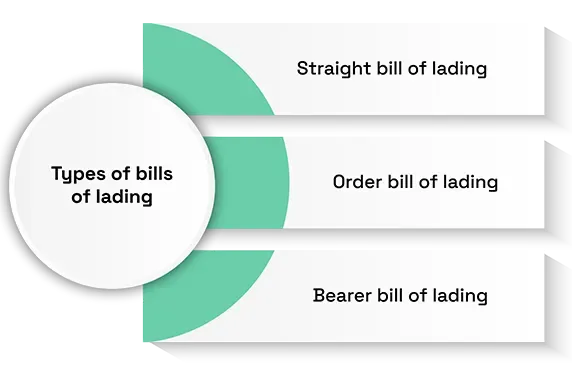
Types of bills of lading
Bills of lading have many types, each developed for some purposes & give different levels of flexibility in the transfer of goods & ownership.
Understanding the distinctions between these types is important for participants in the shipping & trade industry to ensure the safe & efficient movement of goods.
1. Straight bill of lading
A Straight bill of lading is a non-negotiable document that specifies a single consignee or recipient for the goods. It is typically used when the shipper wants to ensure that the cargo is only delivered to the consignee listed on the document.
2. Order bill of lading
An Order Bill of Lading is a negotiable document that allows the transfer of both the goods and the title of the goods to a third party. It typically includes the phrase “to the order of [name of a party].”
3. Bearer bill of lading
A bearer bill of lading is a highly negotiable document that does not specify a main buyer or endorse the goods to that person. It is often marked as “to the bearer” or “to the holder.”
The Purpose of a bill of lading
A Bill of Lading (B/L) plays an important role in shipping & logistics. It works as a contract between the shipper, carrier, & buyer, clearly stating the terms of transportation, including delivery responsibilities, freight payment, & liability in case of loss or damage. It also acts as a receipt, confirming that the carrier has received the goods in the stated condition, which helps compare their condition at the time of delivery. A B/L can serve as a document of title. Depending on its type, such as straight, order, or bearer, it allows ownership of the goods to be transferred, which is especially important in international trade, where goods may change hands multiple times before reaching the final buyer.

Conclusion
In the business of import-export, a Bill of Lading is more than just a transportation document it is the development of safe & managed trade operations. From acting as a receipt & contract to serving as proof of ownership, it makes sure clarity & trust between all parties involved. Understanding the different types of Bill of Lading, such as Straight, Order, House, & Master, helps businesses cover shipments easily, minimize risks, & manage compliance with international trade rules. Selecting the right type based on the nature of the transaction can make the whole transportation process easier, safer, & more usable .
Did you know?
Around 90% of global trade happens through sea shipping, where Bills of Lading—such as Straight, Order, and Bearer—help ensure goods are transferred safely and correctly. Today, more than 50,000 merchant ships, registered in over 150 countries, carry all types of cargo across the world.
FAQ
How many types of BL are in export?
A bill of lading must accompany shipped goods and be signed by an authorized representative from the carrier, shipper, and receiver. Three types of bills of lading include straight bill of lading, order bill of lading, and bearer bill of lading.
What is Telex BL and original BL?
The original bill of lading is a physical, transferable document, while the telex release bill of lading is an electronic message or authorization.
What is BL or AWB?
AWB: Facilitates air freight handling and customs clearance. B/L: Facilitates Sea freight handling, transfer of ownership, and customs clearance.
What is the full meaning of OBL?
Bill of Lading/BL. OBL most commonly stands for Original Bill of Lading in shipping and logistics. It is a legally binding document issued by a carrier to a shipper, confirming the receipt of cargo and outlining terms of transport. It acts as a document of title, allowing the owner to claim the goods at the destination.
What is AWB original 3 for the shipper?
The AWB structure consists of three original copies and multiple additional copies. The Original 1 (green) is for the issuing carrier, Original 2 (pink) accompanies the goods to the consignee, and Original 3 (blue) is signed by the carrier and returned to the shipper as proof of acceptance