Introduction
Global regulations for exporting high-tech goods are difficult, fastly developing, & mainly focused on dual-use products, software, & technology that have both commercial & military applications. As of 2026, these controls are tightening, with high-tech exports seeing intense scrutiny, mainly around Artificial Intelligence (AI), advanced semiconductors, & quantum computing.
High-tech exports are strictly regulated mainly to secure national security, manage technological superiority, & secure the growth of sensitive, “dual-use” technologies that could enhance the military capabilities of adversary nations.
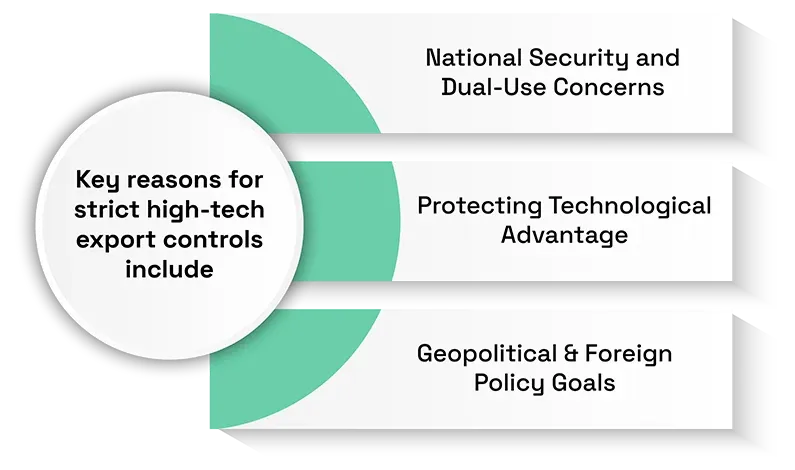
Key reasons for strict high-tech export controls include:
1. National Security and “Dual-Use” Concerns
Many advanced technologies are considered “dual-use,” meaning they have both civilian & military applications.
Military Application: Technologies like advanced semiconductors, AI chips, sensors, & encryption software can be used to enhance spying capabilities or surveillance technologies.
Preventing Proliferation: Governments restrict the transfer of materials, equipment, & knowledge that could help some countries develop Mass Destruction (WMD).
2. Protecting Technological Advantage
Stringent controls are used to secure competitors from obtaining cutting-edge technologies that were developed at great expense.
Limiting Competition: Restrictions are often aimed at preventing foreign entities from accessing advanced computing & robotics, thereby managing the technological superiority of the United States.
Geoeconomics: The U.S. Export Control Reform Act of 2018 specifically broadened its scope to include economic security as a component of national security.
3. Geopolitical & Foreign Policy Goals
Export controls are a diplomatic tool used to influence the actions of other nations.
Sanctions & Embargoes: Entities suspected of violating international norms or posing a fraud to security are added to lists like the Entity List, restricting their ability to need U.S. or allied technology.
Foreign Direct Product Rule: Controls are applied to foreign-produced items that are manufactured using U.S. software or technology, extending the reach of regulations to ensure compliance even outside of national borders.
4. Cybersecurity & Human Rights
The definition of “export” has grown beyond physical goods to include invisible technology transfer & electronic data.
Data Protection: Regulations prevent the transfer of sensitive data or software to jurisdictions where it could be misused.
Human Rights: The EU has proposed including “human security” in its dual-use regulations to secure the export of surveillance technology that could facilitate human rights violations.
Role of Incoterms & Trade Agreements
Incoterms are regulated, universally verified trade rules, created by the International Chamber of Commerce (ICC), that define the allocation of costs, risks, & responsibilities between customers & sellers. They ensure clarity, minimize issues, & align with trade agreements to continue global logistics.
Incoterms clearly define the roles & responsibilities of both the buyer & seller in international trade. They specify who is responsible for managing transport, insurance, & covering export or import licences. They also classify the correct point at which the risk of loss or damage shifts from the seller to the customer during transit. Incoterms verify who is responsible for customs clearance, added with the payment of duties & completion of formalities. By using standard terms like FOB, CIF, & DDP, they help minimize confusion & ensure smooth & transparent trade agreements.
Documentation for Global Regulations for Exporting High-Tech Goods:
Accurate documentation is needed for easy & compliant exports. A commercial invoice & packing list provide detailed information about the product, including accurate descriptions, quantities, & values. Verification details, like Export Control Classification Number (ECCN), help to verify whether a license is needed for exporting specific high-tech goods. A certificate of origin confirms where the product was manufactured, which can affect duties & trade benefits. An end-user certificate (EUC) ensures that the technology will not be diverted to restricted or restricted users. For some controlled items, an import or export license, such as SCOMET in India, is important. Transport documents like the air waybill or bill of lading act as contracts for shipment & are needed for moving goods across borders.
Conclusion
Exporting high-tech goods is no longer just a trade activity, it is a highly regulated process covered by security, technology, & global politics. With strict regulations on dual-use items, businesses must carefully follow global regulations, verification systems, & licensing requirements to avoid risks. Clear use of Incoterms helps define responsibilities & minimize confusion for customers, while proper documentation ensures correct & easy movement of goods across borders.
Did you know?
On 20 April 2026, the UK introduced the Sanctions (EU Exit) (Miscellaneous Amendments) Regulations 2026, introducing new end‑user licensing requirements across all 36 UK sanctions regimes. The Regulations come into force on 13 May 2026.
FAQ
What are export regulations?
Export Control Laws are a set of federal regulations that restrict the release of certain items, information, and software to foreign nationals in the United States and abroad.
What is a high technology export?
High-technology exports are products with high R&D intensity, such as in aerospace, computers, scientific instruments, and electrical machinery. Source. United Nations, Comtrade database through the WITS platform.
What are 5 trade restrictions?
A trade barrier refers to any regulation or policy that restricts or controls the flow of goods and services between countries, often with the intent of protecting domestic industries from foreign competition. These barriers can take various forms, including tariffs, subsidies, licenses, quotas, and embargoes
What are the 4 types of tariffs?
The four main types of tariffs are ad valorem, specific, compound, and tariff-rate quotas.
Who pays for tariffs?
Tariffs are generally paid by importers at the point where goods cross the border into the importing country.