Introduction
In the import-export business, documentation plays an important role in ensuring the smooth & legal movement of goods across borders. Among the most important documents are the Bill of Entry & the Shipping Bill, which are needed for customs clearance in both air & sea shipments. A Bill of Entry is used mainly when importing goods to declare goods & calculate duties, while a Shipping Bill is used during exports to get approval for transporting goods out of the country. These two main documents help customers & authorities verify shipments, ensure compliance with laws & regulations, & allow businesses to move cargo easily without any delays & fines.
What is a Bill of Entry?
A Bill of Entry is a legal document submitted by importers or customs agents to facilitate the customs clearance process for imported goods. This document is useful for ensuring that all applicable taxes & duties are paid & that the goods deal with the importing country’s regulations.
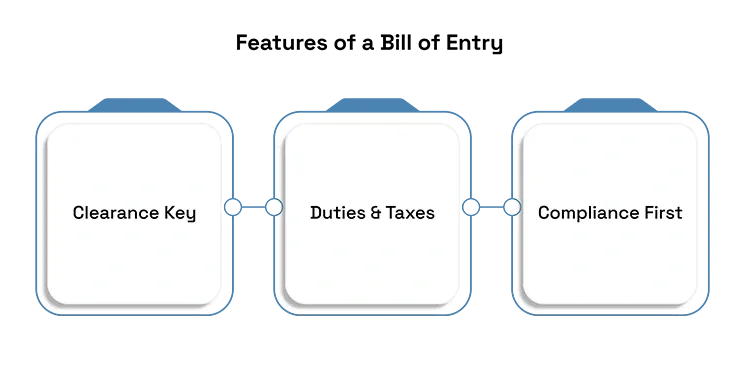
Features of a Bill of Entry
A Bill of Entry is a very important document used for customs clearance when goods arrive in the importing country. It ensures that the importer has followed all required regulations and paid the applicable duties & taxes. There are different types of Bill of Entry based on how the goods will be used. A Home Consumption Bill of Entry is used when goods are meant for immediate use within the country, while a Bond Clearance Bill of Entry is used when goods are stored in a bonded warehouse & cleared later after duty payment.
Advantages of a Bill of Entry
A Bill of Entry gives some important advantages in the import process. It ensures proper tax compliance by allowing importers to pay applicable duties such as GST, IGST, & customs duty for the clearance of goods. It also helps businesses claim Input Tax Credit (ITC) on the GST & IGST paid, which minimizes their whole tax burden. It supports smooth & faster customs clearance by ensuring that all required documents & payments are correctly submitted. Most importantly, it provides legal & regulatory assurance, confirming that the importer has followed all rules & needed for the importing country.
What is a shipping bill?
An exporter, while sending goods from one country to another, has to go through many formalities, including submitting many applications, acquiring licenses, paying duties, & so on. To acquire a clearance for export from Customs, an exporter will have to submit an application for a shipping bill. One cannot load the goods unless the exporter files the shipping bill. The export may be by air or vehicle.
How does the shipping bill process work?
A shipping bill can be made after the particular ship is granted entry outwards, which allows it to move out of the country. If the bill is submitted, it is physically verified, & the value of the goods designed for export is used by the customs authorities. The customs authorities verify these bills & copy them with ‘LET EXPORT ORDER’ & ‘LET SHIP ORDER.’
What exactly is included in the shipping bill?
A Shipping Bill includes such important details required for export clearance. It contains information about the exporter, including their GST number, & the customer in the destination country. It provides a correct description of the goods, along with the HS code, quantity, & product price. The document also refers to the commercial invoice & packing list linked to the shipment. It is added with the calculation of applicable customs duties & taxes, such as GST, based on the value of the goods. Details about the mode of transport, whether by sea, air, or road, are also mentioned, along with the terms of trade like FOB or CIF. The Shipping Bill further specifies the port of export & the destination port, along with container & shipping details such as container numbers, seals, & shipping lines. It may also include insurance information for the goods during transit, & details of any export incentives claimed by the exporter.

How does the shipping bill process work?
The shipping bill process works when an exporter prepares & submits the shipping bill to the customs department. The document was added with useful details about the goods, including descriptions, quantities, & values. Once the shipping bill is approved, the goods are allowed to be shipped from the port. The shipping bill is then used to facilitate the release of the shipment & to claim any export incentives. This process ensures that the export is compliant with Indian laws & that the goods are accurately recorded for both regulatory & financial purposes.
Key Differences Between Bill of Entry and Shipping Bill
| Basis | Bill of Entry (BoE) | Shipping Bill (SB) |
| Direction & Purpose | Used for imports (inward movement of goods) | Used for exports (outward movement of goods) |
| Filed By | Filed by importer or Custom House Agent (CHA) | Filed by exporter or Custom House Agent (CHA) |
| Financial & Compliance Role | Used for duty assessment, IGST payment, and claiming Input Tax Credit (ITC) | Acts as proof of export and helps claim duty drawback, export benefits, and GST refunds |
| Submission Timing | Filed within 30 days after arrival of goods | Submitted before the or aircraft departs |
Conclusion
The import-export process heavily depends on both the main document Bill of Entry & the Shipping Bill. Both are mainly useful documents that ensure the smooth, legal, & easy transportation of goods across the country. While the Bill of Entry mainly focuses on imports by managing duty payment, tax compliance, & customs clearance, the Shipping Bill plays an important role in exports by enabling approval, tracking shipments, & claiming export benefits. Together, these documents help businesses stay updated with regulations & laws, avoid delays, & maintain transparency with customers for trade operations.
Did you know?
India paid $85 billion in sea freight, of which some $75 billion was paid to foreign shipping companies, resulting in a huge outflow of foreign exchange.
FAQ
What is the difference between import-export documentation and an import export license?
The license (IEC) is your one-time registration to trade. Documentation refers to the specific paperwork needed for every single shipment.
Can I export without an IEC?
No, commercial exports require an IEC. Only government bodies or people sending personal goods are exempt.
What is the difference between a bill of entry and a shipping bill?
A bill of entry is used for importing goods into a country and details the goods that are entering the country, required for customs clearance. In contrast, a shipping bill is used for exporting goods out of a country and provides details about the goods being shipped.
Where can I get a bill of entry?
A bill of entry can be obtained and filed through the customs department at the point of entry such as airports, seaports, or land ports where the goods are imported.
Can errors in a Bill of Entry or Shipping Bill cause delays?
Yes, even small mistakes in a Bill of Entry or Shipping Bill—such as incorrect HS codes, wrong product details, or mismatched values can lead to customs delays, penalties, or additional inspections.