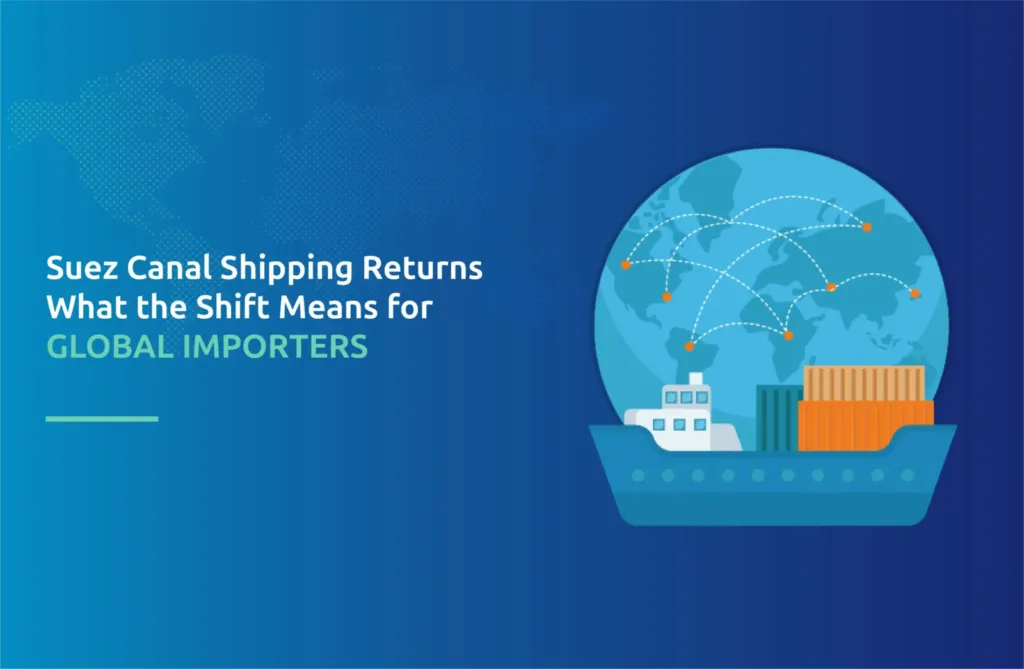
The Suez Canal is once again playing a significant role in some maritime lanes connecting Asia and Europe. Maersk & Hapag-Lloyd announced in September 2026 that more services will be returning to the Suez route rather than passing through the Cape of Good Hope. The action is a gradual return to the Suez corridor rather than a complete restoration of regular shipping patterns, & it comes after prior service disruptions in July and August.
This development may have an impact on delivery timetables, inventory levels, freight costs, transit planning, and the management of international shipments for importers. Businesses shouldn’t believe that every Asia-Europe service will instantly resume to its original route, though, as the situation is still dependent on security conditions in the Red Sea.
Why Are Shipping Lines Returning to the Suez Canal?
Safety concerns in the Red Sea caused major shipping lines to reroute cargo ships around the Cape of Good Hope. That alternative route adds significant distance compared with the Suez corridor.
In 2026, carriers began testing a gradual return. Maersk and Hapag-Lloyd first moved selected services back through the Suez Canal after assessing the regional security situation. In September, they announced that four additional Gemini services — AE5, AE11, AE12 and ME2 — would use the trans-Suez route. These services connect Asian ports with Northern Europe, the Mediterranean and the Middle East.
The change is being introduced service by service. Maersk has also stated that decisions remain dependent on conditions in the Red Sea and that services could be changed again if the security situation deteriorates.
What Does This Mean for Import Transit Times?
The most immediate effect for importers could be shorter ocean transit times on services that return to the Suez route.
Sailing through the Suez Canal avoids the additional distance associated with routing around southern Africa. Maersk previously reported that the return of its MECL service to the trans-Suez route could improve westbound transit times by an average of seven days and eastbound transit times by an average of 14 days.
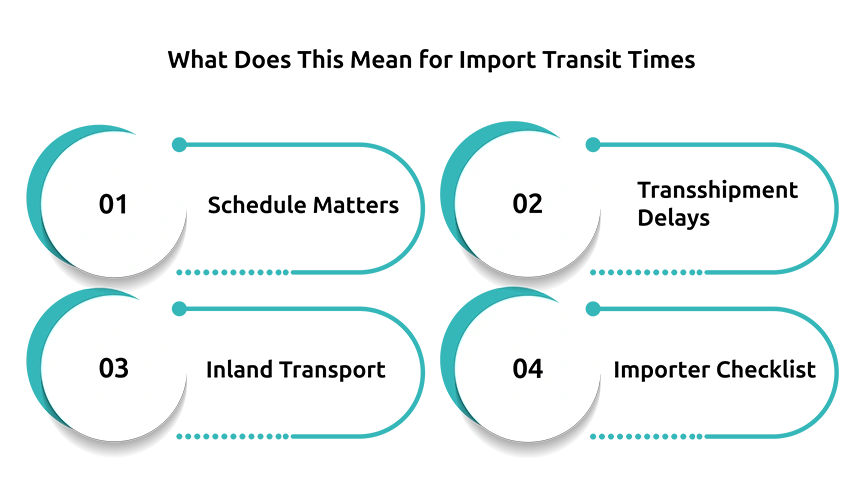
However, these figures should not be treated as a universal saving for every shipment. Transit time depends on the carrier, service, ports of loading and discharge, vessel schedule, transshipment arrangements and inland transportation.
Importers should therefore check the actual sailing schedule for each booking instead of automatically reducing their planned delivery window.
Could Freight Costs Change?
An ocean shipment’s overall economics may be impacted by a shorter shipping route, but a return to Suez does not guarantee that freight prices will drop right away.
Carriers still have to consider fuel consumption, vessel utilisation, insurance, security measures, port operations, equipment availability and network capacity. Some services may also continue to carry contingency or emergency-related charges.
For instance, Maersk noted that supply chains were still affected by the Red Sea and Gulf of Aden scenario when it announced in September that it was using an Emergency Plan Surcharge on some India-to-South Africa routes as operational conditions improved.
Importers should therefore compare the complete shipping cost rather than looking only at the base ocean freight rate.
Why Importers Should Review Their Existing Shipments
A change in routing can affect more than the ocean leg.
Companies with international shipments already in transit should review the latest carrier schedule, estimated arrival date and destination delivery plan. A vessel returning to the Suez route could arrive earlier than a shipment planned around the Cape of Good Hope.
That can affect warehouse bookings, trucking appointments, installation teams and inventory planning.
For high-value equipment such as servers, networking hardware, GPUs and other data-center equipment, timing can be particularly important. An earlier arrival may require the receiving location, customs team and delivery provider to be ready sooner.

What About Customs and Import Planning?
The requirement for correct import compliance is not eliminated by the route modification.
The accuracy of the commercial invoice, packing list, product description, HS classification, customs value, place of origin, and importer information must still be verified by importers.
Companies should also make sure that their customs and inland delivery plans are still suitable if a shipment is entering a nation through a different port or using a different transshipment arrangement.
For businesses using an Importer of Record (IOR) service, the IOR arrangement should be reviewed against the actual destination, product and customs entry. A change in the ocean route does not by itself change who is responsible for the import declaration, duties, taxes or regulatory requirements.
Should Businesses Immediately Change Their Shipping Strategy?
Not necessarily.
The current developments show a gradual return rather than a complete reopening of the Suez route for all services. Maersk and Hapag-Lloyd have specifically stated that further changes depend on continued stability in the Red Sea region.
For importers, the practical approach is to monitor each carrier service individually. Organization should avoid assuming that the latest Cape of Good Hope routing has long term changed simply because another service has returned to Suez.
This is especially important for time-sensitive cargo, high-value technology equipment and shipments tied to installation or project deadlines.
Conclusion
The return of selected container services to the Suez Canal is an important development for international logistics in 2026. It could shorten transit times on affected Asia-Europe & related services & change how importers plan inventory, warehousing & final delivery.
However, the return is still slow. Safety conditions in the Red Sea remain an important factor, & carriers continue to retain alternative plans.
For importers, the key is not simply choosing the shortest route. It is making sure freight, customs, IOR, inventory, and final delivery plans all remain connected when the route changes.
Did you know?
Shipping lines are gradually bringing selected services back through the Suez Canal after years of avoiding the Red Sea route. In September 2026, Maersk and Hapag-Lloyd announced that four additional services would return to the Suez route, potentially reducing transit times compared with routing around the Cape of Good Hope.
FAQ
Why are shipping lines returning to the Suez Canal?
Some shipping lines are returning selected services to the Suez Canal as security conditions in the Red Sea are assessed. The move is being introduced service by service rather than as a complete return across all shipping routes.
How can the Suez Canal affect import transit times?
Using the Suez Canal can reduce the distance compared with routing ships around the Cape of Good Hope. This may shorten transit times for some Asia-Europe services, although actual delivery times depend on the carrier, ports, schedules and inland transportation.
Will returning to the Suez Canal reduce shipping costs?
A shorter route may reduce some operating costs, but it does not automatically mean lower freight rates. Fuel prices, vessel capacity, insurance, security measures, port conditions and carrier surcharges can all affect the final shipping cost.
Does a change in shipping route affect customs clearance?
Changing the ocean route does not remove normal customs requirements. Importers still need accurate invoices, product descriptions, HS classifications, customs values, origin information and importer details. If the route changes the entry port or transshipment arrangement, the customs and delivery plan should also be reviewed.
Should importers change their shipping strategy because services are returning to Suez?
Importers should review each shipment individually rather than assuming that all services have permanently returned to the Suez Canal. Carrier schedules, security conditions, transit times, freight costs and destination requirements should be checked before changing an existing logistics plan.