
Introduction
The Red Sea shipping crisis has disturbed global logistics and rewritten the rules of international freight services almost overnight. Attacks on trading ships and the resulting rerouting around the Cape of Good Hope are causing shipping costs to surge by up to 600%. For companies that rely on smooth global trade, particularly those transporting machinery, aviation components, and urgent goods, the impact is significant. Longer transit times, rising import duties and tariffs, urgent changes in import/export documentation, and increased pressure on supply chain optimization are now the new reality. Businesses are required to use fast, not only to keep deliveries on schedule but also to explain the situation clearly to their European customers, who may suddenly face late arrivals and unwanted price increases.
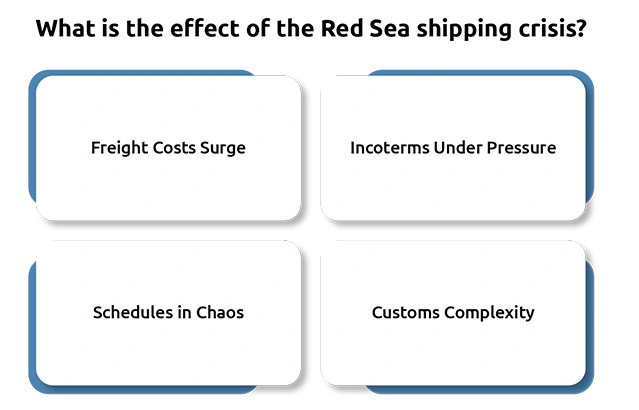
What is the effect of the Red Sea shipping crisis?
The most immediate impact has been growing freight charges, insurance, ship repositioning, and scheduling imbalances, and growing costs. Even logistics organizations using Delivered Duty Paid service (DDP), DAP, or other Incoterms now face greatly higher rates. The crisis has also created unpredictable delays, as carriers are required to reroute over 3,000 sea miles. These longer routes are disrupting Real-time shipment tracking updates and forcing carriers to recalculate their HTS Harmonized Tariff Schedule declarations and HS code filings as cargo changes through alternative customs gateways. Further challenges also include the legal and approval issues of changing ports of entry. Importer of Record responsibilities have become more difficult, with many shipments now requiring extra IOR services to stay compliant. In some cases, the Exporter of Record definition requirements also change when the goods are rerouted, placing further strain on work.

What is the impact on supply chains?
The crisis has set off a chain effect across global trade routes. Longer shipping times create higher container shortages, and that increases spot rate changes. As ships take longer to return to Asia, export congestion rises, delaying goods that are already late. Many companies that depend on JIT (Just-in-Time) manufacturing models now face inactive production lines and increased storage costs. The disruption is also affecting customs processing, where Import-export documentation now frequently requires changes mid-route, mainly when ports change at the last minute. Traditional supply chains give smooth customs clearance and predictable timelines are breaking down, and the pressure is forcing organizations to rethink how they use tools such as last-mile delivery services, warehouse buffering, and supply chain optimization strategies.
How to survive a 600% freight spike
Companies that want to withstand today’s shipping inflation must adapt aggressively. One tactic is rebalancing product distribution using multimodal logistics to change cargo volumes into air and rail corridors where possible. Some businesses are exploring Delivered at Place service, such as DAP or DAPs, for selected lanes to address growing responsibilities and reduce customs difficulties. Also, manufacturers importing into Europe are analyzing whether alternative tariff systems, such as the generalized system of preferences (GSP), can reduce total landed costs. This requires accurate HS code classification and accurate filing under the correct HTS Harmonized Tariff Schedule positions. Working with experienced logistics partners giving IOR services is becoming necessary, as they can handle Importer of Record responsibilities, stop non-agreement, and reduce time lost in customs. Organizations are also improving planning accuracy through live shipment tracking, which helps teams prepare customers for delays ahead of time rather than react after a shipment is already late.
What to tell your European clients
Transparency is your greatest strategic weapon right now. Clients in Europe required more than trust; they need visibility. Explain how the crisis is pushing major carriers to re-route ships and how this affects cost, system, delivery times, and customs gateways. Provide clear breakdowns of cost increases rather than uncertain “market adjustments.” Share how your freight partner is optimizing routes, using International freight services networks, and applying supply chain optimization to minimize the impact on shipping. If you are using DDP, clarify that the Delivered Duty Paid service now includes higher ocean shipping charges globally.
Conclusion
The Red Sea crisis will continue disrupting until stability returns to the region. The businesses that survive will be those that understand their end-to-end logistics, use quickly, and are transparent. With smarter planning, stronger documentation management, and proactive engagement with European clients, organizations can guide this uncertain period and grow stronger in the long-term trade in Europe.
DID YOU KNOW?
On January 25, spot rates from China to the US West Coast and East Coast saw significant increases of ~140% and ~120%, respectively, compared to November 2023.
FAQs:
Why has shipping become so expensive during the Red Sea crisis?
Due to ship attacks, carriers are rerouting thousands of extra miles around Africa. This increases fuel usage, transit time, insurance premiums, and ship repositioning costs, leading to freight increases of up to 600%.
How is the crisis impacting supply chains worldwide?
Longer travel routes create vessel delays, container shortages, customs reprocessing issues, inaccurate delivery estimates, and rising storage costs, especially for companies relying on just-in-time production.
What industries are affected the most?
Businesses shipping machinery, spare parts, aviation components, fast-moving retail goods, and critical inventory face the biggest challenges due to urgent delivery needs and dependency on stable global logistics.
How can companies reduce shipping costs during this disruption?
Some options include shifting partial volume to air or rail, using alternative tariff schemes like GSP, improving HS code accuracy, working with experienced Importer of Record (IOR) providers, and strengthening shipment planning.
What should companies communicate to European clients right now?
Be transparent about rerouting, cost increases, longer transit times, and customs delays. Provide clear status updates, realistic ETAs, and accurate cost breakdowns to maintain customer trust.