An important change is occurring in the international industrial landscape as Southeast Asia develops itself as a leading center for advanced manufacturing. This change is driven by a connection of a young population, strategic trade locations, & strong government support, according to a new report from Eurogroup Consulting. While long-standing industrial leaders like China, Japan, Germany, & the U.S. have everything it takes to grow at the cutting edge of updated manufacturing, Southeast Asia has developed as one of the fastest-developing regions.
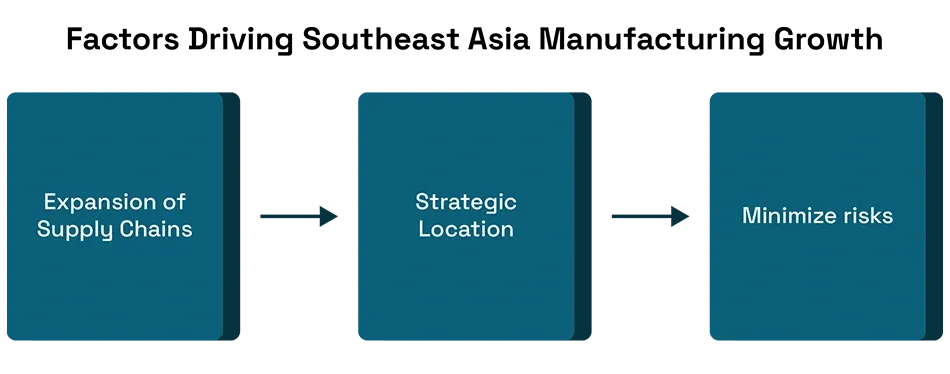
Factors Driving Southeast Asia Manufacturing Growth
Key factors are driving the growth of manufacturing in Southeast Asia:
Expansion of Supply Chains
The pandemic & the U.S.-China trade war showed the risk of global supply chains being mainly dependent on a single country or region. As a result, many companies are changing their production bases to minimize risks & improve stability.
Southeast Asia is an important location & offers changes in production capabilities, growing as an attractive alternative to China for production. Companies identify the benefits of a more provided supply chain & flexible supply chain management, & Southeast Asia is well-positioned to meet this demand.
Strategic Location
Southeast Asia’s important location at the confluence of major trade routes connecting Asia, Europe, & the Middle East makes it an ideal hub for global manufacturing. The region’s well-developed ports & logistics network enables easy transportation of goods to main markets in the whole world.
The growing customer market within Southeast Asia itself presents important opportunities for production. With a population of over 650 million & a mainly developing middle class, the region gives a main local market for manufactured goods. Manufacturers can increase Southeast Asia’s strategic location to easily serve regional & global markets.
Economic Development & Growth
Southeast Asia’s economic development through the Association of Southeast Asian Nations Economic Community has created a single market with a network GDP of over $3.6 trillion. The AEC facilitates the free flow of services, investment, & skilled labor within the region, opening up ASEAN supply chain opportunities & making it easier for manufacturers to operate across borders. This economic development has minimized trade issues, harmonized regulations, & created a more seamless business environment. Southeast Asia’s economies have mainly outperformed global growth rates, & this trend is expected to continue in the coming years. Production can tap into this growth potential by creating a regional presence.
Manufacturing Hubs Driving Southeast Asia’s Industrial Growth
In Southeast Asia, some countries are developing as main developing hubs due to their complete advantages & increasing industrial capacity. Vietnam has observed most growth in producing sectors such as electronics, Aviation, automobile, & medical equipment. This growth is driven by low labor costs, a strong staff, usable trade agreements, increasing foreign investment, & the country’s important location. Thailand has developed a strong production base, mainly in the automotive sector, where the main global automakers & suppliers operate increasingly. Managed by a skilled workforce, well-working supply chain networks, & usable government policies, Thailand has also developed into electronics manufacturing & research-driven industries.
Malaysia has become an important pillar in electronics & electrical manufacturing, mainly in semiconductor production & high-value components. The country’s developed network, strong property security, & skilled labor force have secured technology investments while also supporting growth in aerospace & medical device manufacturing. Indonesia, as Southeast Asia’s largest economy, benefits from a large domestic market & complete labor costs, making it attractive for automotive, high-tech industry, & industrial productive development aimed at increasing value-added production. The Philippines has established a strong presence in electronics manufacturing, mainly semiconductor assembly & testing, supported by a skilled English-speaking workforce & cost competitiveness, while also developing automotive component production. Singapore, although smaller in manufacturing major compared to its regional counterparts, has positioned itself as a leader in high-value manufacturing sectors such as aerospace & precision engineering, supported by updated infrastructure, strong creative property protections, & a highly skilled workforce focused on development-driven producing.

Conclusion
Southeast Asia is being one of the world’s developing production regions as companies look for more updated supply chains, lower costs, & new growth opportunities. With increasing network, supportive government laws, & increasing industrial capacity, countries across the region continue to attract global manufacturers. Although challenges such as network issues, workforce development, & geopolitical risks still exist, the region offers strong long-term growth potential. As businesses continue to change production operations, Southeast Asia is expected to play an mainly important role in the future of global production.
Did you know?
Malaysia is focusing on high-tech exports, such as semiconductors, with a goal to capture 6% of the global market share by 2030.
FAQ
1. Why is Southeast Asia becoming a major manufacturing hub?
Southeast Asia is attracting manufacturers due to lower labor costs, strategic geographic location, growing infrastructure, government support, and efforts to diversify global supply chains.
2. Which countries are leading manufacturing growth in Southeast Asia?
Countries such as Vietnam, Thailand, Malaysia, Indonesia, the Philippines, and Singapore are emerging as major manufacturing centers across industries including electronics, automotive, semiconductors, and industrial production.
3. How did supply chain disruptions accelerate manufacturing growth in Southeast Asia?
Global disruptions, including the pandemic and trade tensions, exposed the risks of concentrated supply chains, encouraging companies to diversify production and establish operations across Southeast Asia.
4. Which industries benefit the most from Southeast Asia’s manufacturing expansion?
Industries such as electronics, semiconductors, automotive, aerospace, & medical devices are experiencing significant growth in the region.
5. What advantages does Southeast Asia offer manufacturers?
The region provides competitive labor costs, access to major trade routes, expanding consumer markets, supportive government policies, and improving logistics infrastructure.